Home
Class 12
PHYSICS
A microscope has objective of aperture 8...

A microscope has objective of aperture 8mm and focal length `2.5 cm`. Estimate its resolving power. Given `lambda= 5500 dotA`.

Text Solution

Verified by Experts
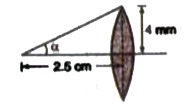
We assume that the object is placed a little beyond its focal distance, say 2.5 cm.

`tan alpha = (4mm)/(2.5cm) = (0.4)/(2.5) = 0.16`
Since `sin alpha` small , `sin alpha ~~ tan alpha = 0.16`
Thus ,` Delta x = (1.22 lamda)/(2mu sin alpha) = (1.22 (5500 xx 10^(-10) m))/(2 xx 1 xx 0.16) = 2 xx 10^(-6) cm`
Promotional Banner

Topper's Solved these Questions

  • WAVE OPTICS

    AAKASH SERIES|Exercise EXERCISE (LONG ANSWER QUESTIONS (INTERFERENCE))|4 Videos
  • WAVE OPTICS

    AAKASH SERIES|Exercise EXERCISE (LONG ANSWER QUESTIONS (DIFFRACTION))|1 Videos
  • WAVE OPTICS

    AAKASH SERIES|Exercise ADDITIONAL PRACTICE PRACTICE SHEET (ADVANCED ) Straight Objective Type Questions)|12 Videos
  • WAVE MOTION AND SOUND

    AAKASH SERIES|Exercise PROBLEMS (LEVEL - II)|97 Videos
  • WAVES

    AAKASH SERIES|Exercise EXERCISE-III (Doppler effect :)|15 Videos

Similar Questions

Explore conceptually related problems

A compound microscope has an objective of focal length 1 cm and an eyepiece of focal length 2.5 cm. An object has to be placed at a distance of 1.2 cm away from the objective for normal adjustment. a.Find the angular magnification. b.Find the length of the microscope tube.

A person with a normal near point (25 cm) using a compound microscope with an objective of focal length 8.0 mm and eye piece of focal length 2.5 cm can bring an object placed 9.0 cm from the objective in sharp focus. What is the separation between the two lenses ? Calculate the magnifying power of the microscope ?

A person with a normal near point (25 cm) using a compound microscope with an objective of focal length 8.0 mm and eye piece of focal length 2.5 cm can bring an object placed 9.0 cm from the objective in sharp focus. What is the separation between the two lenses ? Calculate the magnifying power of the microscope ?

A telescope has an objective of focal length 100 cm and an eye-piece of focal length 5 cm. What is the magnifying power of the telescope when it is in normal adjustment?

A compound microscope has objective of focal length 3.2 mm and eyepiece of 12 mm focal length. If the objective forms image of the object 16 cm beyond its pole, then total magnification achieved is

A compound microscope consists of an objective of focal length 1 cm and an eyepiece of focal length 5 cm. An object is placed at a distance of 0.5 cm from the objective. What should be the separation between the lenses so that the microscope projects an inverted real image of the object on a screen 30 cm behind the eyepiece?

A compound microscope has an objective of focal length 2.0 cm and an eye-piece of focal length 6.25cm and distance between the objective and eye-piece is 15cm . If the final image is formed at the least distance vision (25 cm) , the distance of the object form the objective is

A small telescope has an objective lens of focal length 144 cm and an eye-piece of focal length 6.0 cm . What is the magnifying power of the telescope ? What is the separation between the objective and the eye-piece ?

A small telescope has an objective lens of focal length 144 cm and an eye-piece of focal length 6.0 cm . What is the magnifying power of the telescope ? What is the separation between the objective and the eye-piece ?

A compound microscope uses an objective lens of focal length 4 cm and eye lens of focal length 10 cm . An object is placed at 6 cm from the objective lens. Calculate magnifying power of compound microscope if final image is formed at the near point. Also, calculate length of the tube of compound microscope.

AAKASH SERIES-WAVE OPTICS-EXAMPLE
  1. Bichromatic light is used in YDSE having wavelengths lambda(1)=400nm a...

    Text Solution

    |

  2. Young's double slit experiment is carried out using microwaves of wa...

    Text Solution

    |

  3. In YDSE, the two slits are separated by 0.1 mm and they are 0.5 m fr...

    Text Solution

    |

  4. An interference is observed due to two coherent sources S1 placed at o...

    Text Solution

    |

  5. Two coherent fight sources A and B with separation 2lambda are placed ...

    Text Solution

    |

  6. A thin sheet of glass (mu=1.520) is introduced normally in the path of...

    Text Solution

    |

  7. A double - slit apparatus is immersed in a liquid of refractive index ...

    Text Solution

    |

  8. Light of wavelengthlambda = 500 nm falls on two narrow slits placed a ...

    Text Solution

    |

  9. A thin film is illuminated by wavelength 600 nm in free space at nearl...

    Text Solution

    |

  10. A screen is placed 50 cm from a single slit which is illuminated with ...

    Text Solution

    |

  11. In a single slit diffraction experiment first minima for lambda1 = 660...

    Text Solution

    |

  12. For what distance is ray optics a good approximation when the aperture...

    Text Solution

    |

  13. Assume that light of wavelength 6000Å is coming from a star. What is t...

    Text Solution

    |

  14. A microscope has objective of aperture 8mm and focal length 2.5 cm. Es...

    Text Solution

    |

  15. Light of wavelength 589 nm is used to view an object under a microscop...

    Text Solution

    |

  16. The objective of a microscope has a focal length of 1 cm and diameter ...

    Text Solution

    |

  17. When light of a certain wavelength is incident on a plane surface of a...

    Text Solution

    |

  18. Unpolarized light falls on two polarizing sheets placed one on top of ...

    Text Solution

    |

  19. A circular beam of light of diameter (width) falls on a plane surface ...

    Text Solution

    |

  20. Two polaroid's are oriented with their planes perpendicular to inciden...

    Text Solution

    |

