Home
Class 12
PHYSICS
An air bubble is trapped inside a glass ...

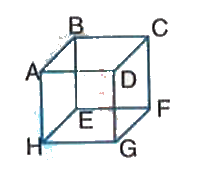
An air bubble is trapped inside a glass cube of edge 30 cm. Looking through the face ABEH, the bubble appears to be at normal distance 12 cm from this face and when seen from the opposite face CDGF, it appears to be at normal distance 8 cm from CDGF. Find refractive index of glass and also the actual position of the bubble.

Text Solution

Verified by Experts

Let the actual distance of the bubble from the face ABEH is then its actual distance from the face CDGF is 30 - x
But `mu=("Actual distance of bubble from refracting surface ")/("Apparent distance of bubble from refracting surface")`
The apparent distance of bubble from refracting surface ABEH `=(x)/(mu) , 12 = (x)/(mu ` ..... (1)
The apparent distance of bubble from refracting - surface CDGF`=(30-x )/( mu ) , 8 = (30 -x)/(mu ) `
Adding Eqs (1) and (2) ` (x)/(mu ) +(30-x)/(mu )=20`
We get `mu =1.5 `
From Eq। (1) `(x)/(mu ) =12 (or) (x)/(1.5 ) = 12 `
so `x=18 cm `
This actual position of bubble is at normal distance 18 cm from face ABEH or at a distance 12 cm from face CDGF.
Promotional Banner

Topper's Solved these Questions

  • RAY OPTICS

    AAKASH SERIES|Exercise EXERCISE (LONG ANSWER QUESTIONS )|9 Videos
  • RAY OPTICS

    AAKASH SERIES|Exercise EXERCISE (SHORT ANSWER QUESTIONS )|24 Videos
  • PRACTICAL PHYSICS

    AAKASH SERIES|Exercise LECTURE SHEET LEVEL-II (ADVANCED) Linked Comprehension Type Questions|4 Videos
  • SEMICONDUCTOR DEVICES

    AAKASH SERIES|Exercise EXERCISE - III|3 Videos

Similar Questions

Explore conceptually related problems

A small air bubble is trapped inside a transparent cube of size 12 cm . When viewed from one of the vertical faces, the bubble apears to be at 5 cm . From it. When viewed from opposite face, it appears at 3 cm from it.

A mark placed on the surface of a sphere is viewed through glass from a position directly opposite. If the diameter of the sphere is 10 cm and refractive index of glass is 1.5 , find the position of the image.

A small air bubble is situated at a distance of 3 cm from the center of a glass sphere of radius 9 cm. When viewed from the nearest side, the bubble appears to be at a distance of 5 cm from the surface. Its apparent distance when viewed from the farthest side is nxx5 cm where n is?

A mark on the surface of a glass spehre (mu=1.5) is viewed from a diametrically opposite position. It appears to be at a distance 10 cm from its actual position. The radius of the sphere is

An object is placed at a distance of 12 cm from a convex lens of focal length 8 cm. Find : the position of the image

A transparent cube of side 210 mm contains a small air bubble. Its apparent distance, when viewed from one face of the cube is 100 mm , and when viewed through opposite face is 40 mm . What is the actual distance of the bubble from the second face and what is the refractive index of the material of the cube ?

A printed page is kept pressed by a glass cube (µ=1.5) of edge 9.0 cm. By what amount will the printed letters appear to be shifted when viewed from the top?

A glass sphere of diameter 50 cm and mu=1.5 has a small air bubble. Looking from outside the diameter, the bubble appears to be at a distance 10 cm the surface. Find the apparent position of the bubble when it is viewed from the diametrically opposite position.

An air bubble in a glass slab with refractive index 1.5 (near normal incidence) is 5 cm deep when viewed from one surface and 3cm deep when viewed from the opposite face. The thickness (in cm) of the slab is

Refractive index of the glass slab is 1.5. There is a point object O inside the slab as shown. To eye E_1 object appears at a distance of 6cm (From the top surface) and to eye E_2 it appears at a distance of 8cm (from the bottom surface). Find thickness of the glass slab.

AAKASH SERIES-RAY OPTICS-PROBLEMS ( LEVEL-II)
  1. An air bubble is trapped inside a glass cube of edge 30 cm. Looking th...

    Text Solution

    |

  2. What are the co-ordinates of the imasge of S formed by a plane mirror ...

    Text Solution

    |

  3. A ray of light in incident along a vector hati + hatj - hatk on a plan...

    Text Solution

    |

  4. Write a relationship between angle of incidence and angle of refractio...

    Text Solution

    |

  5. A bird looking down vertically into a pond from 12cm above the surface...

    Text Solution

    |

  6. There is a dust particle in a glass slab of thickness t and refractive...

    Text Solution

    |

  7. A parallel beam of light is incident on a rectangle transparent plate ...

    Text Solution

    |

  8. A pile 4m high driven into the bottom of a lake is 1m above the wat...

    Text Solution

    |

  9. A point object is placed at a distance of 20 cm from a glass slab, H=1...

    Text Solution

    |

  10. A ray of light travelling in a rarer medium strikes a plane boundary b...

    Text Solution

    |

  11. A small object of height 0.5 cm is placed in front of a convex surface...

    Text Solution

    |

  12. A paperweight in the form of a hemisphere of radius 3.0 cm is used to ...

    Text Solution

    |

  13. A convex glass lens ( mu = 1.5 ) produces a real image of an object. ...

    Text Solution

    |

  14. Two plano-convex lens of glass of refractive index 1.5 have radii of c...

    Text Solution

    |

  15. A rectangulat block of refractive index mu is placed on a printed page...

    Text Solution

    |

  16. A ray is incident on prism at an angle i with normal. When it comes ou...

    Text Solution

    |

  17. The dispersive power of crown and flint glasses are 0.02 and 0.04 resp...

    Text Solution

    |

  18. Two prisms of identical geometrical shape are combined with their refr...

    Text Solution

    |

  19. A thin prism of crown glass (mur=1.515, muv=1.525) and a thin prism o...

    Text Solution

    |

  20. Two small angled prisms A and B deviate the blue rays by 7^@ and 9^@ a...

    Text Solution

    |

  21. A beam of light converges towards a point O, behind a convex mirror of...

    Text Solution

    |
