Home
Class 12
PHYSICS
Due to a vertical temperature gradient i...

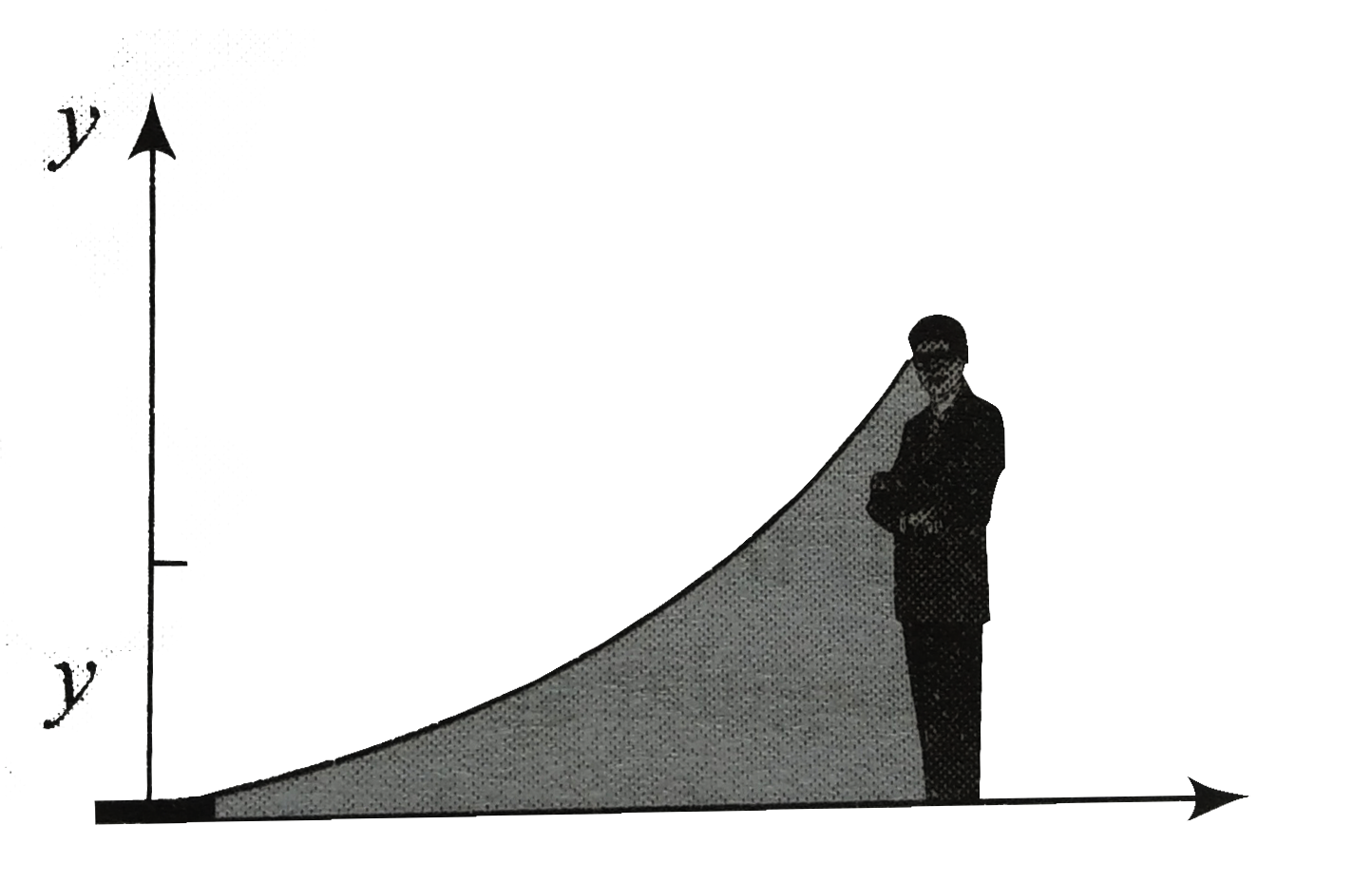
Due to a vertical temperature gradient in the atmosphere, the index of refraction varies. Suppose index of refraction varies as `n=n_(0)``sqrt(1+ay)`, where `n_(0)` is the index of refraction at the surface and `a=2.0xx10^(-6)m^(-1)` . A person of height `h=2.0 m` stands on a level surface. Beyond what distance will he not see the runway?

Text Solution

Verified by Experts
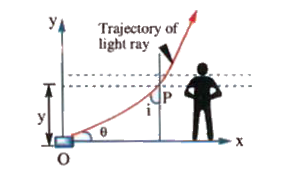
As refractive index is changing along y - direction, we can assume a number of thin layers of air placed parallel to x - axis. Let O be the distant object just visible to the man. Consider a layer of air at a distance y from the ground. Let P be a point on the trajectory of the ray. From figure, `theta = 90-i`.
The slope of tangent at point P is
`theta = dy//dx = coti`,
From Snell.s law, n sin i = constant
At the surface, `n = n_0 and i = 90^@ .`

`n_0 sin 90^@ =n sin i= (n_0sqrt(1+ ay))sin i`
`sin i = (1)/( sqrt(1+ay))implies cot i = (dy)/(dx) = sqrt(ay)`
`int_(0)^(y) (dy)/(sqrt((ay)) = int_(0)^(x) dx implies x=2 sqrt((y)/(a))`
On substituting `y=2.0 m and a=2 xx 10^(-6) m^(-1)`
we have `x_("max") = 2 sqrt((2)/(2 xx 10^(-6)) =2000 m`
Promotional Banner

Topper's Solved these Questions

  • RAY OPTICS

    AAKASH SERIES|Exercise EXERCISE (LONG ANSWER QUESTIONS )|9 Videos
  • RAY OPTICS

    AAKASH SERIES|Exercise EXERCISE (SHORT ANSWER QUESTIONS )|24 Videos
  • PRACTICAL PHYSICS

    AAKASH SERIES|Exercise LECTURE SHEET LEVEL-II (ADVANCED) Linked Comprehension Type Questions|4 Videos
  • SEMICONDUCTOR DEVICES

    AAKASH SERIES|Exercise EXERCISE - III|3 Videos

Similar Questions

Explore conceptually related problems

A man of height 2 m stands on a straight road on a hot day. The vertical temperature in the air results in a variation of refractive index with height y as mu =mu_(0)sqrt((1+ay)) where mu_(0) is the refractive index of air near the road and a= 2 xx 10^(-6)//m . What is the actual length of the road, man is able to see

A man of height 1.47 m stands on a straight road on a hot day. The vertical temperature in the air results in a variation of refractive index with height y as mu=mu_(0)sqrt((1+ay)) where mu_(0) is the refractive index of air near the road a =1.5 xx 10^(-6) /m. What is the apparent length of the road man is able to sec?

A man of height 2.0 m is standing on a level road because of temprature variation the refractive index of air is varying as mu=sqrt(1+ay), where y is height from road. If a=2.0xx10^-6 m^-1. Then, find distant point that he can see on the road.

The optical fibres have in an inner core of refractive index n1 and a cladding of refractive index n2 such that

A light ray enters into a medium whose refractive index varies along the x-axis as n(x) = n_(0) sqrt(1+(x)/(4)) where n_(0)=1 . The medium is bounded by the plates x =0,x =1 & y =0 . It the ray enters at the origin at an angle 30^(@) with x-axis

Define refractive index of a tranparent medium . The speed of light in a medium of absolute refractive index 1.5 " is " 2xx10^(8)ms^(-1) . What is the speed of light in vacuum ?

A point source of light is placed at a distance h below the surface of a large deep lake. (a) Show that the fraction f of the light energy that escapes directly from the water surface is independent of h and is given by f=(1)/(2)-(1)/(2n)sqrt(n^(2)-1) where n is the index of refraction of water. (Note: Absorption within the water and reflection at the surface, except where it is total, have been neglected) (b) Evaluate this ratio for n=4//3 .

The refractive index of an anisotropic medium varies as mu=mu_(0)sqrt((x+1)) , where 0lexlea . A ray of light is incident at the origin just along y-axis (shown in figure). Find the equation of ray in the medium .

The figure shows a transparent slab of length m placed in air whose refractive index in x direction varies as mu = 1 + x^(2)(0 lt x lt 1) . The optical path length of ray R will be

The focal length of a biconvex lens of refractive index 1.5 is 0.06m. Radii of curvature are in the ratio 1:2. Then radii of curvature of two lens surfaces are

AAKASH SERIES-RAY OPTICS-PROBLEMS ( LEVEL-II)
  1. Due to a vertical temperature gradient in the atmosphere, the index of...

    Text Solution

    |

  2. What are the co-ordinates of the imasge of S formed by a plane mirror ...

    Text Solution

    |

  3. A ray of light in incident along a vector hati + hatj - hatk on a plan...

    Text Solution

    |

  4. Write a relationship between angle of incidence and angle of refractio...

    Text Solution

    |

  5. A bird looking down vertically into a pond from 12cm above the surface...

    Text Solution

    |

  6. There is a dust particle in a glass slab of thickness t and refractive...

    Text Solution

    |

  7. A parallel beam of light is incident on a rectangle transparent plate ...

    Text Solution

    |

  8. A pile 4m high driven into the bottom of a lake is 1m above the wat...

    Text Solution

    |

  9. A point object is placed at a distance of 20 cm from a glass slab, H=1...

    Text Solution

    |

  10. A ray of light travelling in a rarer medium strikes a plane boundary b...

    Text Solution

    |

  11. A small object of height 0.5 cm is placed in front of a convex surface...

    Text Solution

    |

  12. A paperweight in the form of a hemisphere of radius 3.0 cm is used to ...

    Text Solution

    |

  13. A convex glass lens ( mu = 1.5 ) produces a real image of an object. ...

    Text Solution

    |

  14. Two plano-convex lens of glass of refractive index 1.5 have radii of c...

    Text Solution

    |

  15. A rectangulat block of refractive index mu is placed on a printed page...

    Text Solution

    |

  16. A ray is incident on prism at an angle i with normal. When it comes ou...

    Text Solution

    |

  17. The dispersive power of crown and flint glasses are 0.02 and 0.04 resp...

    Text Solution

    |

  18. Two prisms of identical geometrical shape are combined with their refr...

    Text Solution

    |

  19. A thin prism of crown glass (mur=1.515, muv=1.525) and a thin prism o...

    Text Solution

    |

  20. Two small angled prisms A and B deviate the blue rays by 7^@ and 9^@ a...

    Text Solution

    |

  21. A beam of light converges towards a point O, behind a convex mirror of...

    Text Solution

    |

