Home
Class 12
PHYSICS
A converging beam of light forms a sharp...

A converging beam of light forms a sharp image on a screen. A lens is placed in the path of the beam, at 10cm from the screen. It is found that the screen has to be moved 8 cm further away from the lens to obtain a sharp image. Find the focal length and nature of lens.

Text Solution

Verified by Experts
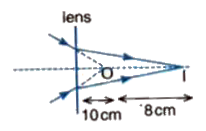

As shown in figure, in this problem, object Ois virtual while image I real,
so that u = 10 cm and v=(10+8)= 18 cm and hence from lens formula, `(1)/(v) -(1)/(u ) =(1)/(f) `
we have `(1)/(18) -(1)/(10) =(1)/(f)`
which on simplification gives `f= -(90)/(4) 22.5cm `
i.e., the lens is diverging (concave) of focal length 22.5 cm
Promotional Banner

Topper's Solved these Questions

  • RAY OPTICS

    AAKASH SERIES|Exercise EXERCISE (LONG ANSWER QUESTIONS )|9 Videos
  • RAY OPTICS

    AAKASH SERIES|Exercise EXERCISE (SHORT ANSWER QUESTIONS )|24 Videos
  • PRACTICAL PHYSICS

    AAKASH SERIES|Exercise LECTURE SHEET LEVEL-II (ADVANCED) Linked Comprehension Type Questions|4 Videos
  • SEMICONDUCTOR DEVICES

    AAKASH SERIES|Exercise EXERCISE - III|3 Videos

Similar Questions

Explore conceptually related problems

A beam of light converges to a point on a screen S. A mirror is placed in front of the screen at a distance of 10cm form the screen. It is found that the beam now converges at a point 20cm in front of the mirror. Find the focal length of the mirror.

When an object is placed at the proper distance ot the left of a converging lens, the image is focused in a screen 30 cm to the right of lens. A dieverging lens is now placed 15 cm to the right of the converging lens and it is found that the screen must be moved 19.2cm farther to the right to obtain a sharp image. Find the focal length of the diverging lens.

A beam of light converges to a point P . A lens is placed in the path of the covergent beam 12 cm from P . At what point does the beam converge if the lens is (a) a convex lens of focal length 20 cm (b) a concave lens of focal length 16 cm ?

A beam of light converges at a point P. Now a convex lens is placed in the part of the converngent beam at 15 cm from P. At what point does a beam converge if the convex lens has a focad length 10 cm ?

An object is placed 30cm away from a convex lens of focal length 10cm and a sharp image is formed on a screen. Now, a convex lens is placed In contact with the convex lens. The screen now has to be moved by 45cm to get a sharp image again. The magnitude of focal length of the convex lends in (in cm)

A beam of light converges to a point P.A lens is placed in the path of the convergent beam 12 cm from P . At what point does the beam converge if the lens is (a) a convex lens of focal length 20 cm . (b) a concave lens of focal length 16 cm ?

A concave lens is placed in the path of a uniform parallel of beam of light falling on a screen as shown . Then

A converging lens is used to form an image on a screen. When the upper half of the lens is covered by an opaque screen

A converging lens is used to form an image on a screen. When the upper half of the lens is covered by an opaque screen

A converging lens is used to form an image on a screen. When the upper half of the lens is covered by an opaque screen

AAKASH SERIES-RAY OPTICS-PROBLEMS ( LEVEL-II)
  1. A converging beam of light forms a sharp image on a screen. A lens is ...

    Text Solution

    |

  2. What are the co-ordinates of the imasge of S formed by a plane mirror ...

    Text Solution

    |

  3. A ray of light in incident along a vector hati + hatj - hatk on a plan...

    Text Solution

    |

  4. Write a relationship between angle of incidence and angle of refractio...

    Text Solution

    |

  5. A bird looking down vertically into a pond from 12cm above the surface...

    Text Solution

    |

  6. There is a dust particle in a glass slab of thickness t and refractive...

    Text Solution

    |

  7. A parallel beam of light is incident on a rectangle transparent plate ...

    Text Solution

    |

  8. A pile 4m high driven into the bottom of a lake is 1m above the wat...

    Text Solution

    |

  9. A point object is placed at a distance of 20 cm from a glass slab, H=1...

    Text Solution

    |

  10. A ray of light travelling in a rarer medium strikes a plane boundary b...

    Text Solution

    |

  11. A small object of height 0.5 cm is placed in front of a convex surface...

    Text Solution

    |

  12. A paperweight in the form of a hemisphere of radius 3.0 cm is used to ...

    Text Solution

    |

  13. A convex glass lens ( mu = 1.5 ) produces a real image of an object. ...

    Text Solution

    |

  14. Two plano-convex lens of glass of refractive index 1.5 have radii of c...

    Text Solution

    |

  15. A rectangulat block of refractive index mu is placed on a printed page...

    Text Solution

    |

  16. A ray is incident on prism at an angle i with normal. When it comes ou...

    Text Solution

    |

  17. The dispersive power of crown and flint glasses are 0.02 and 0.04 resp...

    Text Solution

    |

  18. Two prisms of identical geometrical shape are combined with their refr...

    Text Solution

    |

  19. A thin prism of crown glass (mur=1.515, muv=1.525) and a thin prism o...

    Text Solution

    |

  20. Two small angled prisms A and B deviate the blue rays by 7^@ and 9^@ a...

    Text Solution

    |

  21. A beam of light converges towards a point O, behind a convex mirror of...

    Text Solution

    |

