Home
Class 12
PHYSICS
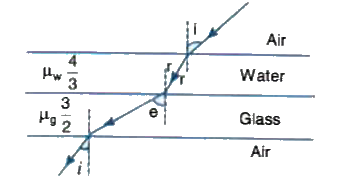
In the arrangement shown in the figure a...

In the arrangement shown in the figure a light ray is incident at an angle of `37^@` on the layer of water. Find the angle of emergence (e) through the layer of glass.

Text Solution

Verified by Experts

`e= sin^(-1) ( 0.4)`
Promotional Banner

Topper's Solved these Questions

  • RAY OPTICS

    AAKASH SERIES|Exercise PROBLEMS ( LEVEL-II)|60 Videos
  • RAY OPTICS

    AAKASH SERIES|Exercise EXERCISE (VERY SHORT ANSWER QUESTIONS )|53 Videos
  • PRACTICAL PHYSICS

    AAKASH SERIES|Exercise LECTURE SHEET LEVEL-II (ADVANCED) Linked Comprehension Type Questions|4 Videos
  • SEMICONDUCTOR DEVICES

    AAKASH SERIES|Exercise EXERCISE - III|3 Videos

Similar Questions

Explore conceptually related problems

In the figure given the angle between incident ray and the reflected ray is 70^@ Find the angle of incidence.

The angle of a prism is 60^(@) When light is incident at an angle of 60^(@) on the prism, the angle of emerge is 40^(@) . The angle of incidence i for which the light ray will deviate the least is such that

One side of a glass slab is silvered as shown in the figure. A ray of light is incident on the other side at angle of incidence 45^@. Refractive index of glass is given as sqrt2 . The deflection suffered by the ray when it comes out of the slab is

A mirror is inclined at an angle of theta with the horizontal. If a ray light is incident at an angle theta as shown , then the angle made by reflected ray with the horizontal is

A ray of light-is incident on glass at the polarising angle ip. Find the angle between the reflected and refracted rays.

Two plane mirrors are arranged at right angles to each other as shown in figure.A ray of light is incident on the horizontal mirror at an angle theta . For what value of theta the ray emerges parallel to the incoming ray after reflection from the vertical mirror ?

A ray of light incident at an angle of incidence i_(1) passes through an equilateral glass prism such that the refracted ray inside the prism is parallel to its base and emerges at an angle of emergence i_(2) . (i) How is the angle of emergence 'i_(1)' related to the angle of incidence 'i_(1)' ? (Ii) What can you say about the angle of deviation in such a situation ?

A ray of light incident at an angle of incidence 'I' passes through an equilateral glass prism such that the refracted ray inside the prism is parallel to its base and emerges from the prism at an angle of emergence 'e'. How is the angle of emergence 'e' related to the angle of incidence 'i' ?

A light ray is incident on a glass sphere at an angle of incidence 60^(@) as shown. Find the angles r, r^(1) , e and the total deviation after two refractions.

In the figure given the angle between incident ray and the reflected ray is 70^@ Find the angle between the mirror and the incident ray.

AAKASH SERIES-RAY OPTICS-PROBLEMS ( LEVEL-I)
  1. The refractive index of denser medium with respect to rarer medium is ...

    Text Solution

    |

  2. A source of yellow light placed in air is observed by a person swimmin...

    Text Solution

    |

  3. In the arrangement shown in the figure a light ray is incident at an a...

    Text Solution

    |

  4. One side of a glass slab is silvered as shown in the figure. A ray of ...

    Text Solution

    |

  5. Calculate the refractive index of material with respect to air if its ...

    Text Solution

    |

  6. The velocities of light in two different media are 2*10^8m/s and 2.5 *...

    Text Solution

    |

  7. An optical fibre (RI = 1.72) is surrounded by a glass coating (RI= 1.5...

    Text Solution

    |

  8. A ray of light travelling in glass (mug=3//2) is incident on a horizon...

    Text Solution

    |

  9. A liquid of refractive index 1.5 is poured into a cyclindrical jar of ...

    Text Solution

    |

  10. The radii of curvature of a lens are + 20 cm and + 30 cm. The material...

    Text Solution

    |

  11. The radii of curvature of a lens are + 20 cm and + 30 cm. The material...

    Text Solution

    |

  12. An object of size 3.0 cm is placed 14 cm in front of a concave lens of...

    Text Solution

    |

  13. A concave - convex lens has faces of radii 4 cm and 3 cm respectively ...

    Text Solution

    |

  14. A concave - convex lens has faces of radii 4 cm and 3 cm respectively ...

    Text Solution

    |

  15. A concave - convex lens has faces of radii 4 cm and 3 cm respectively ...

    Text Solution

    |

  16. If the angle of prism is 60^@ and the angle of minimum deviation is al...

    Text Solution

    |

  17. A ray of light passing through a prism having refractive index sqrt2 s...

    Text Solution

    |

  18. A ray of light passes through an equilateral glass prism, such that th...

    Text Solution

    |

  19. A ray of light is incident at an angle of 60^(@) on the face of a pris...

    Text Solution

    |

  20. A ray of light is incident normally on one of the refracting surfaces ...

    Text Solution

    |
