Home
Class 11
PHYSICS
A stone is projected from the ground in ...

A stone is projected from the ground in such a direction so as to hit a bird on the top of a telegraph post of height h and attains the maximum height of 2h above the ground. If at the insatant of projection, the bird were to fly away horizontally with a uniform speed, find the ratio between the horizontal velocity of bird and the horizontal component of velocity of stone, if the stone hits the bird while descending.

Text Solution

Verified by Experts
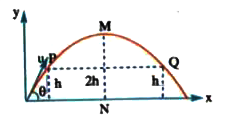
Let the stone is projected with a velocity u at an angle `theta` with the horizontal, we have
`(2h)=((usin theta)^(2))/(2g)` or `u sin theta=2sqrt(gh)`
Suppose t is the time taken by the stone to reach the height h above the ground. Then
`h=u sin theta t-1/2"gt"^(2)` (or) `("gt"^(2))/2- u sin theta+h=0`
As we have `u sin theta =2sqrt(gh)" " :.("gt"^(2))/2-2sqrt(gh)t+h=0`

Solving above equation for t we get
`t=(2sqrt(th)+-sqrt((2sqrt(gh))^(2)-4xxg/2h))/(2xxg/2)=(2sqrt(gh)+-sqrt(2gh))/g`
Let `t_(1)=sqrt((2h)/g)(sqrt(2)-1)` and `t_(2)=sqrt((2h)/g)(sqrt(2)+1)`
Where `t_(1)` and `t_(2)` correspond to P and Q in the figure. Suppose v is the horizontal velocity of the bird. Then `PQ=vt_(2)`
For the motion of stone `PQ=u cos theta (t_(2)-t_(1))" ":.vt_(2)=ucos theta(t_(2)-t_(1))`
which gives `v/(u cos theta)=((t_(2)-t_(1))/(t_(2)))=(sqrt((2gh)/g)(sqrt(2)+1)-(sqrt(2)-1))/(sqrt((2h)/g)(sqrt(2)+1))=2/(sqrt(2)+1)`
Promotional Banner

Similar Questions

Explore conceptually related problems

A stone is projected from the ground with a velocity of 20 m/s at angle 30^(@) with the horizontal. After one second it clears a wall then find height of the wall. (g=10 ms^(-2))

A particle is projected from the ground with velocity u making an angle theta with the horizontal. At half of its maximum heights,

A body is thrown horizontally from the top of a tower. It reaches the ground after 4s at an angle 45° to the ground. The velocity of projection is

A body of mass m is projected from ground with speed u at an angle theta with horizontal. The power delivered by gravity to it at half of maximum height from ground is

A stone is projected vertically up from the ground with velocity 40 ms^(-1) . The interval of time between the two instants at which the stone is at a height of 60 m above the ground is (g = 10 "ms"^(-2))

A body is projected horizontally from the top of a tower with initial velocity 18 m s^-1 . It hits the ground at angle 45^@ . What is the vertical component of velocity when it strikes the ground ?

A stone projected at an angle of 60^@ from the ground level strikes at an angle of 30^@ on the roof of a building of height h . Then the speed of projection of the stone is:

A stone projected at an angle of 60^@ from the ground level strikes at an angle of 30^@ on the roof of a building of height h . Then the speed of projection of the stone is:

If R and H represent horizontal range and maximum height of the projectile, then the angle of projection with the horizontal is

Assertion : Two projectile have maximum heights 4H and H respectively. The ratio of their horizontal components of velocities should be 1:2 for their horizontal ranges to be same. Reason : Horizontal range = horizontal component of velocity xx time of flight.

