Home
Class 11
PHYSICS
Two particles move in a uniform gravitat...

Two particles move in a uniform gravitational field with an acceleration g. At the initial moment the particles were located over a tower at one point and moved with velocities `v_1 = 3m//s and v_2= 4m//s` horizontally in opposite directions. Find the distance between the particles at the moment when their velocity vectors become mutually perpendicular.

Text Solution

Verified by Experts
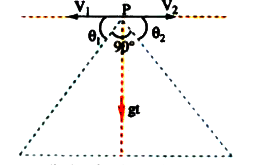
The situation is shown fig.

Let the velocity vectors become perpendicular after time t when both particles has fallen same vertical distance `1/2"gt"^(2)` and have acquired same vertical velocites gt.
Let their resultant velocities make angle `theta_(1)` and `theta_(2)` with horizontal.
Then `tan theta_(1)=("gt")/(v_(1))` and `tan theta_(2)=("gt")/(v_(2))`
Since velocity vectors are perpendicular
`theta_(1)+theta_(2)=90^(@)`, hence `tan theta_(2)=cot theta_(1)`
It makes `tan theta_(1)=("gt")/(v_(1))` and `cot theta_(1)=("gt")/(v_(2))`
On multiplying we get `t=(sqrt(v_(1)v_(2)))/g` and `D=(u_(1)+u_(2))t`
Promotional Banner

Similar Questions

Explore conceptually related problems

Two particles move in a uniform gravitational field with an acceleration g. At the intial moment the particles were located at one point and moved with velocity v_(1)=1" "ms^(-1)" and "v_(2)=4" "ms^(-1) horizontally in opposite directions. Find the time interval after their velocity vectors become mutually perpendicular

Two particles are projected from a tower horizontally in opposite directions with velocities 10 m//s and 20 m//s . Find the time when their velocity vectors are mutually perpendicular. Take g=10m//s^2 .

A particle moves in a straight line with a uniform acceleration a. Initial velocity of the particle is zero. Find the average velocity of the particle in first 's' distance.

Two particles are moving with velocities v_(1) and v_2 . Their relative velocity is the maximum, when the angle between their velocities is

Two particles, 1 and 2, move with constant velocities v_1 and v_2 along two mutually perpendicular straight lines toward the intersection point O. At the moment t=0 the particles were located at the distances l_1 and l_2 from the point O. How soon will the distance between the particles become the smallest? What is it equal to?

Two particles are projected with speeds u_1 and u_2 in mutually opposite directions from top of a tower horizontally. Find the time after which their velocity becomes perpendicular to each other.

A particle moves with a uniform velocity of 50 m/s for 20 min. What is the velocity of particle at t = 2 min ?

A particle is projected with a velocity 10 m//s at an angle 37^(@) to the horizontal. Find the location at which the particle is at a height 1 m from point of projection.

A particle starts from the point (0m, 8m) and moves with uniform velocity of 3 hat i m//s . After 5 seconds, the angular velocity of the particle about the origin will be : .

A particle moving along a straight line with a constant acceleration of -4 m//s^(2) passes through a point A on the line with a velocity of +8 m//s at some moment. Find the distance travelled by the particle in 5 seconds after that moment.

