Home
Class 11
PHYSICS
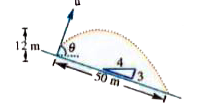
A stone is throw down the slope as sho...

A stone is throw down the slope as shown. Determing the magnitdue u and direction of its initial velocity so that the sotne will rise 12 m and still have a range of 50m down the slope.

Text Solution

Verified by Experts

The correct Answer is:

17.74m/s, `theta=59.8^(@)`
Promotional Banner

Similar Questions

Explore conceptually related problems

A block kept on a inclined plane slides down the plane with constant velocity when the slope angle of the plane is theta . It is then projected up with an initial velocity u. How far up the incline will it move before coming to rest ? Will it slide down again ?

A body is thrown with the velocity u = 12.0 ms^(-1) at an angle of alpha = 45^(@) to the horizon. If it touches the ground at the distance s from the point where it was thrown. From what height h should stone be thrown in a horizontal direction with the same initial velocity u so that it falls at the same spot ?

A shell is fired from a gun from the bottom of a hill along its slope. The slope of the hill is prop = 30^@ and the angle of the barrel to the horizontal beta = 60^@ . The initial velocity v of the shell is 21 m s^-1 . Then find the distance of point from the gun at which the shell will fall.

The force of buoyancy exerted by the atmosphere on a balloon is B in the upward direction and remains constant. The force of air resistance on the balloon acts opposite to the direction of velocity and is proportional to it. The balloon carries a mass M and is found to fall down near the earth's surface with a constant velocity v. How uch mass hsould be removed from teh balloon so that it may rise with a constant velocity v?

A wheel A is connected to a second wheel B by means of inextensible string, passing over a pulley C , which rotates about a fixed horizontal axle O , as shown in the figure. The system is released from rest. The wheel A rolls down the inclined plane OK thus pulling up wheel B which rolls along the inclined plane ON . Determine the velocity (in m/s) of the axle of wheel A , when it has travelled a distance s = 3.5 m down the to be slope. Both wheels and the pulley are assumed homogeneous disks of identical weight and radius. Neglect the weight of the string. The string does not over C . [Take alpha =53^@ and beta=37^@ ]

A man standing on the edge of a cliff throws a stone straight up with initial speed (u) and then throws another stone straight down with same initial speed and from the same position. Find the ratio of the speeds. The stones would have attained when they hit ground at the base of the cliff.

A trolley moves down a slope from rest with constant acceleration. In the first second of its motion it travels 1.6 m. Its acceleration (in m//s^(2) ) is

A boy is running along positive x - axis with 9 m//s . While running he manages to throw a stone in a plane perpendicular to his direction of running with velocity 12 m//s at an angle 30^@ with vertical. Find the speed of the stone at the highest point of the trajectory.

An object A is kept fixed at the point x= 3 m and y = 1.25 m on a plank p raised above the ground . At time t = 0 the plank starts moving along the +x direction with an acceleration 1.5 m//s^(2) . At the same instant a stone is projected from the origin with a velocity vec(u) as shown . A stationary person on the ground observes the stone hitting the object during its downward motion at an angle 45(@) to the horizontal . All the motions are in the X -Y plane . Find vec(u) and the time after which the stone hits the object . Take g = 10 m//s

An object A is kept fixed at the point x= 3 m and y = 1.25 m on a plank p raised above the ground . At time t = 0 the plank starts moving along the +x direction with an acceleration 1.5 m//s^(2) . At the same instant a stone is projected from the origin with a velocity vec(u) as shown . A stationary person on the ground observes the stone hitting the object during its downward motion at an angle 45(@) to the horizontal . All the motions are in the X -Y plane . Find vec(u) and the time after which the stone hits the object . Take g = 10 m//s
