Home
Class 11
PHYSICS
Two simple harmonic motions y(1) = Asino...

Two simple harmonic motions `y_(1) = Asinomegat` and `y_(2)` = Acos`omega`t are superimposed on a particle of mass m. The total mechanical energy of the particle is

Text Solution

Verified by Experts
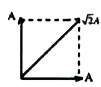
Phase difference between the two SHMs is `90^@`
Therefore, resultant amplitude is
`A= sqrt(2A), E=1/2 momega^2 A_R^2 = 1/2 m omega^2 (sqrt2 A)^2 - m omega^2 A^2`
Promotional Banner

Similar Questions

Explore conceptually related problems

Two waves of equation y_(1)=acos(omegat+kx) and y_(2)=acos(omegat-kx) are superimposed upon each other. They will produce

When two displacement represented by y_(1) = a sin (omega t) and y_(2) = b cos (omega t) are superimposed, the motion is

Two simple harmonic motions given by, x = a sin (omega t+delta) and y = a sin (omega t + delta + (pi)/(2)) act on a particle will be

Two SHMs directed along x-axis and y-axis are superimposed on a particle of mass m. If x=A_1sinomegat and y= A_2 sin(omegat+pi),then path of the particle will be.

Two SHMs s_(1) = a sin omega t and s_(2) = b sin omega t are superimposed on a particle. The s_(1) and s_(2) are along the direction which makes 37^(@) to each other

Passage I) In simple harmonic motion force acting on a particle is given as F=-4x , total mechanical energy of the particle is 10 J and amplitude of oscillations is 2m, At time t=0 acceleration of the particle is -16m/s^(2) . Mass of the particle is 0.5 kg. At x=+1m, potential energy and kinetic energy of the particle are

Passage I) In simple harmonic motion force acting on a particle is given as F=-4x , total mechanical energy of the particle is 10 J and amplitude of oscillations is 2m, At time t=0 acceleration of the particle is -16m/s^(2) . Mass of the particle is 0.5 kg. Potential energy of the particle at mean position is

Passage I) In simple harmonic motion force acting on a particle is given as F=-4x , total mechanical energy of the particle is 10 J and amplitude of oscillations is 2m, At time t=0 acceleration of the particle is -16m/s^(2) . Mass of the particle is 0.5 kg. Displacement time equation equation of the particle is

A particle is subjected to two simple harmonic motions. x_(1) = 4.0 sin (100pi t) and x_(2) = 3.0 sin(100pi t + (pi)/(3)) Find (a) the displacement at t = 0 (b) the maximum speed of the particle and (c ) the maximum acceleration of the particle.

The particle executing simple harmonic motion has a kinetic energy K_(0) cos^(2) omega t . The maximum values of the potential energy and the energy are respectively

