Home
Class 12
PHYSICS
Considering the earth as a short magnet ...

Considering the earth as a short magnet with its centre coinciding with the centre of earth, show that the angle of dip`phi`is related to magnetic latitude `lambda` by the relation `tan phi = 2 tan lambda`.

Text Solution

Verified by Experts
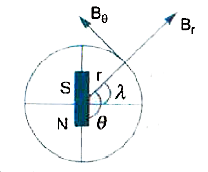

consider the situation as shown in the figure . For dipole , at position ` (r , theta )` we have
`B_r = (mu_0)/(4pi)(2 M cos theta )/(r^(3)) and B_0 = (mu_0)/( 4pi)(M sin theta )/(r^(3))` .......... (1)
and as ` tan phi = (B_V)/(B_H) = -(B_r)/(B_(theta))`, so in the light of eq (1) ,
` tan phi = -2 cot theta `
But from figure ` theta = 90 + lambda `
so , ` tan phi = -2 cot (90 + lambda )` , i.e., ` than phi = 2 tan lambda`.
Promotional Banner

Topper's Solved these Questions

  • MAGNETISM

    AAKASH SERIES|Exercise EXERCISE (LONG ANSWER QUESTIONS )|6 Videos
  • MAGNETISM

    AAKASH SERIES|Exercise EXERCISE (SHORT ANSWER QUESTIONS )|6 Videos
  • LOGIC GATES

    AAKASH SERIES|Exercise Exercise (Very Short Answer)|10 Videos
  • MOTION IN A PLANE

    AAKASH SERIES|Exercise EXERCISE-3 (Circular Motion)|7 Videos

Similar Questions

Explore conceptually related problems

Considering the earth as a short magnet with its centre coinciding with the centre of earth, show that the angle of dip phi is related to magnetic latitude lambda through the relation tan phi=2 tan lambda

At magnetic poles of earth, angle of dip is

R is the radius of the earth and omega is its angular velocity and g_(p) is the value of g at the poles. The effective value of g at the latitude lambda=60^(@) will be equal to

A very long bar magnet is placed with its north pole coinciding with the centre of a circular loop carrying an electric current. i . The magnetic field due to the magnet at a point on the periphery of the wire is B . The radius of the loop is a . The force on the wire is

Let the magnetic field on earth be modelled by that of a point magnetic dipole at the centre of earth. The angle of dip at a point on the geographical equator

Let the magnetic field on earth be modeled by that of a point magnetic dipole at the centre of earth. The angle of dip at a point on the geographical equator is

A short bar magnet placed in a horizontal plane has its axis aligned along the magnetic north south direction. Null points are found on the axis of the magnet at 14cm from the centre of the magnet. The earth's magnetic field at the plane is 0*36G and the angle of dip is zero. What is the total magnetic field on the normal bisector of the magnet at the same distance as the null points (i.e. 14 cm) from the centre of the magnet? (At null points, field due to a magnet is equal and apposite to the horizontal component of earth's magnetic field).

Two coils each of 100 turns are held such that one lies in vertical plane and the other in the horizontal plane with their centres coinciding. The radius of the vetical coil is 0.20m and that of the horizontal coil is 0.30m. How will you neutralize the magnetic field of the earth at their common centre? What is the current to be passed through each coil? Horizontal component of earth's magnetic field =0.35xx10^-4T and angle of dip = 30^@ .

Consider the plane S formed by the dipole axis and the axis of earth. Let P be point on the magnetic equator and in S. Let Q be the point of intersection of the geographical and magnetic equators Obtain the declination and dip angles at P and Q.

Consider the plane S formed by the dipole axis and the axis of earth. Let P be point on the magnetic equator and in S. Let Q be the point of intersection of the geographical and magnetic equators Obtain the declination and dip angles at P and Q.

AAKASH SERIES-MAGNETISM-ADDITIONAL EXERCISE
  1. Considering the earth as a short magnet with its centre coinciding wit...

    Text Solution

    |

  2. In Fg. 5.4 (b). The magnetic needle has magnetic moment 6.7xx10^(-2)Am...

    Text Solution

    |

  3. A short bar magnet placed with its axis at 30^(@) with an external fie...

    Text Solution

    |

  4. A short bar magnet placed with its axis at 30^(@) with an external fie...

    Text Solution

    |

  5. A short bar magnet placed with its axis at 30^(@) with an external fie...

    Text Solution

    |

  6. (a) What happens if a bar magnet is cut into two pieces : (i) transver...

    Text Solution

    |

  7. A magnetised needle in a uniform magnetic field experiences a torque b...

    Text Solution

    |

  8. Must every magnetic configuration have a north pole and a south pole? ...

    Text Solution

    |

  9. (b) A magnetised needle in a uniform magnetic field experiences a torq...

    Text Solution

    |

  10. What is the magnitude of the equatorial and axial fields due to a bar ...

    Text Solution

    |

  11. The figure shows the various p[osiotions (labelled by subscripts) of s...

    Text Solution

    |

  12. The figure shows the various p[osiotions (labelled by subscripts) of s...

    Text Solution

    |

  13. The figure shows the various p[osiotions (labelled by subscripts) of s...

    Text Solution

    |

  14. Magnetic field lines show the direction (at every point) along which a...

    Text Solution

    |

  15. Magnetic field liness can be entirely confined within the core of a to...

    Text Solution

    |

  16. If magnetic monpole existed, how would Gauss law of magnetism be modif...

    Text Solution

    |

  17. Does a bar magnet exert a torque on itself due to its own field? Does ...

    Text Solution

    |

  18. Magnetic field arises due to charges in motion. Can a system have magn...

    Text Solution

    |

  19. The earth’s magnetic field at the equator is approximately 0.4 G. Esti...

    Text Solution

    |

  20. In the magnetic meridian of a certain place, the horizontal component ...

    Text Solution

    |

  21. A solenoid has a core of a material with relative permeability 400. Th...

    Text Solution

    |

