Home
Class 11
PHYSICS
A mild steel wire of length 1.0 m and cr...

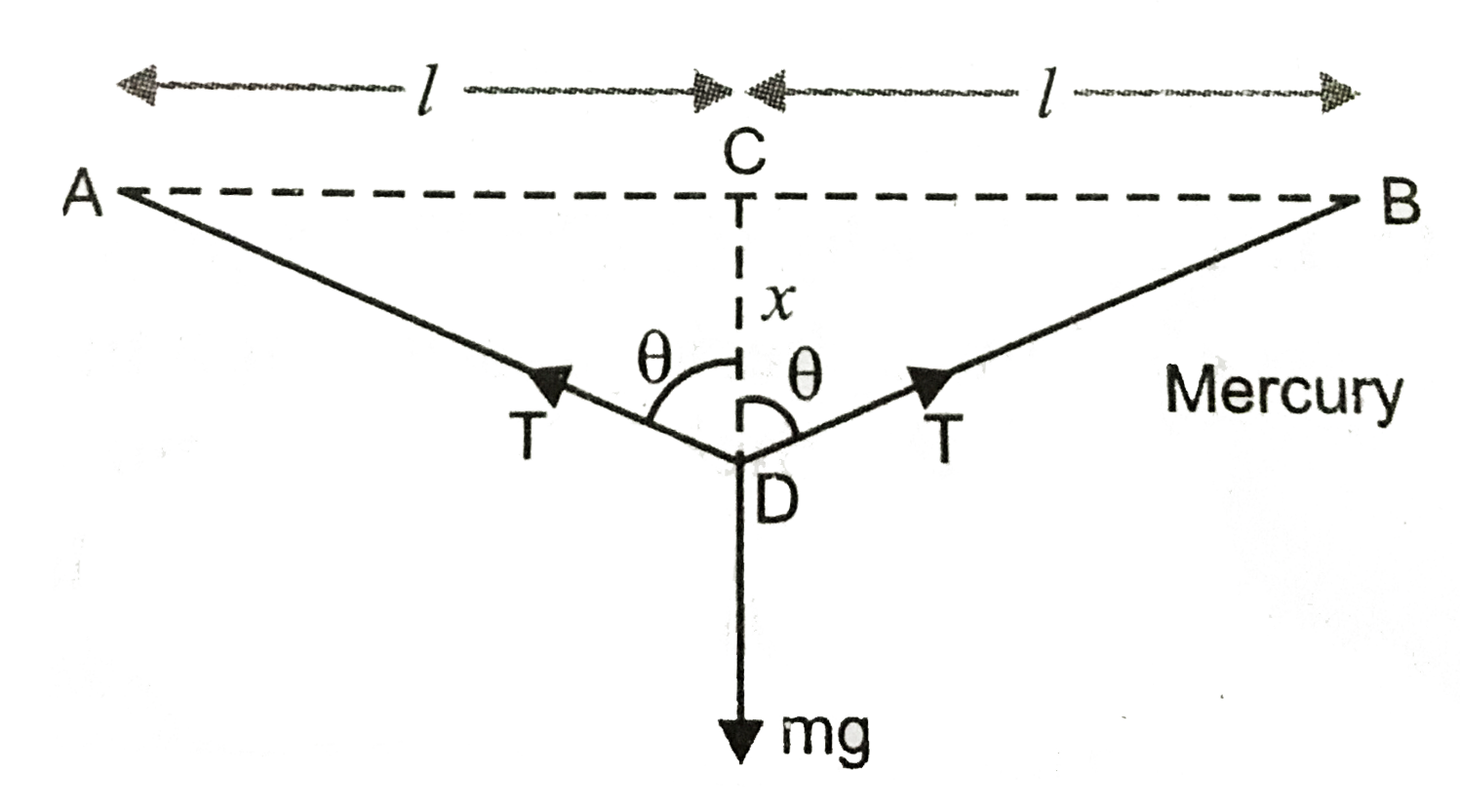
A mild steel wire of length 1.0 m and cross-sectional are `0.5 xx 10^(-2)cm^(2)` is streached, well within its elastic limit, horizontally between two pillars. A mass of 100 g is suspended from the mid point of the wire, calculate the depression at the mid point.
`g = 10ms^(-2), Y=20 xx 10^(11)Nm^(-2`.

Text Solution

Verified by Experts

`x=l[(Mg)/(YA)]^(1//3)` Here, `m 2l=1m, l=0.5m`,
`A=0.50xx10^(-6) m^(2) , , M=0.1 kg`,
`Y=2xx10^(11) N//m^(2) and g=10m//s^(2)`
`therefore` Depression `x=1.074xx10^(-2)m`
Promotional Banner

Similar Questions

Explore conceptually related problems

A mild steel wire of length 1.0m and cross sectional area 2L is strethched, within its elastic limit horizontally between two pillars(figure). A mass of m is suspended form the midpont of the wire. Strain in the wire is

A steel wire of length 2L and cross-section area A is stretched, wetl within elastic limit horizontally between two pillars, a mass m is suspended from the mid-point of wire such that depression at the middle is x. Strain in the wire is proportional to

A mild steel wire of length 2L is strethched, within its elastic limit horizontally between two pillars(figure). A mass of m is suspended form the midpont of the wire. Strain in the wire is

A steel wire of original length 1 m and cross-sectional area 4.00 mm^2 is clamped at the two ends so that it lies horizontally and without tension. If a load of 2.16 kg is suspended from the middle point of the wire, what would be its vertical depression ? Y of the steel =2.0xx10^11Nm^-2 . Take g=10 ms^-2

Find the net vertical displacement of point O, when a mass of 2.5 kg is suspended from the mid-point O of the rod shown (Y=2xx10^(11)N//m^(2)) .

A wire of length 1 m and area of cross section 2xx10^(-6)m^(2) is suspended from the top of a roof at one end and a load of 20 N is applied at the other end. If the length of the wire is increased by 0.5xx10^(-4)m , calculate its Young’s modulus (in 10^(11)N//m^(2)) .

A brass of length 2 m and cross-sectional area 2.0 cm^(2) is attached end to end to a steel rod of length and cross-sectional area 1.0 cm^(2) . The compound rod is subjected to equal and oppsite pulls of magnitude 5 xx 10^(4) N at its ends. If the elongations of the two rods are equal, the length of the steel rod (L) is { Y_(Brass) = 1.0 xx 10^(11) N//m^(2) and Y_(steel) = 2.0 xx 10^(11) N//m^(2)

A uniform wire of length 6m and a cross-sectional area 1.2 cm^(2) is stretched by a force of 600N . If the Young's modulus of the material of the wire 20xx 10^(10) Nm^(-2) , calculate (i) stress (ii) strain and (iii) increase in length of the wire.

A wire 10m long has a cross-sectional area 1.25 xx 10^(-4) m^(2) . It is subjected to a load of 5kg. Wt. If Y for the material is 4 xx 10^(10) Nm^(-2) , calculate the elongation produced in the wire. Take g = 10 ms^(-2) .

A copper wire of negligible mass, 1 m length and cross-sectional area 10^(-6) m^(2) is kept on a smooth horizontal table with one end fixed. A ball of mass 1 kg is attached to the other end. The wire and the ball are rotating with an angular velocity of 20 rad//s . If the elongation in the wire is 10^(-3) m . a. Find the Young's modulus of the wire (in terms of xx 10^(11) N//m^(2) ). b. If for the same wire as stated above, the angular velocity is increased to 100 rad//s and the wire breaks down, find the breaking stress (in terms of xx 10^(10) N//m^(2) ).
