Home
Class 11
PHYSICS
The graph shows the behaviour of a lengt...

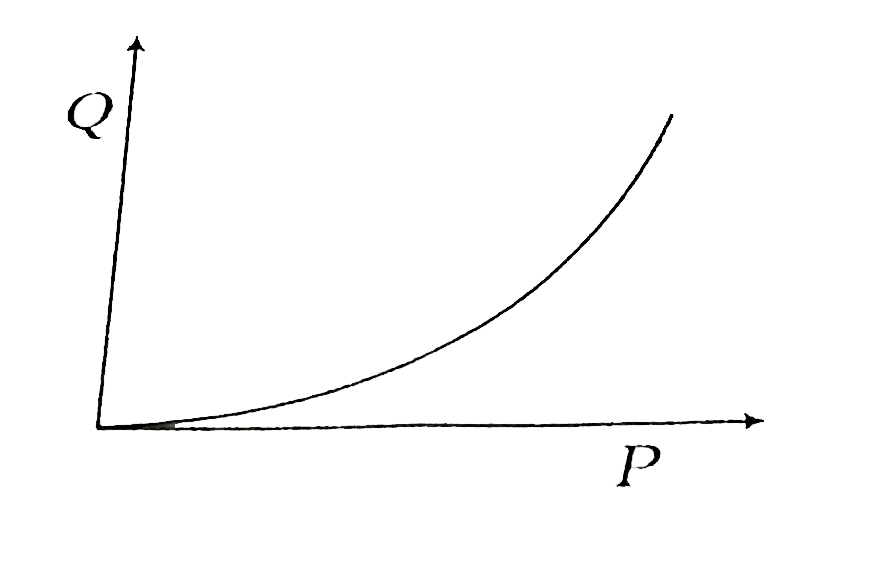
The graph shows the behaviour of a length of wire in the region for which the substance obeys Hooke's law. P and Q represent.

A

P = applied force, Q = extension

B

extension, applied force

C

extension, stored elastic energy

D

stored elastic energy, extension

Text Solution

Verified by Experts

The correct Answer is:

3
Promotional Banner

Similar Questions

Explore conceptually related problems

The graph show the behaviour of a length of wire in the region for which the substances obeys Hooke's law. P and Q represent

The graph shows the behaviour of a steel wire in the region for whoch the wire obeys Hooke's law. The graph is a parabola. The variables X and Y -axes, respectively can be [ stress (sigma) ,strain ( epsilon) and elastic potential energy(U) ]

Which one of the following graphs shows the variation of magnetic induction B which distance r from a long wire carrying a current ?

The given (p - U) graph shows the variation of internal energy of an ideal gas with increase in pressure. Which of the following pressure - volume graph is equivalent to this graph ? .

The stress strain graph for a metal wire is as shown in the figure. In the graph, the region in which Hooke's law is obeyed, the ultimate strength and fracture are represented by

The given graph shows the variation of velocity with displacement. Which one of the graphs given below correctly represents the variation of acceleration with displacement ?

The given graph shows the variation of velocity with displacement. Which one of the graphs given below correctly represents the variation of acceleration with displacement ?

1 meter long metallic wire is broken into two unequal parts P and Q. P part of the wire in uniformly extended into another wire R . Length of R is twice the length of P and the resistance of R is equal to that of Q . Find the ratio of the resistance P and R and also the ratio of the length P and Q

The breakdown of a sample of a chemical compounds is represented by the function p(n)=300(0.5)^(n) , where p(n) represents the number of millligrams of the substance that remains at the end of n years. Which of the following is true? I. 300 represents the number of milligrams of the substance that remains after the first year. II. 0.5 represents the fraction of the starting amount by which the substance gets reduced by the end of each year. III. Each year the substance gets reduced by one-half of 300.

Which of the following graphs represent the behaviour of an ideal gas ?
