Home
Class 11
PHYSICS
A mobile phone lies along the principal ...

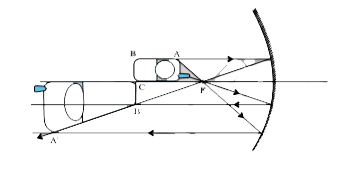
A mobile phone lies along the principal axis of a concave mirror, as shown in Fig. 9.7. Show by suitable diagram, the formation of its image. Explain why the magnification is not uniform. Will the distortion of image depend on the location of the phone with respect to the mirror?

Text Solution

Verified by Experts

The ray diagram for the formation of the image of the phone is shown in fig. The image of the part which is on the plane perpendicular to principal axis will be on the same plane. It will be of the same size, i.e., `B.C=BC`. You can youself realise why the image is distorted.
Promotional Banner

Similar Questions

Explore conceptually related problems

A mobile phone lies along the principal axis of a concave mirror as shown in Fig. Show by suitable diagram, the formation of its image. Explain why the magnification is not uniform, and distortion will occur depending on the location of the mobile with respect to the mirror.

(a) A mobile phone lies along the principal axis of a concave mirror. Show, with the help of a suitable diagram, the formation of its image. Explain why magnification is not uniform. (b) Suppose the lower half of the concave mirror's reflecting surface is covered with an opaque material. What effect this will have on the image of the object? Explain.

An object is kept on the principal axis of a concave mirror of focal length 10cm, at a distance of 15 cm from its pole. The image formed by the mirror is:

A thin stick of length f/5 placed along the principal axis of a concave mirror of focal length f such that its image is real and elongated just touch the stick. What is the magnification?

A rod of length 10 cm lies along the principal axis of a concave mirror of focal length 10 cm in such a way that the end closer to the pole is 20 cm away from it. Find the length of the image.

A rod of length 10 cm lies along the principal axis of a concave mirror of focal length 10 cm in such a way that the end closer to the pole is 20 cm away from it. Find the length of the image.

A rod of length 10 cm lies along the principal axis of a concave mirror of focal length 10 cm in such a way that the end closer to the pole is 20 cm away from it. Find the length of the image.

A 1 cm object is placed perpendicular to the principal axis of a convex mirror of focal length 7.5 cm. Find its distance from the mirror if the image formed is 0.6 cm in size.

An object AB is kept in front of a concave mirror as shown in Fig. (i) Complete the ray diagram showing the image formation of the object. (ii) How will the position and intensity of the image be affected surface is painted black ?

When an object lies at the focus of a concave mirror, them the position of the image formed and its magnification are
