Home
Class 11
PHYSICS
A dog of mass 10 kg is standing on a fla...

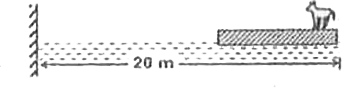
A dog of mass 10 kg is standing on a flat 10 m long boat so that it is 20 m meters from the shore. It walks 8 m on the boat towards the shore and then stops. The mass of the boat is 40 kg and friction between the boat and the water surface is negligible. How far is the dog from the shore now ?

Text Solution

Verified by Experts
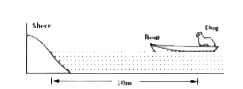
Given that initially the system is at rest so initial momentum of the system (Dog + boat) is zero.
Now as in motion of dog no external force is applied to the system final momentum of the system zero.
So, `m vec(v)_(1)+M vec(v)_(2)=0` [as (m + M) = Finite]
or `m(Delta vec(r )_(1))/(dt)+M(Delta vec(r )_(2))/(dt)=0 " " ["as "vec(v)=(d vec(r ))/(dt)]`
or `m Delta vec(r )_(1)+M Delta vec(r )_(2)=0`
[as `Delta vec(r )= vec(d)=` displacement] `md_(1)-Md_(2)=0` [as `vec(d)_(2)` is opposite to `vec(d)_(1)`]
i.e., `md_(1)=Md_(2) " "` ....(1)

Now when log moves 4 m towards shore relative to boat, the boat will shift a distance `d_(2)` relative to shore opposite to the displacement of dog so, the displacement of dog relative to shore (towards shore) will be
`d_(2)=4-d_(1)(because d_(1)+d_(2)=d_(rel)=4) " "` ......(2)
substituting the value of `d_(2)` from Eqn. (2) in (1)
`md_(1)=M(4-d_(1))` or `d_(1)=(M xx 4)/((m+M))=(20xx4)/(5+20)=3.2m`
As initially the dog was 10 m from the shore, so now he will be `10 - 3/2 = 6.8` m away from the shore.
Promotional Banner

Similar Questions

Explore conceptually related problems

(i) Find the acceleration of the centre of mass of two particle approaching towards each other under their own grabitational field. (ii) A boy of mass 30 kg is standing on a flat boat so that he is 20 meter from the shore. He walks 8 m on the boat towards the shore and then stops. The mass of the boat is 90 kg and friction between the boat and the water surface is negligible. How far is the boy from the shore now ?

A boy of mass 30 kg is standing at one end on a stationary boat over a lake. The boat has a mass 70 kg and length 10 m. Now the boy walked to the other end of the boat. Relative to the ground

A boy having a mass of 40kg stands at one end A of a boat of length 2m at rest. The boy walks to the other end B of the boat and stops. What is the distance moved by the boat? Friciton exists between the feet of the boy and the surface of the boat. But the friction between the boat and the water surface may be neglected. Mass of the boat is 15kg .

A man of mass 60 kg is standing on a boat of mass 140 kg, which is at rest in still water. The man is initially at 20 m from the shore. He starts walking on the boat for 4 s with constant speed 1.5 m/s towards the shore. The final distance of the man from the shore is

A man of mass m walks from end A to the other end B of a boat of mass M and length l. The coefficient of friction between the man and the boat is mu an neglect any resistive force between the boat and the water.

A man weighing 70 kg is standing at the centre of a flat boat of mass 350 kg. The man who is at a distance of 10 m from the shore walks 2 m towards it and stops. How far will he be from the shore? Assume the boat to be of uniform thickness and neglect friction between boat and water?

A boat of mass 90 kg is floating in still water. A boy of mass 30 kg walks from one end to the other on it. If the length of the boat is 3 m, then the distance through which the boat will move is

Two men of masses 40 kg and 20 kg are standing on a boat of mass 100 kg. Length of boat is 20m. Neglect the friction between water and boat. Find the displacement of the boat when both the persons reach at middle of boat.

