Home
Class 11
PHYSICS
In the arrangement shown , by what accel...

In the arrangement shown , by what acceleration the boy must go up so that 100 kg block remains stationary on the wedge. The wedge is fixed and friction is absent everywhere . ( Take `g = 10 m s^(-2)` )

Text Solution

Verified by Experts
For the block to remain stationary, `T = mg sin theta`
`T=100xx10xx sin 53`
`= 100xx ""^(2)cancel(10)xx(4)/(cancel(5))=800N`
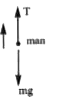
FBD for man
`T-mg=ma`
T = m (g + a)
`80 cancel(0)=5cancel(0)(10+a)`
`a=6 m//s^(2)`
Promotional Banner

Similar Questions

Explore conceptually related problems

By what acceleration the boy must go up so that 100kg block remains stationary on the wedge. The wedge is fixed and is smooth (g =10m//s^(2)) .

Find the mass M so that it remains at rest in the abjoining figure. Both the pulley and string are light and friction is absent everywhere. (g = 10 m//s^(2))

In the arrangement shown in fig. the block of mass m=2kg lies on the wedge of mass M=8kg . The initial acceleration of the wedge, if the surfaces are smooth, is

Neglect friction. Find acceleration of m, 2 m and 3 m as shown in the figure. The wedge is find.

A ball of mass 1 kg is released from position A inside a wedge with a hemispherical cut of radius 0.5 m as shown in figure. The force exerted by the wedge on ball, when the ball is in position B is (neglect friction everywhere) (Take g = 10 m//s^(2) )

The block C shown in the figure is ascending with an acceleration a=3m//s^(2) by means of some motor not shown here. Find the acceleration of the bodies A and B of masses 10 kg and 5kg respectively in m//s^(2) , assuming pulleys are massless and friction is absent everywhere.

A block of mass m slides down on a wedge of mass M as shown in figure .Let a_(1) be the asseleration of the acceleration of and a_(2) the the acceleration od block 1 N_(1) is the normal reaction between block and wedge and N_(2) the normal reaction between wedge and gound .frication is absent everwhere .Select the correct alternative(s)

All surfaces shown in the figure are frictionless. A block of mass 2 kg is kept on a wedge of mass 10 kg. If the mass m remains stationary w.r.t wedge , the magnitude of force P is ( g = 10 m//s^(2))

A block of mass m, is kept on a wedge of mass M, as shown in figure such that mass m remains stationary w.r.t. wedge. The magnitude of force P is

In the arrangement shown in figure the masses of the wedge M and the body m are known. The appreciable friction exists only between the wedge and the body m , the friction coefficient being equal to k . The masses of the pulley and the thread are negligible. Find the acceleration of the body m relative to the horizontal surface on which the wedge slides.

