Home
Class 11
PHYSICS
Block A is placed on block B, whose mass...


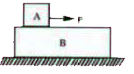
Block A is placed on block B, whose mass is greater than that of A. There is friction between the blocks, while the ground is smooth. A horizontal force P, increasing linearly with time, begins to act on A. The accelerations `a_(1)` and `a_2` of A and B respectively are plotted against time (t). The correct graph is

Text Solution

Verified by Experts

The two blocks will move together with the same acceleration as long as the force of friction between them is less than the limiting friction, as the only force on the lower block B is the force of friction. Once limiting friction is reached, the acceleration of B becomes constant `(=(F_("lim"))/("mass of B"))`, and the acceleration of A continues to increase at a
Promotional Banner

Similar Questions

Explore conceptually related problems

A block B is placed on the block A .The mass of block B is less than the mass of block A . Friction exists between the blocks , whereas the ground on which block A is placed is taken to be smooth. A horizontal force F , increasing linearly with time begins to act on B . The acceleration a_(A) and a_(B) of blocks A and B , respectively , are plotted against t . The correctly plotted graph is

There is friction between the block A and B while ground is smooth. Magnitude of force F is increasing linearly with time, a_(1) and a_(2) are accelerations of block A and B. Which graph best represents acceleration a_(1) and a_(2) of block A and B respectively with time?

A block A of mass 2 kg is placed over smooth block B of mass 4 kg which is placed over a smooth horizontal floor The coefficient of friction between A and B is 0.4 when a horizontal forces of magnitude 10 N is applied on A the acceleration of block of A and B are

Two blocks of mass 10 kg and 30 kg are kept as shown in the figure. The surface between the block is fricitional while the ground is smooth. A horizontal force of magnitude 60 N is applied horizontally on the upper block. Find the frictional force on block of mass 30 kg ?

A block of mass 1 kg is placed on a truck which accelerates with acceleration 5ms^(-2) . The coefficient of static friction between the block and truck is 0.6. The frictional force acting on the block is

Acceleration of block A varies with time as shown in figure the value of coefficient of kinetic friction between block A and B is

A block A slides over an another block B which is placed over a smooth inclined plane as shown in figure . The coefficient of friction between the two blocks A and B is mu . Mass of block B is two times the mass of block A . The acceleration of the centre of mass of two blocks is

A 3 kg block is placed over a 10 kg block and both are palced on a smooth horizontal surface. The coefficient of friction between the block is 0.2 . If a horizontal force of 20 N is applied to 3 kg block, accelerations of the two block in ms^(-2) are (take, g=ms^(-2) )

A block of mass 'm' is placed on the floor of a lift, moving upward with an uniform acceleration a = g. ( mu is the coefficient of friction between block and the floor of lift). If a horizontal force of umg acts on the block, then horizontal acceleration of the body is .......

A block A of mass 4 kg is placed on another block B of mass 5 kg and the block rests on a smooth horizontal table. For sliding the block A on B, a horizontal force of 12 N is required to be applied on it. The maximum horizontal force that can be applied on B so that both A and B move together and the acceleration produced by this force is

