Home
Class 11
PHYSICS
Three identical balls, ball I, ball II a...

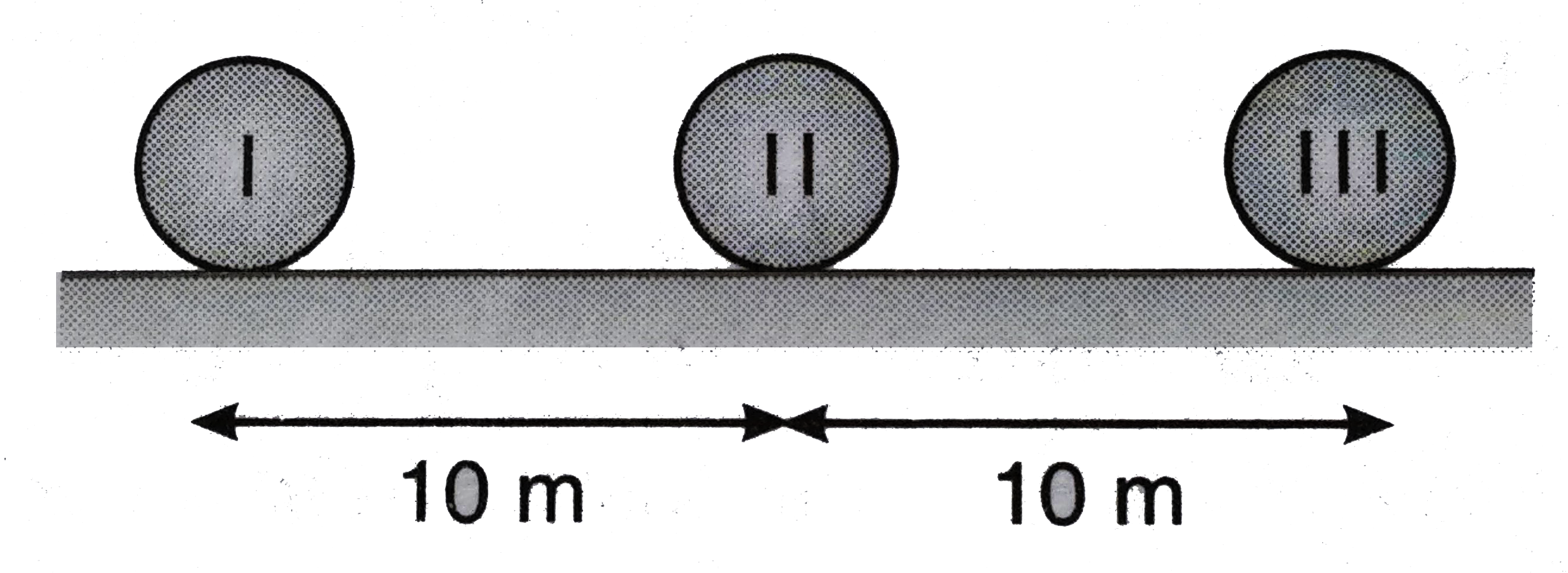
Three identical balls, ball I, ball II and ball III are placed on a smooth floor on a straight line at the separation of `10m` between balls as shown in figure. Initially balls are stationary. But I is given velocity of `10m//s` towards ball II, collision between balls I and II is inelastic with coefficient of restitution `0.5` but collision between balls II and III is perfectly elastic. What is the time interval between two consecutive collisions between ball I and II?

A

1

B

2

C

3

D

4

Text Solution

Verified by Experts

The correct Answer is:

D
Promotional Banner

Similar Questions

Explore conceptually related problems

A ball is dropped from a height h on a floor. The coefficient of restitution for the collision between the ball and the floor is e. The total distance covered by the ball before it comes to the rest.

A glass ball collides with an identical ball at rest with v_(0)=2 m/sec. If the coefficient of restitution of collision is e = 0.5, find the velocities of the glass balls just after the collision.

A ball of mass m moving at a speed v makes a head-on collision with an identical ball at rest. The kinetic energy of the balls after the collision is three fourths of the original. Find the coefficient of restitution.

If the collision of a ball of mass m is inelastic, then the relation between theta and alpha is (where theta is the coefficient of restitution)

Ball 1 collides directly with another identical ball 2 at rest. Velocity of second ball becomes two times that of 1 after collison. Find the coefficient of restitution between the two balls?

Ball 1 collides directly with another identical ball 2 at rest. Velocity of second ball becomes two times that of 1 after collison. Find the coefficient of restitution between the two balls?

Three balls A, B and C are placed on a smooth horizontal surface. Given that m_A=m_C=4m_B . Ball B collides with ball C with an initial velocity v as shown in figure. Find the total number of collisions between the balls. All collisions are elastic.

Velocity of the ball A after collision with the ball B as shown in the figure is (Assume perfectly inelastic and head - on collision)

Five balls are placed one after the other along a straight line as shown in the figure. Initially, all the balls are at rest. Then the second ball has been projected with speed v_(0) towards the third ball. Mark the correct statements, (Assume all collisions to be head-on and elastic.)

A ball A of mass M collides elastically with a similar ball B at rest as shown in figure. Initially velocity of ball A is u m/s. After collision,
