Home
Class 11
PHYSICS
A ball of mass 1kg strikes a wedge of ma...

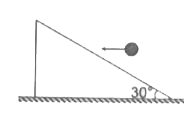
A ball of mass 1kg strikes a wedge of mass 4kg horzontally with a velocity of `10m//s`. Just after collision, velocity of wedge becomes `4m//s`.Friction is absent everywhere and collision is elastic. Select the correct alternative.

A

speed of ball after collision is `4ms^(-1)`

B

speed of ball after collision is `8ms^(-1)`

C

impulse between ball and wedge during collision is 16N-s

D

impulse between ball and wedge during collision is 32 N-s

Text Solution

Verified by Experts

The correct Answer is:

D
Promotional Banner

Similar Questions

Explore conceptually related problems

A small ball of mass 1kg strikes a wedge of mass 4kg horizontally with a velocity of 10m//s . Friction is absent everywhere and collision is elastic. Select the incorrect answer:

A block of mass 1 kg is pushed towards another block of mass 2 kg from 6 m distance as shown in figure. Just after colision velocity of 2 kg block becomes 4 m//s .

A ball mass 2 kg moving horizontally with velocity 10 m/s hits a wedge of mass 5 kg placed on a horizontal surface as shown in the figure. Just after collision klvelocity of wedge is 3.2 m/s. There is no friction at any contact surface. Then (take sin 30^(@)=3//5 )

A ping-pong ball strikes a wall with a velocity of 10 ms^(-1) . If the collision is perfectly elastic, find the velocity if ball after impact

A bomb of mass 12 kg explodes into two pieces of masses 4 kg and 8 kg. The velocity of mass 4 kg is 20 m/s. Find the velocity of mass 8 kg.

what will be the wavelength of a ball of mass 0.1 kg moving with a velocity of 10 m s^(-1) ?

An object of mass 40kg and having velocity 4 m//s collides with another object of mass 60 kg having velocity 2 m//s . The loss of energy when the collision is perfectly inelastic is

Block A has a mass 3kg and is sliding on a rough horizontal surface with a velocity u_A=2m//s when it makes a direct collision with block B, which has a mass of 2kg and is originally at rest. The collision is perfectly elastic. Determine the velocity of each block just after collision and the distance between the blocks when they stop sliding. The coefficient of kinetic friction between the blocks and the plane is mu_k=0.3 ( Take g=10m//s^2 )

A ball of mass 1 kg is dropped from a height of 3.2 m on smooth inclined plane. The coefficient of restitution for the collision is e= 1//2 . The ball's velocity become horizontal after the collision.

A body of mass 2 kg moving with a velocity 3 m//s collides with a body of mass 1 kg moving with a velocity of 4 m//s in opposite direction. If the collision is head on and completely inelastic, then
