Home
Class 11
PHYSICS
Two identical balls A and B. each of mas...

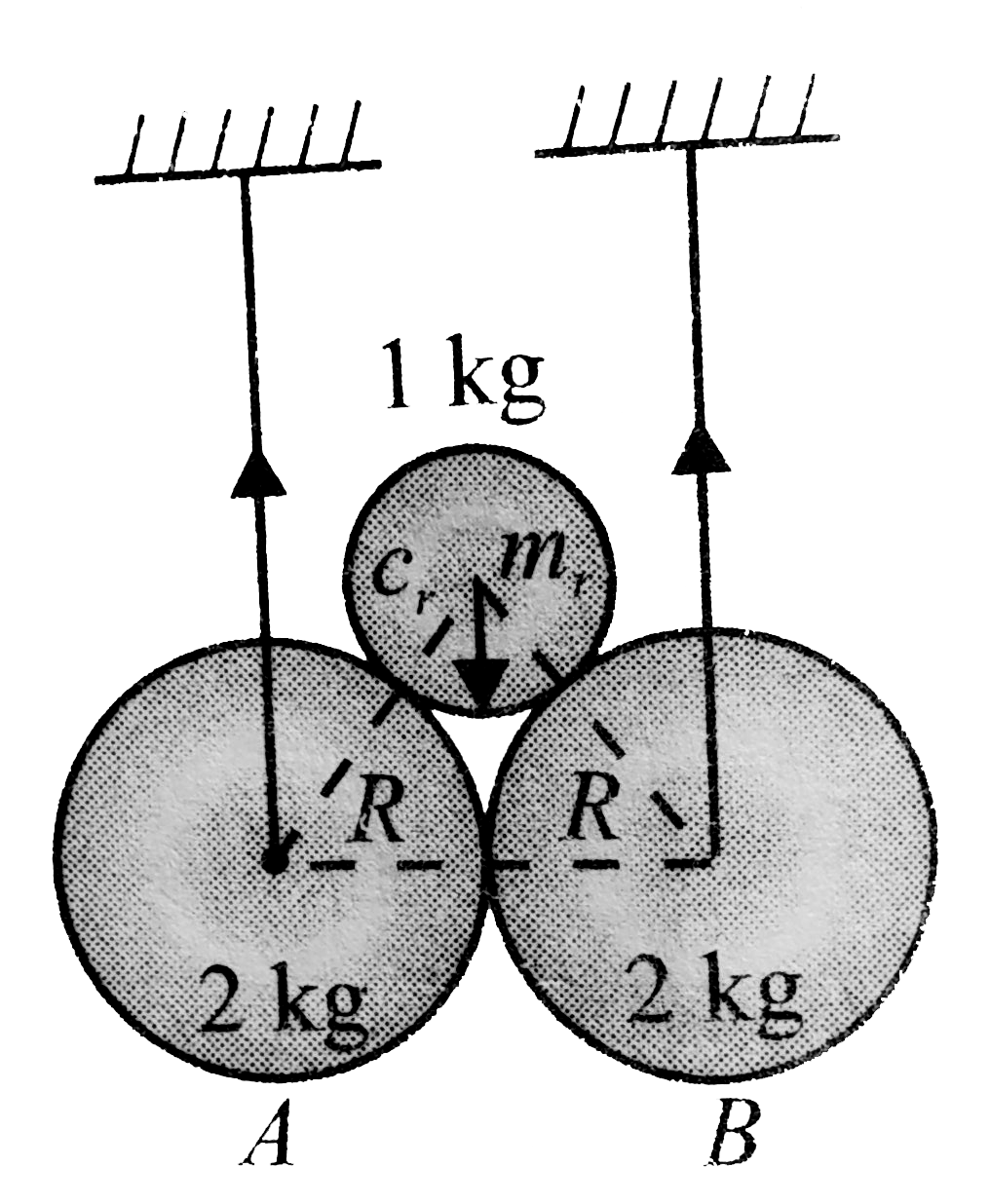
Two identical balls `A` and `B`. each of mass `2 kg` and radius `R`, are suspended vertically from inextensible strings as shown in Fig. The third ball `C` of mass `1 kg` and radius `r=(sqrt(2)-1)R` falls and hits `A` and `B` symmetrically with `10 m//s`. Speed of both `A` and `B` just after the collision is `3 m//s`.

The value of coefficient of restitution is

A

`(1)/(4)`

B

`(1)/(sqrt(2))`

C

`sqrt(2)-1`

D

`(1)/(2)`

Text Solution

Verified by Experts

The correct Answer is:

C
Promotional Banner

Similar Questions

Explore conceptually related problems

Two identical balls A and B . each of mass 2 kg and radius R , are suspended vertically from inextensible strings as shown in Fig. The third ball C of mass 1 kg and radius r=(sqrt(2)-1)R falls and hits A and B symmetrically with 10 m//s . Speed of both A and B just after the collision is 3 m//s . speed of C just asfter collision is

Two identical balls A and B . each of mass 2 kg and radius R , are suspended vertically from inextensible strings as shown in Fig. The third ball C of mass 1 kg and radius r=(sqrt(2)-1)R falls and hits A and B symmetrically with 10 m//s . Speed of both A and B just after the collision is 3 m//s . Impulse provided by each sting during collision is

Three solid spheres each of mass m and radius R are released from the position shown in Fig. What is the speed of any one sphere at the time of collision?

In the figure shown, the two identical balls of mass M and radius R each, are placed in contact with each other on the frictionless horizontal surface. The third ball of mass M and radius R//2 , is coming down vertically and has a velocity = v_(0) when it simultaneously hits the two balls and itself comes to rest. Then, each of the two bigger balls will move after collision with a speed equal to

An iron ball of mass m , suspended by a light inextensible string of length l from a fixed point O , is shifted by theta_(0) as shown so as to strike the vertical wail perpendicularly.The maximum angle made by the string with vertical after the first collision, if e is the coefficient of restitution, is

A particle of mass m strikes a disc of radius R and mass m with a speed u as shown in the figure. What is the speed of the particle just after the collision if the collision is perfectly inelastic ?

A ball of mass 1kg hangs in equilibrium from two strings as shown in If g = 10m//s^(2) what are the valuse of tension in strings OA and OB .

A ball of mass 1 kg strikes a heavy plarform elastically, moving upwards with a velocity of 5 m//s . The speed of the ball just before the collision is 10 m//s downwards. Then the impulse imparted by the platform on the ball is

Two identical blocks A and B each of mass 2 kg are hanging stationary by a light inextensible flexible string, passing over a light and frictionless pulley, as shown in Fig. A shell C of mass 1 kg moving vertically upwards with velocity 9 m//s collides with block B and gets stuck to it. Calculate the time after which block B starts moving downwards.

Three balls A, B and C of masses 2 kg, 4 kg and 8 kg , respectively, move along the same straight line and in the same direction, with velocities 4m//s,1m//s, 3/4m//s . If A collides with B and subse-quently B collides with C , find the velocity of ball A and ball B after collision, taking the coefficient of restitution as unity.
