Home
Class 11
PHYSICS
A particle of mass m is moving in YZ-pla...

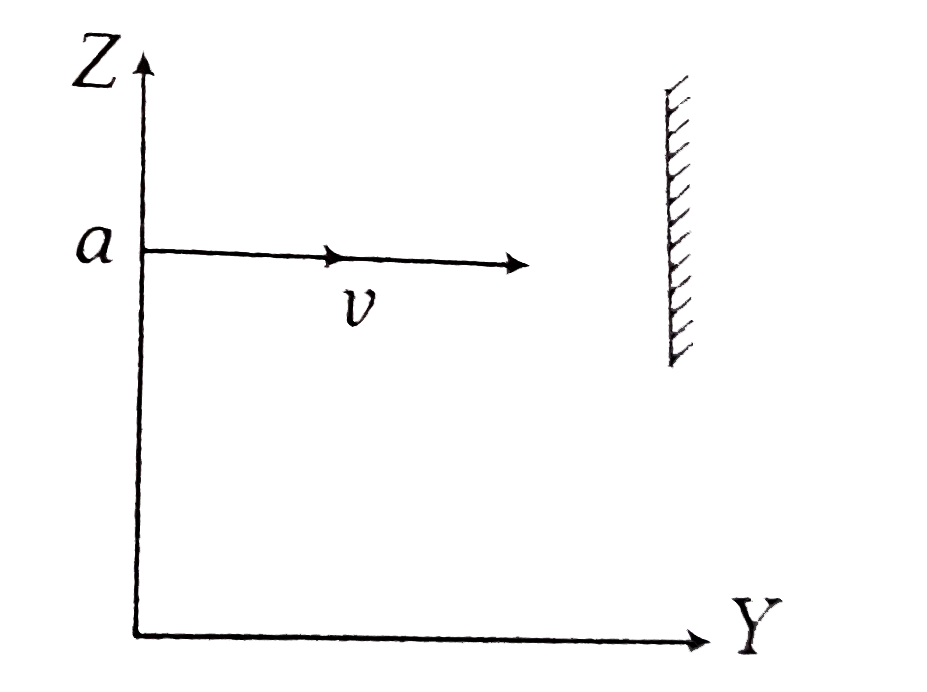
A particle of mass m is moving in YZ-plane with a uniform velocity `v` with its trajectory running parallel to `+ve` Y-axis and intersecting Z-axis at `z=a` in figure. The change in its angular momentum about the origin as it bounces elastically form a wall at y=constant is

A

`mvabari`

B

`2mvabari`

C

`-mvabari`

D

`-2amvbari`

Text Solution

Verified by Experts

The correct Answer is:

B
Promotional Banner

Similar Questions

Explore conceptually related problems

A particle of mass m is moving in yz-plane with a unifrom velocity v with its trajectory running parallel to +ve y-axis and intersecting z-axis at z = a Fig. The change in its angular momentum about the origin as it bounces elastically from a wall at y = constant is :

A particle of mass m is moving with constant velocity v parallel to the x-axis as shown in the figure. Its angular momentum about origin O is

A particle of mass m moves along line PC with velocity v as shown. What is the angular momentum of the particle about O ?

If the particle of mass m is moving with constant velocity v parallel to x-axis in x-y plane as shown in (figure), Find its angular momentum with respect of origin at any time t .

A mass m is moving with a constant velocity along a line parallel to the x-axis, away from the origin. Its angular momentum with respect to the origin.

A particle is moving parallel to x-axis as shown in the figure. The angular velocity of the particle about the origin is

A particle is moving with constant speed v in xy plane as shown in figure. The magnitude of its angular velocity about point O is

A particle mass parallel to x-axis with constant velocity v as shown in the figure. The angular velocity of the particle about the origin O

A particle is moving along a straight line parallel to x-axis with constant velocity. Find angular momentum about the origin in vector form :

A particle is moving in x-y plane as shown in the figure. Angular velocity of the particle with respect to the origin is
