Home
Class 11
PHYSICS
A Iong slender rod of mass 2 kg and leng...

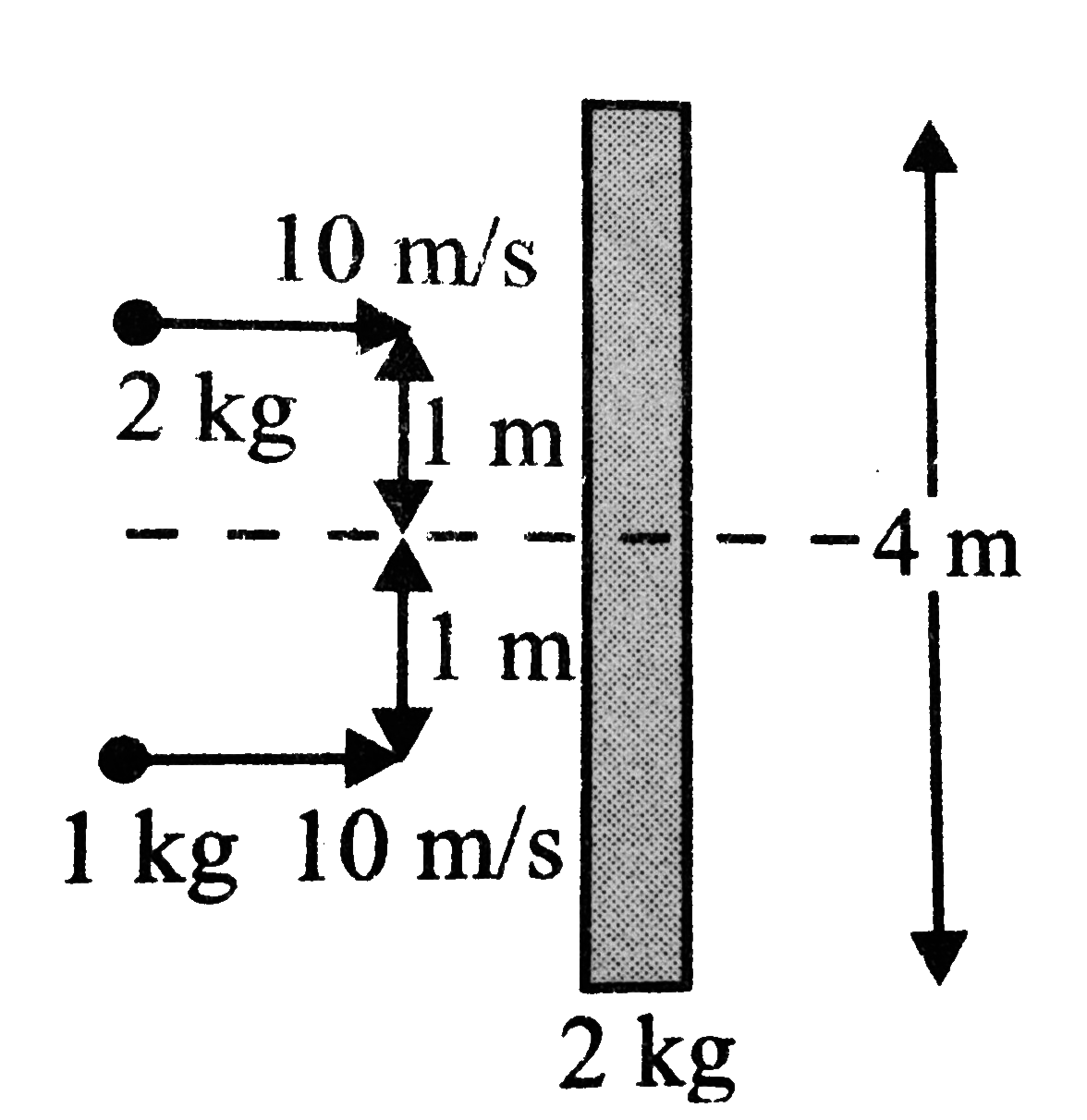
A Iong slender rod of mass `2 kg` and length `m` is placed on a smooth horizontal table. Two particles of masses `2 kg` and ` 1kg` strike the rod simultaneously and stick to the rod after collision as shown in fig.

Angular velocity of the rod after collision is

A

rad /s

B

rad /s

C

19/17 rad /s

D

30/17 rad /s

Text Solution

Verified by Experts

The correct Answer is:

D
Promotional Banner

Similar Questions

Explore conceptually related problems

A Iong slender rod of mass 2 kg and length m is placed on a smooth horizontal table. Two particles of masses 2 kg and 1kg strike the rod simultaneously and stick to the rod after collision as shown in fig. Velocity of the centre of mass of the rod after collision is

A rod of mass 2kg and length 1m is pivoted at one end A and kept on a smooth surface. A particle of mass 500gm strikes the other end B of the rod and sticks to the rod. If particle was moving with the speed of 10m//s , what is the angular speed of the rod after collision ?

Three (A,B,C) particle each of mass m are connected by three mass-less rod of length l. All three particle lies on smooth horizontal plane. A particle of mass moving along one of the rod with velocity v_(0) strikes on a particle and stops as shown in diagram. Angular velocity of eachh particle after collision is.

A uniform rod of mass 2 kg and length 1 m lies on a smooth horizontal plane. A particle of mass 1 kg moving at a speed of 2ms^-1 perpendicular to the length of the rod strikes it at a distance (1)/(4) m from the centre and stops . Find the angular velocity of the rod about its centre just after the collision (in rad/s)

A uniform rod of mass m and length L is at rest on a smooth horizontal surface. A ball of mass m, moving with velocity v_0 , hits the rod perpendicularly at its one end and sticks to it. The angular velocity of rod after collision is

A rigid uniform rod of mass M and length L is placed along the Y-axis on a smooth horizontal surface with its centre at the origin. Two particles , each of mas m ( = M //12) hits simultaneously , at the two ends with equal speed v as shown in the figure. The collision is completely inelastic. (i) Find the angular velocity of the system after the collision. (ii) Two particles of mass 2m and m are placed respectively at ( L//2, 0) and ( - L//2, 0) . Calculate the time when the rod hits these particles.

A uniform rod of mass M and length a lies on a smooth horizontal plane. A particle of mass m moving at a speed v perpendicular to the length of the rod strikes it at a distance a/4 from the centre and stops after the collision. Find a. the velocity of the cente of the rod and b. the angular velocity of the rod abut its centre just after the collision.

A uniform rod of length L lies on a smooth horizontal table. The rod has a mass M . A particle of mass m moving with speed v strikes the rod perpendicularly at one of the ends of the rod sticks to it after collision. Find the velocity of the particle with respect to C before the collision

A uniform rod of mass m=2 kg and length l is kept on a smooth horizontal plane. If the ends A and B of the rod move with speeds v and 2v respectively perpendicular to the rod, find the: a. angulr velocity of CM of the rod. b. Kinetic energy of the rod (in Joule).

A rod AB of mass M and length 8l lies on a smooth horizontal surface. A particle, of mass m and velocity v_(0) strike's the rod perpendicular to its length, as shown in Fig. As a result of the collision, the centre of mass of the rod attains a speed of v_(0)//8 and the particle rebounds back with a speed of v_(0)//4 . Find the following: a. The ratio M//m . b. The angular velocity of the rod about O . c. The coefficient of restitution 'e' for the collision. d. The velocities of the ends 'A' and 'B' of the rod, namely, v_(A) and v_(B) respectively.
