Home
Class 11
PHYSICS
A small sphere of mass 1 kg is rolling w...

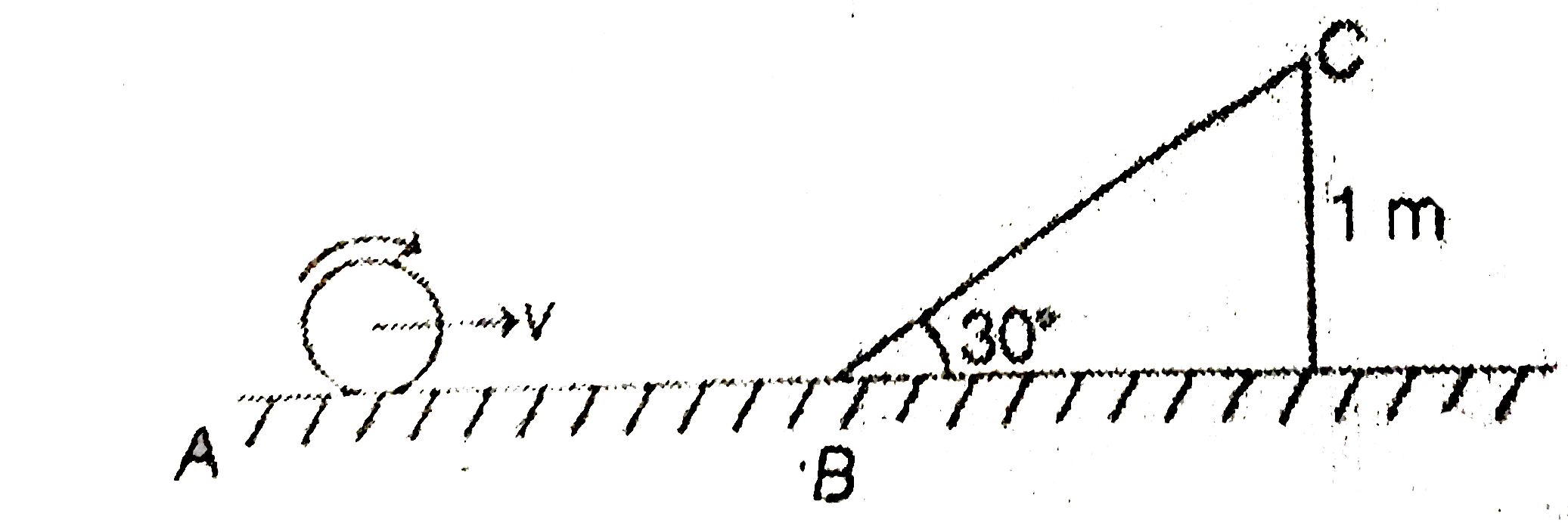
A small sphere of mass 1 kg is rolling without slipping with linear speed
`v=sqrt((200)/(7) m//s`

It leaves the inclined plane at point C.
Find ratio of rotational and translational kinetic energy of the sphere when it strikes the ground after leaving from point C.

A

`2/5`

B

`2/3`

C

`1/6`

D

`1/2`

Text Solution

Verified by Experts

The correct Answer is:

C
Promotional Banner

Similar Questions

Explore conceptually related problems

A small sphere of mass 1 kg is rolling without slipping with linear speed v=sqrt((200)/(7) m//s It leaves the inclined plane at point C. Find the linear speed at point C.

A solid sphere of mass m rolls down an inclined plane a height h . Find rotational kinetic energy of the sphere.

A ring of mass m is rolling without slipping with linear speed v as shown in figure. Four particles each of mass m are also attached at points A, B , C and D find total kinetic energy of the system.

A uniform thin spherical shell of mass m and radius R rolls down without slipping over an inclined plane of angle theta with the horizontal. The ratio of rotational kinetic energy to the total kinetic energy of the shell will be

A circular disc of mass 2 kg and radius 10 cm rolls without slipping with a speed 2 m/s. The total kinetic energy of disc is

A solid sphere is rolling without slipping on a horizontal plane. The ratio of its rotational kinetic energy and translational kinetic energy is

A solid sphere of mas 2kg rolls on a table with linear speed of 1 m//s . Its total kinetic energy is

A solid sphere rolls on horizontal surface without slipping. What is the ratio of its rotational to translation kinetic energy.

A uniform sphere of mass m and radius R rolls without slipping down an inclined plane set at an angle theta to the horizontal. Find ( a ) the friction coefficient at which slipping is absent, ( b ) the kinetic energy of the sphere t seconds after the beginning of motion.

A disc is rolling without slipping with linear velocity v as shown in figure. With the concept of instantaneous axis of rotation, find velocities of point A, B, C and D.
