Home
Class 11
PHYSICS
A solid sphere is rotating about an axis...

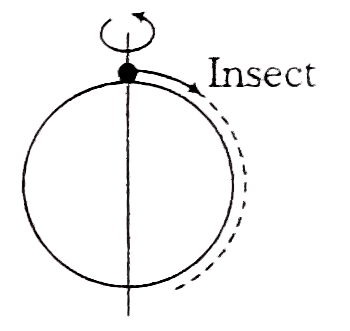
A solid sphere is rotating about an axis shown in figure. An insect follows the dotted path on the circumference of sphere as shown in the figure.

`{:(,"Column-I",,"Column-II"),("(A)","Moment of inertia","(p)","Will remain constant"),("(B)","Angular velocity","(q)","Will first increase, then decrease"),("(C)","Angular momentum","(r)","Will first decrease then increase"),("(D)","Rotational kinetic energy","(s)","Will continuously decrease"),(,,"(t)","Will continuously increase"):}`

Text Solution

Verified by Experts

The correct Answer is:

A-Q;B-R;C-P;D-R
Promotional Banner

Similar Questions

Explore conceptually related problems

A solid sphere is rotating about an axis as shown in figure. An insect follows the dotted path on the cricumference of sphere as shown . Match the following

If earth decreases its rotational speed. Match the following columns {:(,"Column-I",,"Column-II"),("(A)","Value of g at pole","(p)","Will remain same"),("(B)","Value of g at equator","(q)","Will increase"),("(C)","Distance of geostationary","(r)","Will decrease"),("(D)","Energy of geostationary satellite","(s)","Cannot say"):}

Two concentric spherical shells are as shown in figure. Match the following columns {:(,"Column-I",,"Column-II"),("(A)","Potential at A","(p)","greater than B"),("(B)","Gravitational field at A","(q)","less than B"),("(C)","As one moves from C to D","(r)","Potential remains constant"),("(D)","As one moves from D to A","(s)","Gravitational field decreases"),(,,"(t)","None"):}

If radius if earth is reduced to half without changing its mass, then match the following columns {:(,"Column-I",,"Column-II"),("(A)","Angular momentum of earth","(p)","Will become two times"),("(B)","Time period of rotation of earth","(q)","Will become four times"),("(C)","Rotational kinetic energy of earth","(r)","Will remain constant"),("(D)",,"(s)","None"):}

Match the following {:(,"Column-I",,"Column-II"),("(A)","Kepler's first law","(p)",T^(2)propr^(3)),("(B)","Kepler's second law","(q)","Areal velocity is constant"),("(C)","Kepler's third law","(r)","Orbit of planet is elliptical"):}

In elliptical orbit of a planet, as the planet moves from apogee position to perigee position to perigee position, match the following columns {:(,"Column-I",,"Column-II"),("(A)","Speed of planet","(p)","Remains same"),("(B)","Distance of planet from centre of sun","(q)","Decreases"),("(C)","Potential energy","(r)","Increase"),("(D)","Angular momentum about centre of sun","(s)","Cannot say"):}

Match the following columns. |{:(,"Column I",,"Column II"),((A),"Constant positive acceleration",(p),"Speed may increase"),((B),"Constant negative acceleration",(q),"Speed may decrease"),((C ),"Constant displacement",(r ),"Speed is zero"),((D),"Constant slope of a-t graph",(s),"Speed must increase"),(,,(t),"Speed must decrease"):}|

{:(,"Column - I",,"Column - II"),((A),"Coordination number",(p),"FCC"),((B),"9 places of symmetry.",(q),"Line passing through centres of two diagonal opposite edges"),((C ),"2 fold axis of symmetry",(r ),"Decrease with increase in temperature"),((D),"Coordination number = 12",(s),"SCC"):}

{:(,"Column I",,,"Column II"),((A),"Moment of inertia",,(p),"newton"//"metre"^(2)),((B),"Surface tension",,(q),"kg"//("metre-sec")),((C),"Angular acceleration",,(r),"kg-metre"^(2)),((D),"Coefficient of viscosity",,(s),"newton"//"metre"),((E),"Modulus of elasticity",,(t),"radian"//"sec"^(2)):}

Match the following . When an independent positive charge moves from higher potential to lower potential, then {:(,"Table - 1",,"Table - 2",),((A),"its kinetic energy",(P),"will remain constant",),((B),"its potential energy",(Q),"will decrease",),((C),"its mechanical energy",(R),"will increase",):}
