Home
Class 11
PHYSICS
A bicycle has pedal rods of length 16 cm...

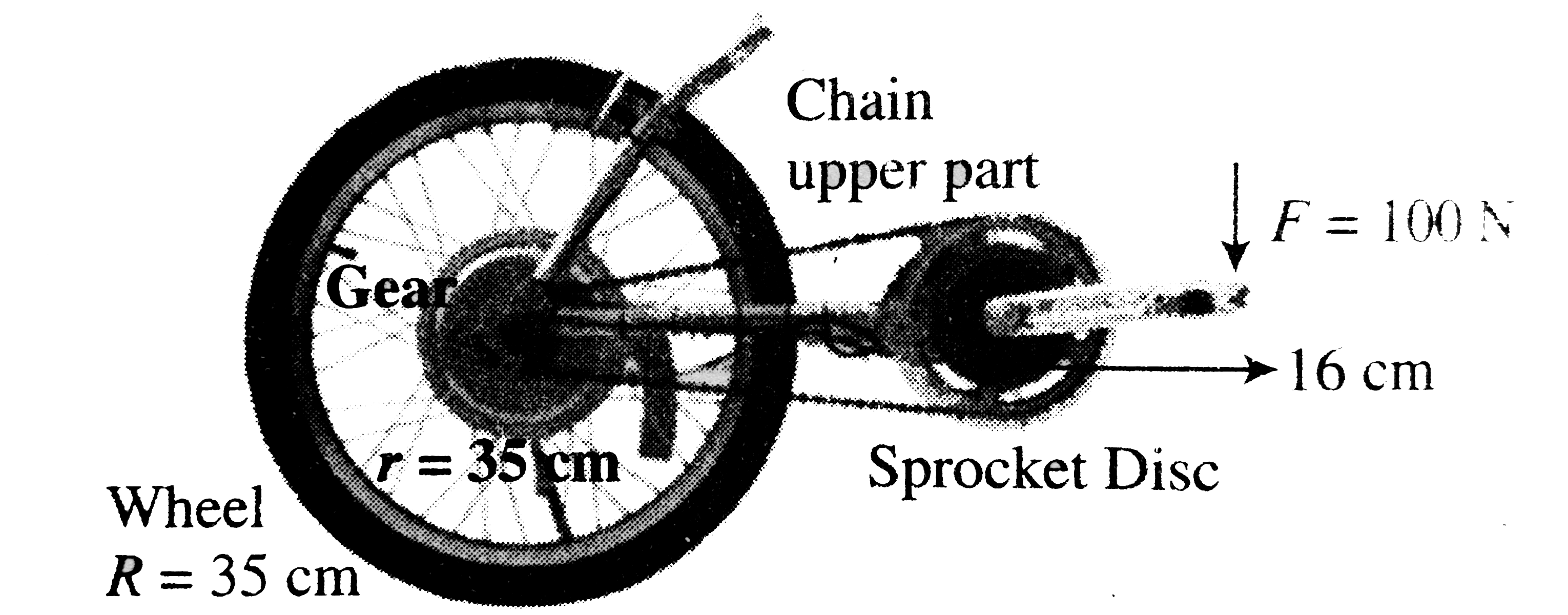
A bicycle has pedal rods of length `16 cm` connected to sprocketed disc of radius `10 cm`. The bicycle wheels are `70 cm` in diameter and the chain runs over a gear of radius `4cm`. The speed of the cycle is constant and the cyclist applies `100 N` for, that is always perpendicular to the pedal rod, as shown in figure. Assume tension in the lower part of chain is negligible. The cyclist is peddling at a constant rate of two revolutions per second. Assume that the force applied by other foot is zero when one foot is exerting `100 N` force. Neglect friction within cycle parts and the rolling friction.

The speed of the bicycle is

A

`6.4pi" m/s"`

B

`3.5pi" m/s"`

C

`2.8pi" m/s"`

D

`5.6pi" m/s"`

Text Solution

Verified by Experts

The correct Answer is:

B
Promotional Banner

Similar Questions

Explore conceptually related problems

A bicycle has pedal rods of length 16 cm connected to sprocketed disc of radius 10 cm . The bicycle wheels are 70 cm in diameter and the chain runs over a gear of radius 4cm . The speed of the cycle is constant and the cyclist applies 100 N for, that is always perpendicular to the pedal rod, as shown in figure. Assume tension in the lower part of chain is negligible. The cyclist is peddling at a constant rate of two revolutions per second. Assume that the force applied by other foot is zero when one foot is exerting 100 N force. Neglect friction within cycle parts and the rolling friction. The power delivered by the cyclist is equal to

A bicycle has pedal rods of length 16 cm connected to sprocketed disc of radius 10 cm . The bicycle wheels are 70 cm in diameter and the chain runs over a gear of radius 4cm . The speed of the cycle is constant and the cyclist applies 100 N for, that is always perpendicular to the pedal rod, as shown in figure. Assume tension in the lower part of chain is negligible. The cyclist is peddling at a constant rate of two revolutions per second. Assume that the force applied by other foot is zero when one foot is exerting 100 N force. Neglect friction within cycle parts and the rolling friction. The tension in the upper portion of the chain is equal to

A bicycle has pedal rods of length 16 cm connected to sprocketed disc of radius 10 cm . The bicycle wheels are 70 cm in diameter and the chain runs over a gear of radius 4cm . The speed of the cycle is constant and the cyclist applies 100 N for, that is always perpendicular to the pedal rod, as shown in figure. Assume tension in the lower part of chain is negligible. The cyclist is peddling at a constant rate of two revolutions per second. Assume that the force applied by other foot is zero when one foot is exerting 100 N force. Neglect friction within cycle parts and the rolling friction. The net force of the friction on the rear wheel due to the road is:

What is the circumference of a circular disc of radius 14 cm?

A circle has radius 4cm. What is the length of its longest chord?

A bicycle wheel, diameter 56 cm, is making 45 revolutions in every 10 seconds. Calculate the speed, in kilometre per hour, of the bicycle.

A circle has diameter 16 cm . What is the radius of the circle ?

A B is a chord of length 16cm of a circle of radius 10cm. The tangents at A and B intersect at a point P . Find the length of P A .

A semicircular disc has a radius of 21 cm. Find its perimeter.

The radius of a wheel of a cycle is 70 cm and it takes 5 minutes to make 3000 rotations . Find the speed of the cycle in km per hour . (Take pi=(22)/(7)) .
