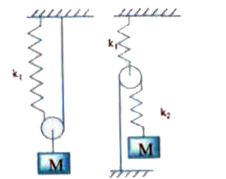
(a) As mass M is in equilibrium , the tension in the string with which it is hanging will be Mg. As pulley is massless the tension in the upper string must be such that the restoring force in the string is equal to the tension in it . Thus we have
`k_1)x=(Mg)/2 "or" x_(1)=(Mg)/(2k_(1))`
(b) Here again mass M is in equilibrium, thus the tension in the string connected to it must be equal to Mg and hence the restoring force in the lower will alxo be Mg . If `x_(1)` be the extension in this spring , we have
`k_(1)x_(1)=Mg "or" x_(1)=(Mg)/k_(1)`
As pulley is light , the tension in upper string must be twice that of teh lower srting , 2Mg which is equal to restoring force in the upper spring . If `x_(2)` is the extension in the upper spring , we have
`k_(2)x_(2)=Mg"or" x_(2) =(2Mg)/k_(2)`
Wherever a body is in equilibium , due to inertia it is maintained in a state of rest. If any of the supporting force a body is removed , body start from rest with some acceleration in the in the direction opposite to the force applied by teh support , as all other forces acting on body will have a resultant in that direction.
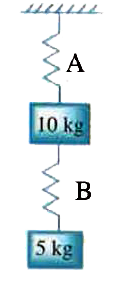
We discuss the situation with an example shown in figure. Two masses 5 kg and 10kg are hanging in equilibrium with the strings A and B. If tensions in the strings A and B are `T_(1)"and " T_(2)` respectively , then we have
`T_(1)=5g =50N , T_(2) =15g = 150N`
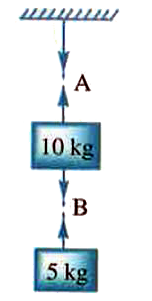
If at some instant we break string B , tension `T_(1)`becomes zero instantane - ously and block will start falling from rest under gravity and 10 kg block , as it is still in equilibrium, `T_(2)` will instantly change to 10 N to balance its weight.
If instead of string B, we break the string A, tension `T_(2)` becomes zero and both the blocks will start falling with acceleration g.
Now `t_(1)` is just an internal force for the system of two blocks and as there is no interaction between the two blocks and both are falling under gravity `T_(1)` will also instantly become zero.
Now to understand the concept in a better way we slightly modify the situation of previous example. Instead of strings, we use springs as shown in figure. Initially the block are in equilibrium . If spring B breads, its tension will instantly become zero as we are using ideal springs (massless`//`inertialess), but due to inertia initially 10 kg mass will not move from its initial position , so tension in upper spring will not change instantly hence it will accelerate in upward direction with acceleration given as
`a=(150-100)/(10)=5 m//s^(2)`
If spring a breaks tension in spring A will instantly become zero , but as due to inertia 5kg and 10kg blocks will start moving from rest . As initally just after breaking of spring A two masses are at rest, tension in spring B will not change at this instant which is `T=5g=50N,
Thus at this instant (just after spring A is cut )
acceleration of 10 kg mass is `a_(1)(10g+kx)/(10)=(100-:50)/(10)=15 m//s^(2)`
and that of 5 kg mass is `a_(2)=(5g-kx)/5=(50-50)/5=0 m // sec^(2)`