Home
Class 11
PHYSICS
All the surfaces shown in figure are ass...

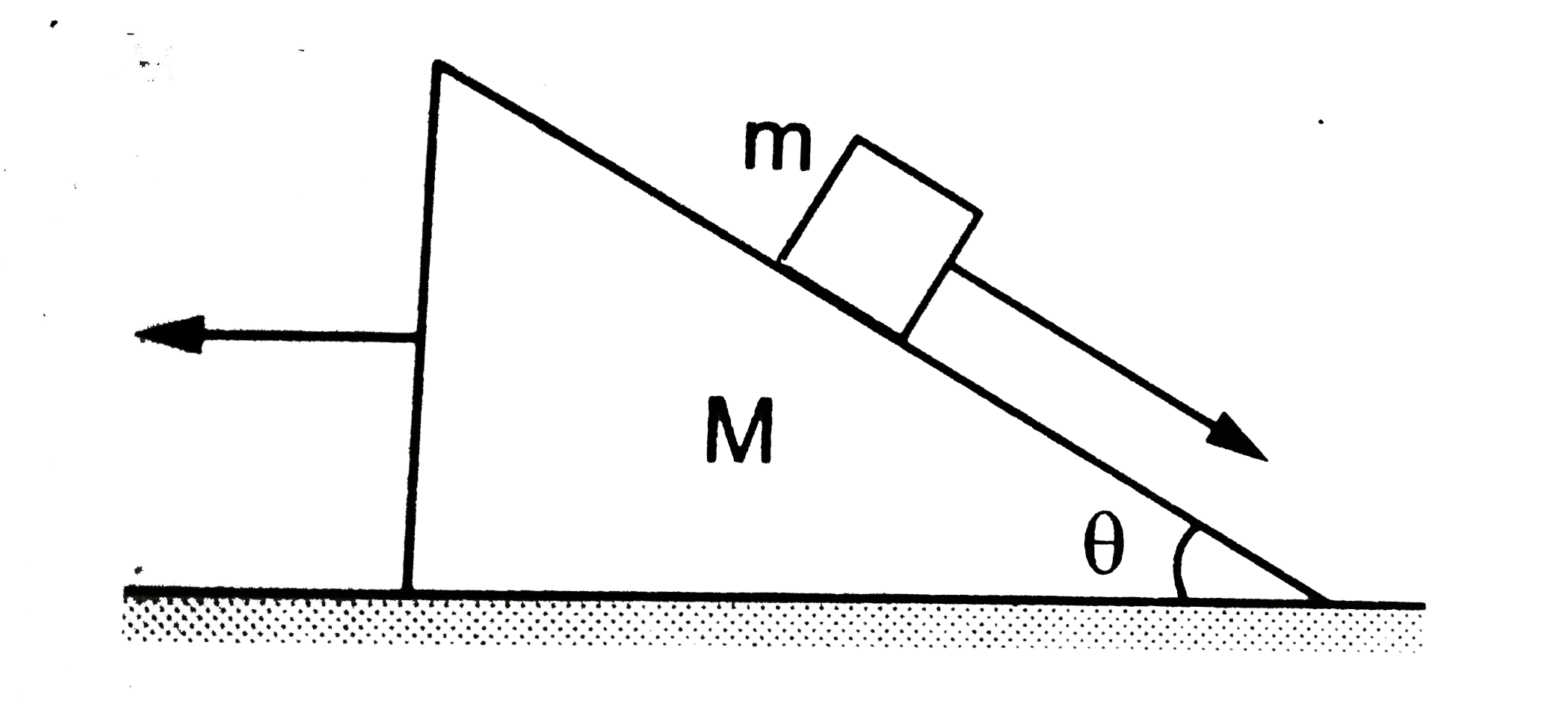
All the surfaces shown in figure are assumed to be frictionless. The block of mass m slides on the prism which in turn slides backward on the horizontal surface. Find the acceleration of the smaller block with respect to the prism.

Text Solution

Verified by Experts
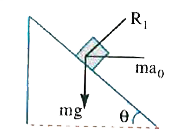
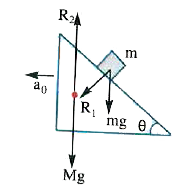
Let `a_(0) ` be the acceleration of prism in the backward direction . The mass .m. is placed on non - inertial frame , therefore it is acted on by fictitious force `ma_(0) ` in the forward direction . The forces acting on mass m are
(i) Weight mg acting downward,
(ii) Normal reaction R,
(iii) Fictitious force `ma_(0) `.
According free body diagram of .m. is shown in figure .
Suppose block m slides down the prism with acceleration a .
The equation of motion of .m. parallel to incline is
`ma_(0) cos theta +mg sin theta ` ....(1)

The block is in equilibrium perpendicular to incline , so resolving force perpendicular to incline
`R_(1)+ma_(0) sin theta =mg cos theta ` ....(2)
Now we consider the forces acting on the prism . As prism is on ground (inertial frame ) no fectitious force acts on it . The forces on prism are
(i) Weight (Mg) downward.
(ii) Normal force `R_(1)` exerted by block
(iii) Normal reaction `R_(2)` exerted by ground .
For horizontal motion of prism
`R_(1) sin theta = MA_(0) rArr R_(1) =(Ma_(0)) /(sin theta) ` ....(3)
substituting this value in (2) ,
`(Ma_(0) )/(sin theta) +ma_(0) sin theta =mg cos theta`
This gives `a_(0)=(mg sin theta cos theta )/(M+m sin^(2) theta)` ....(4)
`:.` From (1) , `a=(mg sin theta cos^(2) theta)/(M+m sin ^(2) theta )+g sin theta`
`=((M+m)gsin theta)/(M+m sin^(2) theta)`
Promotional Banner

Similar Questions

Explore conceptually related problems

A force of 50N acts in the direction as shown in figure. The block of mass 5kg, resting on a smooth horizontal surface. Find out the acceleration of the block.

A force of 50N acts in the direction as shown in figure. The block of mass 5kg, resting on a smooth horizontal surface. Find out the acceleration of the block.

Assuming all the surface to be frictionless. The smaller block m is moving horizontally with acceleration a and vertically downwards with acceleration a. Then magnitude of net acceleration of smaller block m with respect to ground

Assuming all the surfaces to be frictionless accelration of the block c shown in the figure is

A block of mass m rests on a stationary wedge of mass M. The wedge can slide freely on a smooth horizontal surface as shown in figure. If the block starts from rest

A block of mass M is pulled along a horizontal frictionless surface by a rope of mass m as shown in A horizontal force F is applied to one end of the rope. Find (a) the acceleration of the rope and block (b) the force that the rope exerts on the block (c) the tension in the rope at its mid point

A block of mass 2kg slides down the face of a smooth 45^@ wedge of mass 9 kg as shown in the figure. The wedge is placed on a frictionless horizontal surface. Determine the acceleration of the wedge.

A block of mass m slides down along the surface of the bowl from the rim to the bottom as shown in fig. The velocity of the block at the bottom will be-

A block of mass 20 kg is set into motion on a frictionless horizontal surface with the help of massless smooth pulley and rope as shown in the figure. Find the acceleration of the pulley