Home
Class 11
PHYSICS
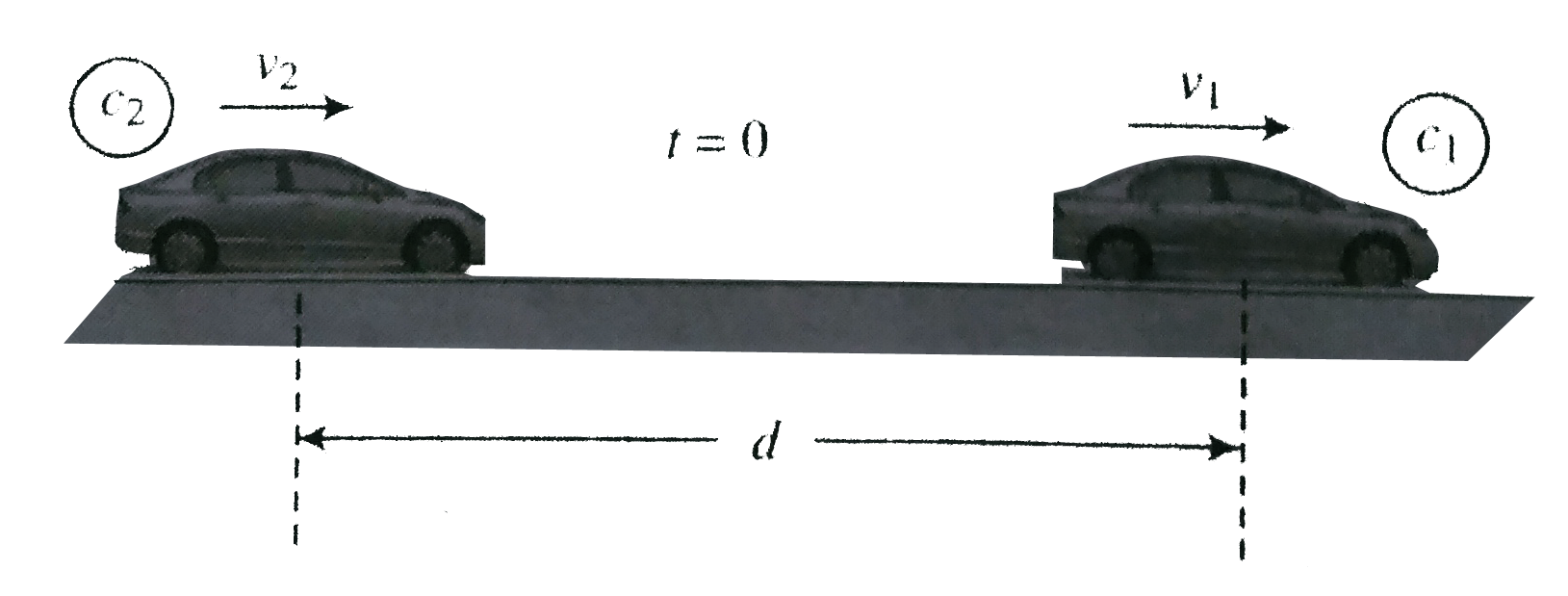
Two cars C(1) and C(2) moving in the sam...

Two cars `C_(1)` and `C_(2)` moving in the same direction on a straight single lane road with velocities `v_(1)=12 m s^(-1)` and `v_(2) =10 m s^(-1)`, respectively . When the separation between the two was `d=200 m`, `C_(2)` started accelerating to avoid collision. What is the minimum acceleration of car `C_(2)` so that they do not collide?
.

Text Solution

Verified by Experts

By relative
`veca_(C_(1)C_(2))=veca_(C_(1)-veca_(C_(2))=0-a=(-a)`
`vecV_(C_(1)C_(2))=vecV_(C_(1))-vecV_(C(2))=12-10=2m//s`
So by relativity we want the car to stop.
`:. V^(2)-u^(2)=2as`.
` rArr 0-2^(2)=-2xxaxx200`
`rArra=1/(100)m//s^(2)=0.1m//s^(2)=1cm//s^(2)`.
`:."Minimum acceleration needed by car"C_(2)=1 cm//s^(2)`.
Promotional Banner

Similar Questions

Explore conceptually related problems

Two bodies starts moving from same point along straight line with velocities v_(1) = 6 m//s " and " v_(2) = 10 m//s simultaneously. After what time the separation becomes 40 m ?

Two equal masses m_1 and m_2 moving along the same straight line with velocites +3 m//s and - 5 m//s respectively collide elastically. Their velocities after the collision will be respectively.

Two equal masses m_1 and m_2 moving along the same straight line with velocites +3 m//s and - 5 m//s respectively collide elastically. Their velocities after the collision will be respectively.

If acceleration of A is 2m//s^(2) to left and acceleration of B is 1m//s^(2) to left, then acceleration of C is-

A particle moving with uniform acceleration from A to B along a straight line has velcities v_(1) and v_(2) at A and B respectively. If C is the mid-point between A and B then determine the velocity of the particle at C . .

Two blocks of masses m_(1) = 2 kg and m_(2) = 5 kg are moving in the same direction along a frictionless surface with speeds 10 m//s and 3 m//s , respectively, m_(2) being ahead of m_(1) . An ideal spring with k = 1120 N//m is attached to the back side of m_(2) . Find the maximum compression of the spring when the blocks collide. What are the final velocities of the blocks when they separate?

Two cars of same mass are moving with velocities v_(1) and v_(2) respectively. If they are stopped by supplying same breaking power in time t_(1) and t_(2) respectively then (v_(1))/(v_(2)) is

A car moving with constant acceleration crosses two points A and B with velocities 10 m/s and 20 m/s in its path. Find the velocity of the car midway between A and B. (in m/s).

Two particles of masses m and 2m moving in opposite directions collide elastically with velocity 2v and v , respectiely. Find their velocities after collision.

Car A has an acceleration of 2m//s^2 due east and car B, 4 m//s^2. due north. What is the acceleration of car B with respect to car A?

