Home
Class 11
PHYSICS
A body moving in a curved path possesses...

A body moving in a curved path possesses a velocity 3 m/s towards north at any instant of its motion .After 10s ,the velocity of the body was found to be 4 m/s towards west.Calculate the average acceleration during this interval.

Text Solution

Verified by Experts
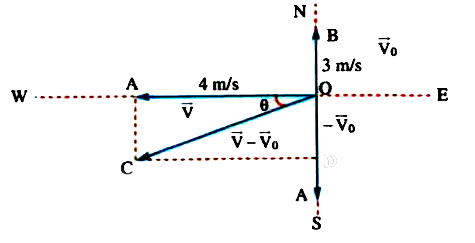
To solve this problem the vector nature of velocity must be taken into account.
In the figure, the initial velocity`v_(0)`and the final velocity v arfe drawn from a common origin . The vecto difference of them is found by the parallelogram method.
The magnitude of difference is
`|v-v_(0)|=OC=sqrt(OA^(2)+AC^(2))`
`=sqrt(4^(2)+3^(2))=5m//s`
The direction is given by
`tan theta =3/4=0.75, theta =37^(0)`
Average acceleration `=|vecv-vecv_(0)|/t=5/(10)=0.5m//s^(2)`at`37^(@)`south of west
Promotional Banner

Similar Questions

Explore conceptually related problems

A particle is moving eastwards with velocity of 5 m//s . In 10 sec the velocity changes to 5 m//s northwards. The average acceleration in this time is.

A particle is moing with a velocity of 10m//s towards east. After 10s its velocity changes to 10m//s towards north. Its average acceleration is:-

A body is moving with velocity 30 m//s towards east. After 10 s its velocity becomes 40 m//s towards north. The average acceleration of the body is.

A body is moving with velocity 30 m//s towards east. After 10 s its velocity becomes 40 m//s towards north. The average acceleration of the body is.

The velocity-time graph of an object is given below. Calculate the average acceleration of the object in the time interval of 4 s to 6 s.

A boy standing at the top of a tower of 20 m . Height drops a stone. Assuming g = 10 ms^-2 towards north. The average acceleration of the body is.

A body moves from rest with a uniform acceleration and travels 270 m in 3 s. Find the velocity of the body at 10 s after the start.

A particle is moving eastwards with a speed of 6 m/s. After 6 s, the particle is found to be moving with same speed in a direction 60^(@) north of east. The magnitude of average acceleration in this interval of time is

Fig. 2.38 shows the displacement of a body at different times. (a) Calculate the velocity of the body as it moves for time interval (i) 0 to 5 s, (ii) 5 s to 7 S and (iii) 7 s to 9 s. (b) Calculate the average velocity during the time interval 5 s to 9 s. [Hint : From 5 s to 9 s, displacement = 7 m - 3 m = 4 m ]

A body of mass m_(1) moving with a velocity 3 m//s collides with another body at rest of m_(2) . After collision the velocities of the two bodies are 2 m//s and 5 m//s , respectively , along the direction of motion of m_(1) . The ratio m_(1)//m_(2) is

