Home
Class 11
PHYSICS
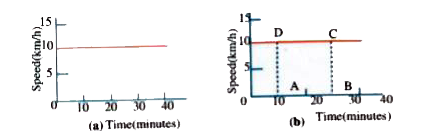
Figure a represents the speed-time graph...

Figure a represents the speed-time graph for a particle .Find the distance covered by the particle betweent=10 min and t= 30 min .

Text Solution

Verified by Experts

We draw perpendicular lines from the 10-minute point and the 30-minute point to the time -axis (Figure b). The distance covered is equal to area of the rectangle ABCD. It s value is
`AB.AD =(30min-10min)xx(10km//h)`
=`20minxx10km//h`
`h=(20)/(60)hxx10km//h`
`=(10)/3km`
Promotional Banner

Similar Questions

Explore conceptually related problems

Figure shows the speed versus time graph for a particle. Find the distance travelled by the particle during the time t=0 to t=3s.

Speed time graph of a particle shown in figure. Find distance travelled by particle in 5 second .

The diagram shows the displacement - time graph for a particle moving in a straight line. The distance (in m) coverted by the particle in the time interval t=0 to t=5s is

The speed verses time graph for a particle is shown in the figure. The distance travelled (in m) by the particle during the time interval t = 0 to t = 5 s will be __________

velocity time graph of a particle is shown in figure. Find displacement of the particle.

A graph between the square of the velocity of a particle and the distance s moved by the particle is shown in the figure. The acceleration of the particle is

The speed - time graph of a particle moving along a solid curve is shown below. The distance traversed by the particle from t = 0 to t = 3 is

The speed-time graph of a particle moving along a fixed direction is shown in the Fig. 2 (CF) . 15. The distance traversed by the particle between t= 2 s and 6 s is . .

Figure shows x-t graph of a particle. Find the Time T such that the average velocity of the particle during the period 0 to T is Zero.

A particle is constrained to move on a straight line path. It returns to the starting point after 10 sec . The total distance covered by the particle during this time is 30 m . Which of the following statements about the motion of the particle is false
