Home
Class 11
PHYSICS
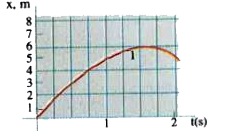
Find the average velocity for the time i...

Find the average velocity for the time intervals `Deltat=t_(2)-0.75` when `t_(2)` is 1.75 ,1.25 and 1.0 s. What is the instantaneous velocity at t=0.75 s?

Text Solution

Verified by Experts

The correct Answer is:

About `2ms^(-1); 2.7ms^(-1);3.2 ms^(-1); 4.0ms^(-1)` from slope at `0.75 s`
Promotional Banner

Similar Questions

Explore conceptually related problems

A angular positio of a point on the rim of a rotating wheel is given by theta=4t-3t^(2)+t^(3) where theta is in radiuans and t is in seconds. What are the angualr velocities at (a). t=2.0 and (b). t=4.0s (c). What is the average angular acceleration for the time interval that begins at t=2.0s and ends at t=4.0s ? (d). What are the instantaneous angular acceleration at the biginning and the end of this time interval?

The position of a particle varies with time according to the relation x=3t^(2)+5t^(3)+7t , where x is in m and t is in s. Find (i) Displacement during time interval t = 1 s to t = 3 s. (ii) Average velocity during time interval 0 - 5 s. (iii) Instantaneous velocity at t = 0 and t = 5 s. (iv) Average acceleration during time interval 0 - 5 s. (v) Acceleration at t = 0 and t = 5 s.

A point moves with uniform acceleration and v_(1), v_(2) , and v_(3) denote the average velocities in the three successive intervals of time t_(1).t_(2) , and t_(3) Which of the following Relations is correct?.

A particle executes simple harmonic motion about x=0 along x-axis. The position of the particle at an instant is given by x= ( 5 cm) sin pi t . Find the average velocity and average acceleration for a time interval 0-0.5 s . Hint : Average velocity =( x_(2)- x_(1))/(t_(2)-t_(1)) x_(1) = 5 sin 0 x_(2) = 5 sin ( pi xx 0.5) t_(2) - t_(1) = 0.5 Average acceleration = ( v_(2) - v_(1))/( t_(2) - t_(1)) v=(dx)/(dt) = 5 pi cos pit implies a _(av) = ( 5 pi cos ( pi xx 0.5) -5 pi cos theta)/(0.5)

Assertion : In v-t graph shown in figure, average velocity in time interval from 0 to t_0 depends only on v_0. It is independent of t_0. Reason : In the given time interval average velocity is v_0 /2.

A particle is describing uniform circular motion in the anti-clockwise sense such that its time period of revolution is T. At t = 0 the particle is observed to be at A. If theta_1 be the angle between acceleration vector at t=T/4 and average velocity vector in the time interval 0 to T/4 and theta_2 be the angle between acceleration vector at t= T/4 and the vector representing change in velocity in the time interval 0 to T/4, then :

The distance travelled by a particle in time t is given by s=(2.5m/s^2)t^2 . Find a. the average speed of the particle during the time 0 to 5.0 s, and b. the instantaneous speed ast t=5.0 is

Acceleration of a particle is given by a= 3t^(2)+2t +1 Where t is time . Find (i) its velocity at time t assuming velocity to be 10 m/s at t = 0. (ii) its position at time t assuming that the particle is at origin at t = 0. (iii) What is the average speed of the particle in the duration t = 0 to t = 1s? (iv) What is the average acceleration of the particle in the duration t = 0 to t = 1s?

Assertion : In the upsilon-t diagram as shown in figure, average velocity between the interval t = 0 and t = t_(0) is independent of t_(0) Reason : Average velocity in the given interval is (1)/(2)upsilon_(m) .

The displacement s of an object is given as a function of time t s=5t^(2)+9t Calculate the instantaneous velocity of object at t = 0.
