Home
Class 11
PHYSICS
Two stones are thrown up simultaneously ...

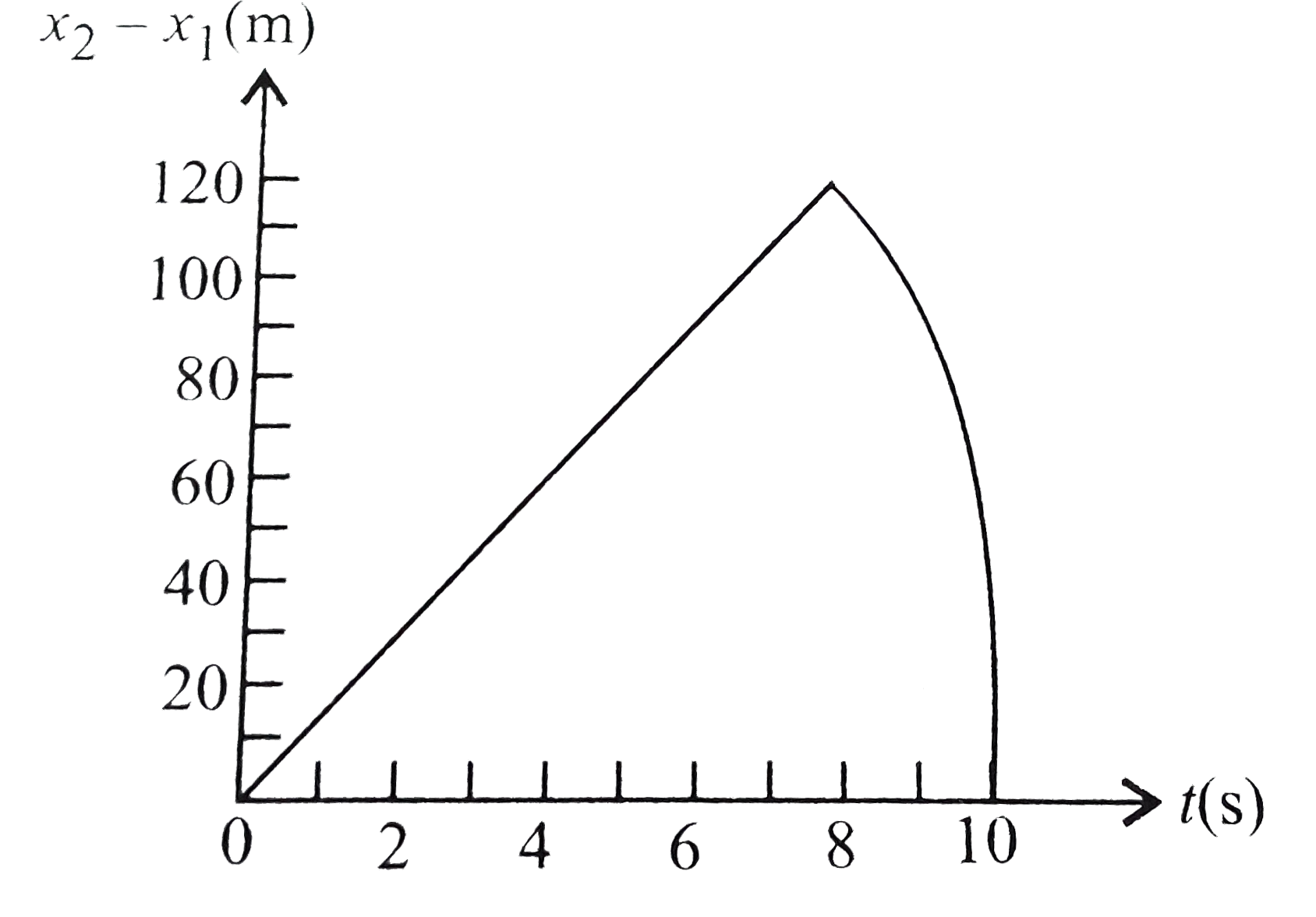
Two stones are thrown up simultaneously from the edge of a cliff 200 m high with initial speeds of `15 m s^(-1)` and `30 m s^(-1)` respectively. The time variation of the relative position of the second stone with respect to the first is shown in the figure. The equation of the linear part is

Text Solution

Verified by Experts

The correct Answer is:

Graph is correct
Promotional Banner

Similar Questions

Explore conceptually related problems

Two stones are through up simultaneously from the edge of a cliff 240 m high with initial speed of 10 m/s and 40 m/s respectively. Which of the following graphs best represents the time variation of relative position of the second stone with respect to the first? Assume stones do not rebound after hitting the ground and neglect air resistance, take . g= 10 m//s^(2) (The figures are schematic and not drawn to scale)

Two stones are thrown up simultaneously from the edge of a cliff with initial speed v and 2 v . The relative position of the second stone with respect to first varies with time till both the stones strike the ground as.

Two particles are thrown simultaneously from points A and B with velocities u_1 = 2ms^(-1) and u_2 - 14 ms^(-1) , respectively, as shown in figure. The relative velocity of B as seen from A in

Two stones are thrown from the same point with velocity of 5 ms^(-1) one vertically upwards and the other vertically downwards. When the first stone is at the highest point the relative velocity of the second stone with respect to the first stone is,

Two stones are projected from the top of a tower in opposite directions, with the same velocity V but at 30^(@) & 60^(@) with horizontal respectively. The relative velocity of first stone relative to second stone is

A stone is thrown upwards and it rises to a height 0f 200m. The relative velocity of the stone with respect to the earth will be maximum at :-

From the top of a 490 m high cliff, a boy throws a stone horizontally with a initial speed of 15 ms^(-1) . What is the time taken by the stone to reach the ground.

Two stones are thrown vertically upwards simultaneously from the same point on the ground with initial speed u_(1) = 30 m//sec and u_(2) = 50 m//sec . Which of the curve represent correct variation (for the time interval in which both reach the ground) of (x_(2) - x_(1)) = the relative position of second stone with respect to first with time (t) (v_(2) - v_(1)) = the relative velocity of second stone with respect to first with time (t). Assuming that stones do not rebound after hitting.

Two particles are projected with speed 4m//s and 3m//s simultaneously from same point as shown in the figure. Then:

One stone is projected horizontally from a 20 m high cliff with an initial speed of 10 ms^(-1) . A second stone is simultaneously dropped from that cliff. Which of the following is true?
