Home
Class 12
PHYSICS
It is found that electromagnetic signals...

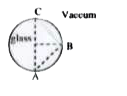
It is found that electromagnetic signals sent inside glass sphere from A towards B reach point C. the speed of electromagnetic signals in glass cannot be:

A

`1.0 xx 10^8 m//s `

B

`2.4 xx 10^8 m//s `

C

`2 xx 10^7 m//s `

D

`4 xx 10^7 m//s `

Text Solution

Verified by Experts

The correct Answer is:

B
Promotional Banner

Topper's Solved these Questions

  • GEOMETRICAL OPTICS

    AAKASH SERIES|Exercise LECTURE SHEET (EXERCISE-II (LEVEL-II (ADVANCED) LINKED COMPREHENSION TYPE QUESTIONS))|8 Videos
  • GEOMETRICAL OPTICS

    AAKASH SERIES|Exercise LECTURE SHEET (EXERCISE-II (LEVEL-II (ADVANCED) MATRIX MATCHING TYPE QUESTIONS))|1 Videos
  • GEOMETRICAL OPTICS

    AAKASH SERIES|Exercise LECTURE SHEET (EXERCISE-II (LEVEL-I (MAIN) STRAIGHT OBJECTIVE TYPE QUESTIONS))|17 Videos
  • ELEMENTS OF VECTORS

    AAKASH SERIES|Exercise QUESTIONS FOR DESCRIPTIVE ANSWERS|10 Videos
  • LAWS OF MOTION

    AAKASH SERIES|Exercise PRACTICE EXERCISE|106 Videos

Similar Questions

Explore conceptually related problems

It is found that all electromagnetic signals sent from A towards B reach point C inside the glass sphere, as shown in figure. The speed of electromagnetic signals in glass cannot be:

A laser signal sent towards the moon returns after t seconds. If c is the speed of light then the distance of the moon from the observer is

A metal sphere is suspended from a nylon thread. Initially, the metal sphere is uncharged. When a positively charged glass rod is brought close to the metal sphere, the sphere is drawn towards the rod. But if the sphere touches the rod, it suddenly flies away from the rod. Explain, why the sphere is first attracted then repelled?

A 1-L flask contains some mercury. It is found that at different temperature, the volume of air inside the flask remains the same. What is the volume of mercury in the flask, given that the coefficient of linear expansion of glass =9xx10^(-6)//^(@)C and the coefficient of volume expansion of Hg=1.8xx10^(-4)//^(@)C ?

A 1-L flask contains some mercury. It is found that at different temperature, the volume of air inside the flask remains the same. What is the volume of mercury in the flask, given that the coefficient of linear expansion of glass =9xx10^(-6)//^(@)C and the coefficient of volume expansion of Hg=1.8xx10^(-4)//^(@)C ?

Velocity of the boat with respect to river is 10 m/s. From point A it is steered in the direction shown to reach point C. Find the time of the trip and distance between B and C

The diagram below shows two parallel rays A and B of red and violet light respectively incident from air on air-glass boundary. Complete the diagram showing the refracted rays for them in the glass. (i) How do the speeds of the rays differ in glass ? (ii) are the two refracted rays in glass parallel ? Give a reason for your answer. (iii) How does the refractive index of glass differ for the two rays ?

A uniform solid of valume mass density rho and radius R is shown in figure. (a) Find the gravitational field at a point P inside the sphere at a distance r from the centre of the sphere. Represent the gravitational field vector vec(l) in terms of radius vector vec(r ) of point P. (b) Now a spherical cavity is made inside the solid sphere in such a way that the point P comes inside the cavity. The centre is at a distance a from the centre of solid sphere and point P is a distance of b from the centre of the cavity. Find the gravitational field vec(E ) at point P in vector formulationand interpret the result.

A spherical surface of radius of curvature R separates air (refractive index 1.0) from glass (refractive index 1.5). The center of curvature is in the glass. A point object P placed in air is found to have a real image Q in the glass. The ling PQ cuts the surface at a point O, and PO=OQ . The distance PO is equal to

A point source of electromagnetic radiation has average power output of 800 watt, then find (a) Maximum value of electric field at a distance 3.5 m from the source (b) Maximum value of magnetic field (c) Average energy density at 3.5 m from the source.

AAKASH SERIES-GEOMETRICAL OPTICS-LECTURE SHEET (EXERCISE-II (LEVEL-II (ADVANCED) STRAIGHT OBJECTIVE TYPE QUESTIONS))
  1. A cubic container is filled with a liquid whose refractive index incre...

    Text Solution

    |

  2. Four similar prisms of angle of prism are arranged. Which of the follo...

    Text Solution

    |

  3. A light ray is incident upon a prism in minimum deviation position and...

    Text Solution

    |

  4. A ray of light strikes a plane mirror at an angle of incidence 45^@ as...

    Text Solution

    |

  5. The xz plane separates two media A and B with refractive indices mu(1)...

    Text Solution

    |

  6. A microscope is focussed on a point object, and then its objective is ...

    Text Solution

    |

  7. It is found that electromagnetic signals sent inside glass sphere from...

    Text Solution

    |

  8. A light ray is incident on a transparent slab of refractive index mu=s...

    Text Solution

    |

  9. The time required for the light to go from A to B, when a ray of lilgh...

    Text Solution

    |

  10. The apparent depth of water in cylindrical water tank of diameter 2R c...

    Text Solution

    |

  11. A ray of light travels from a medium of refractive index mu to air. It...

    Text Solution

    |

  12. A man of height 1.47 m stands on a straight road on a hot day. The ver...

    Text Solution

    |

  13. A glass slab of thickness 3 cm and refractive index 3/2 is placed on i...

    Text Solution

    |

  14. Solar rays are incident at 45^(@) on the surface of water (mu=4//3). T...

    Text Solution

    |

  15. A ray of light is incident normally on one face of 30^(@) - 60^(@) - 9...

    Text Solution

    |

  16. Light is incident from a medium A to medium B. The graph of sine of an...

    Text Solution

    |

  17. The angle of deviation (delta) vs angle of ancidence (i) is plotted fo...

    Text Solution

    |

  18. For maximum deviation D("max").

    Text Solution

    |

  19. A ray of monochromatic light is incident on the plane surface of separ...

    Text Solution

    |

  20. n number of identical equilateral prisms are kept in contact as shown ...

    Text Solution

    |
