Home
Class 12
PHYSICS
A point object O is placed at a distance...

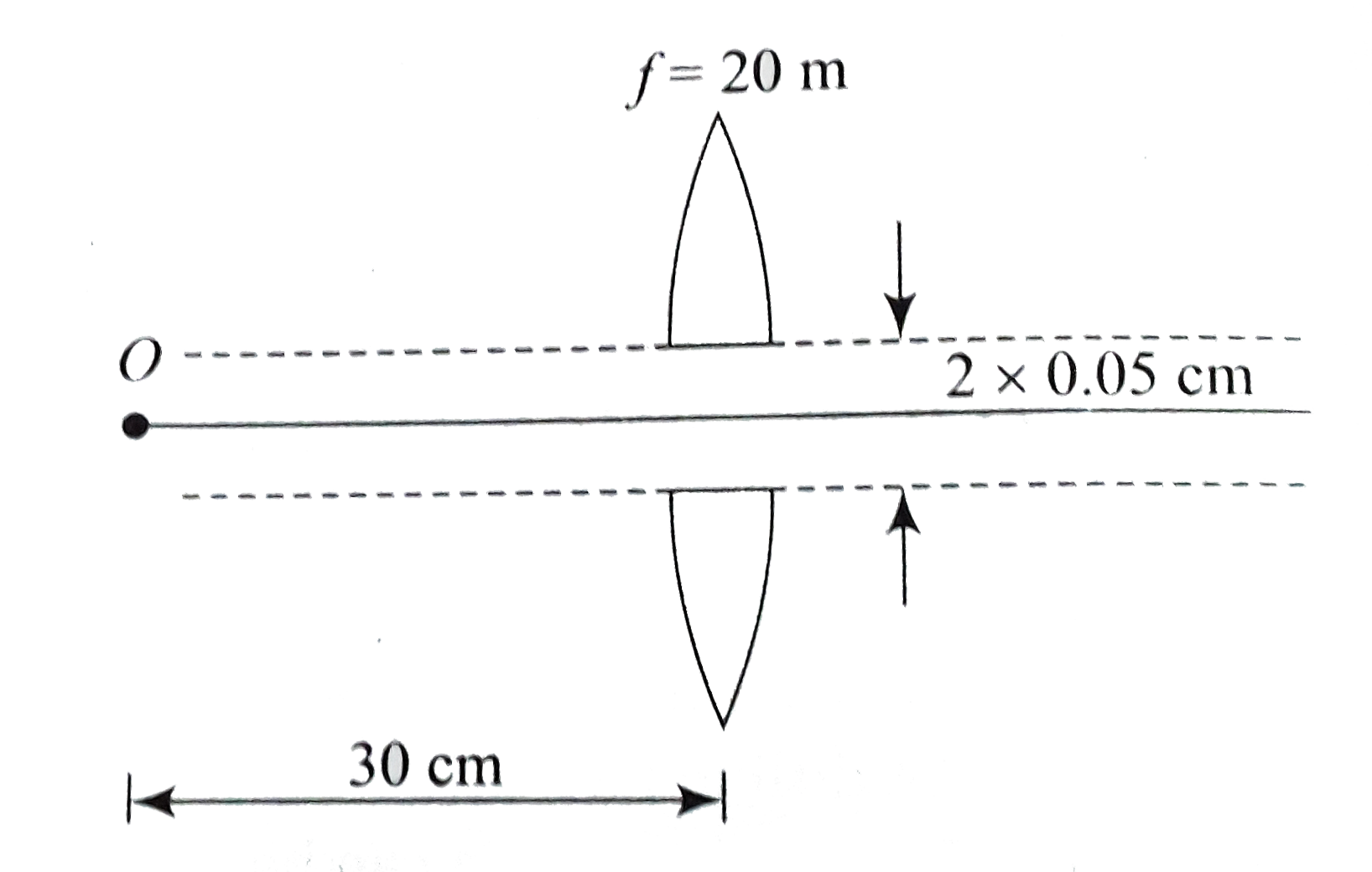
A point object O is placed at a distance of 0.3m from a convex lens (focal length 0.2m) cut into two halves each of which is displaced by 0.0005 m as shown in figure

Q. If this arrangement will generate more than one image, then what will be the total number of image?

A

30 cm, 2 images, 0.5 cm

B

40 cm, 2 images, 0.3 cm

C

50 cm, 2 images, 0.4 cm

D

60 cm, 2 images, 0.3 cm

Text Solution

Verified by Experts

The correct Answer is:

D
Promotional Banner

Topper's Solved these Questions

  • GEOMETRICAL OPTICS

    AAKASH SERIES|Exercise ADDITIONAL PRACTICE EXERCISE (LEVEL-II LECTURE SHEET(ADVANCED) MORE THAN ONE CORRECT ANSWER TYPE QUESTIONS)|3 Videos
  • GEOMETRICAL OPTICS

    AAKASH SERIES|Exercise ADDITIONAL PRACTICE EXERCISE (LEVEL-II LECTURE SHEET(ADVANCED) LINKED COMPREHENSION TYPE QUESTIONS)|8 Videos
  • GEOMETRICAL OPTICS

    AAKASH SERIES|Exercise ADDITIONAL PRACTICE EXERCISE (LEVEL-I (MAIN) STRAIGHT OBJECTIVE TYPE QUESTIONS)|22 Videos
  • ELEMENTS OF VECTORS

    AAKASH SERIES|Exercise QUESTIONS FOR DESCRIPTIVE ANSWERS|10 Videos
  • LAWS OF MOTION

    AAKASH SERIES|Exercise PRACTICE EXERCISE|106 Videos

Similar Questions

Explore conceptually related problems

A point object O is placed at a distance of 0.3 m from a convex lens of focal length 0.2 m. It is then cut into two halves each of which is displaced by 0.0005 m as shown in figure. image will be formed from the lens at a distance of

A point object is placed at a distance of 0.3 m from a convex lens (focal length 0.2 m) cut into two halves each of which is displaced by 0.0005 m as shown in the figure. Find the position of the image . If more than one image is formed find their number and the distance between them.

A point object is placed at a distance of 0.3 m from a convex lens (focal length 0.2 m) cut into two halves each of which is displaced by 0.0005 m as shown in the figure. Find the position of the image . If more than one image is formed find their number and the distance between them.

A point object is placed at a distance of 0.3 m from a convex lens (focal length 0.2 m) cut into two halves each of which is displaced by 0.0005 m as shown in the figure. Find the position of the image . If more than one image is formed find their number and the distance between them.

An object is placed at a distance of f/2 from a convex lens of focal length f. The image will be

A point object O is placed at a distance of 20 cm from a convex lens of focal length 10 cm as shown in the figure. At what distance x from the lens should a convex mirror of focal length 60 cm, be placed so that final image coincide with the object?

A point object O is placed at a distance of 20 cm from a convex lens of focal length 10 cm as shown in figure. At what distance x from the lens should a concave mirror of focal length 60 cm, placed so that final image coincides with the object ?

A point object O is placed at a distance of 20 cm is front of a equiconvex lens (.^(a)mu_(g) = 1.5) of focal length 10 cm. The lens is placed on a liquid of refractive index 2 as shown in figure. Image will be formed at a distance h from lens the value of h is

A point like object is placed at a distance of 1 m in front of a convex lens of focal length 0.5 m . A plane mirror is placed at a distance of 2 m behind the lens. The position and nature of the final image formed by the system is :

An object is at a distance of 20 m form a convex lens of focal length 0.3m The lens forms an image of the object moves away form the lens at a speed of 5m//s the speed and direction of the image will be :

AAKASH SERIES-GEOMETRICAL OPTICS-ADDITIONAL PRACTICE EXERCISE (LEVEL-II LECTURE SHEET(ADVANCED) STRAIGHT OBJECTIVE TYPE QUESTIONS)
  1. A light ray is incident at an angle of incedence (pi//4). The graph of...

    Text Solution

    |

  2. Light is incident from glass (mu = 1.50) to water (mu = 1.33) find th...

    Text Solution

    |

  3. A ray of light is incident at an angle of 75^(@) into a medium having ...

    Text Solution

    |

  4. A beam of parallel rays of width b cm propagates in glass at an angle ...

    Text Solution

    |

  5. A small object of height 0.5 cm is placed in front of a convex surface...

    Text Solution

    |

  6. A ball is kept at a height h above the surface of a heavy transparent ...

    Text Solution

    |

  7. A ring of radius 1cm is placed 1m in front of a spherical glass ball...

    Text Solution

    |

  8. The radii of curvature of two spherical surfaces of a concave convex l...

    Text Solution

    |

  9. A light ray travelling parallel to the principal axis of a convex lens...

    Text Solution

    |

  10. Twot thin lenses when placed in contact, then the power of combination...

    Text Solution

    |

  11. A convex lens is placed some where between an object and a screen whic...

    Text Solution

    |

  12. A point object moves along the principal axis of a convex lens of foca...

    Text Solution

    |

  13. A thin plano-convex lens of focal length f is split into two halves. O...

    Text Solution

    |

  14. A converging lens L(1) of focal length 20 cm is separated by 8 cm from...

    Text Solution

    |

  15. A point object is placed at a distance of 20 cm from a thin plano-conc...

    Text Solution

    |

  16. Figure shows an arrangement ofan equiconvex lens (f=20 cm in air) and ...

    Text Solution

    |

  17. A point object O is placed at a distance of 0.3m from a convex lens (f...

    Text Solution

    |

  18. A small object stuck on the surface of a glass sphere (n=1.5) is viewe...

    Text Solution

    |

  19. A plano-convex lens has thickness 4cm. When places on a horizontal tab...

    Text Solution

    |

  20. In the given diagram find the position where the equivalent lens can b...

    Text Solution

    |
