Home
Class 12
PHYSICS
A convex lens of focal length 20cm and a...

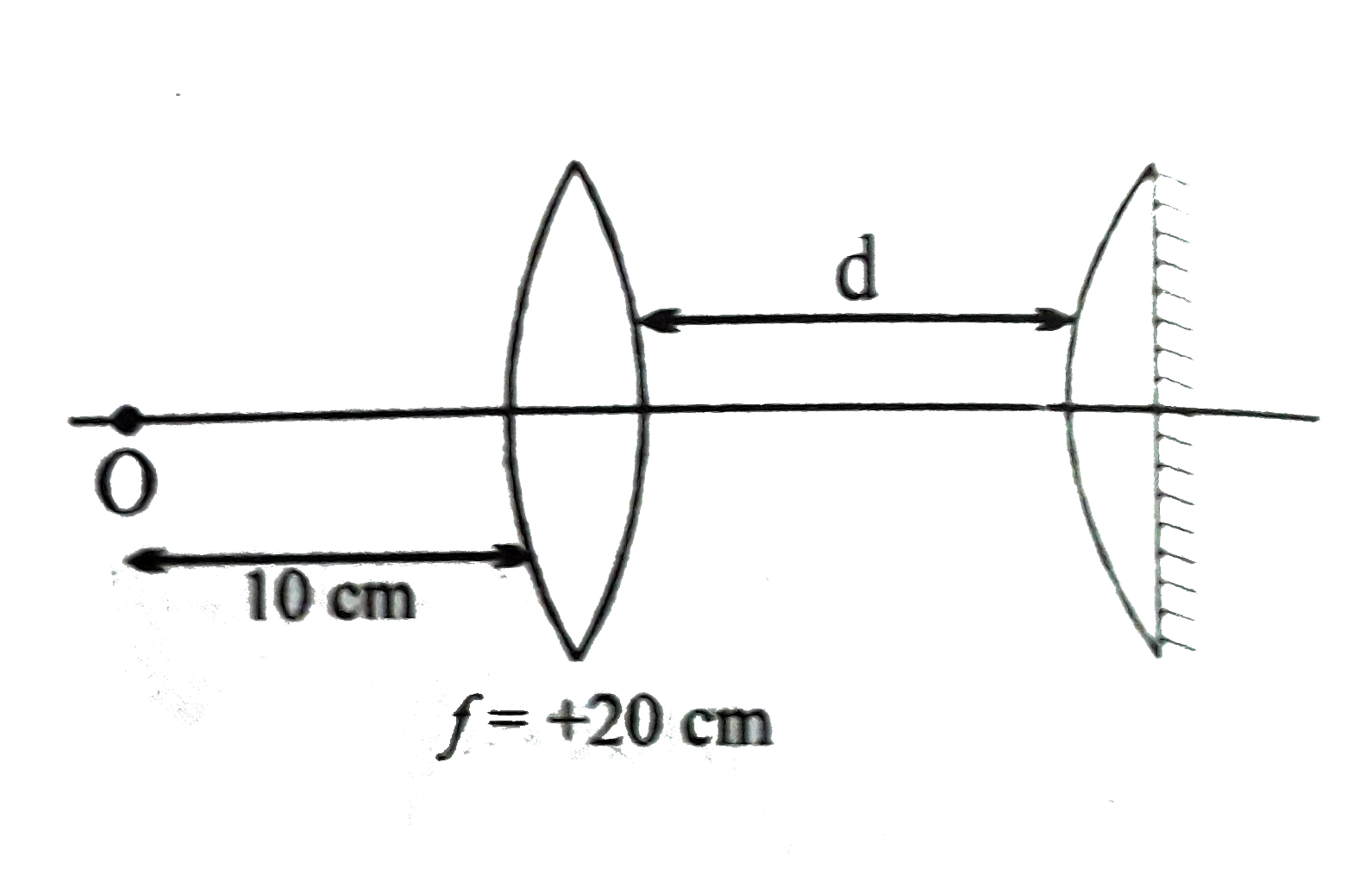
A convex lens of focal length 20cm and another plano convex lens of focal length 40cm are placed co-axially . The plano convex lens is silvered on plane surface. What should be the distance (in cm) so that final image of the object 'O' is formed on O itself.

A

10

B

15

C

20

D

25

Text Solution

Verified by Experts

The correct Answer is:

C
Promotional Banner

Topper's Solved these Questions

  • GEOMETRICAL OPTICS

    AAKASH SERIES|Exercise ADDITIONAL PRACTICE EXERCISE (LEVEL-II PRACTICE SHEET (ADVANCED) MORE THAN ONE CORRECT ANSWER TYPE QUESTIONS)|4 Videos
  • GEOMETRICAL OPTICS

    AAKASH SERIES|Exercise ADDITIONAL PRACTICE EXERCISE (LEVEL-II PRACTICE SHEET (ADVANCED) LINKED COMPREHENSION TYPE QUESTIONS)|7 Videos
  • GEOMETRICAL OPTICS

    AAKASH SERIES|Exercise ADDITIONAL PRACTICE EXERCISE (LEVEL-II LECTURE SHEET(ADVANCED) INTEGER TYPE QUESTIONS)|4 Videos
  • ELEMENTS OF VECTORS

    AAKASH SERIES|Exercise QUESTIONS FOR DESCRIPTIVE ANSWERS|10 Videos
  • LAWS OF MOTION

    AAKASH SERIES|Exercise PRACTICE EXERCISE|106 Videos

Similar Questions

Explore conceptually related problems

A convex lens of focal length 40 cm is in contact with a concave lens of focal length 25 cm. The power of the combination is

A convex lens of focal length 20 cm and a concave lens of focal length 10 cm are placed 20 cm apart. In between them an object placed at distance x from the convex lens. What is the value of x (in cm ) so that images from by both the lenses coincides ?

A diverging lens of focal length 20 cm and a converging mirror of focal length 10 cm are placed coaxially at a separation of 5 cm. Where should an object be placed so that a real image is formed at the object itself ?

A convex lens of focal length 20 cm and a convex mirror of focal length 10 cm are placed co-axially 50 cm apart from each other. An incident beam parallel to its principal axis is incideent on the convex lens. Locate the position of final image formed due to the combination.

Two plano-convex lenses of focal lengths 20cm and 30cm are placed together to form a double convex lens. The final focal length will be

A convex lens of focal length 20cm is placed 10cm away from a second convex lens of focal length 25 cm. What wil be the location of the image of an object at 30 cm in front of the first lens?

An object is placed at a distance of 10cm to the left on the axis of convex lens A of focal length 20cm. A second convex lens of focal length 10cm is placed coaxially to the right of the lens A at a distance of 5cm from A. Find the position of the final image and its magnification. Trace the path of the rays.

An optical system consists of a thin convex lens of focal length 30 cm and a plane mirror placed 15 cm behind the lens. An object is placed 15 cm in front of the lens. The distance of the final image from the object is

A convex lens of focal length 10 cm and a concave lens of same focal length in value are placed co-axially at a separation of 20 cm as shown in figure. A point object is at infinity on the principal axis. Take the optic center of convex lens as origin of co ordinate system and the principal axis as x-axis as shown in figure. In the initial positin (as given in the passage ) if the concave lens has a velocit of 9 cm/s towards the convex lens, the velocity of the final image will be

A plano convex lens has focal length f = 20 cm . If its plane surface is silvered, then new focal length will be

AAKASH SERIES-GEOMETRICAL OPTICS-ADDITIONAL PRACTICE EXERCISE (LEVEL-II PRACTICE SHEET (ADVANCED) STRAIGHT OBJECTIVE TYPE QUESTIONS)
  1. A plane mirror is fixed at the bottom of a tank containing water. A sm...

    Text Solution

    |

  2. A ray of light travelling in glass having refractive index (a)mu(g)=3/...

    Text Solution

    |

  3. A light ray is normally incident onone face of equilateral glass prism...

    Text Solution

    |

  4. A equilateral glass prism has a refractive index sqrt(2). A light ray ...

    Text Solution

    |

  5. The n transparent slabs of refractive index1.5 each having thickness 1...

    Text Solution

    |

  6. A glass sphere of diameter 50 cm and mu=1.5 has a small air bubble. Lo...

    Text Solution

    |

  7. A parallel beam falls on solid glass sphere of radius R and refractive...

    Text Solution

    |

  8. A transparent glass sphere of radius 10 cm and refractive index mu=1.5...

    Text Solution

    |

  9. A convex lens of focal length 20cm and another plano convex lens of fo...

    Text Solution

    |

  10. A symmetrical bioconcave lens having radius of curvature R is made up ...

    Text Solution

    |

  11. Light is incident on the thin lens as shown in figure. The refractive ...

    Text Solution

    |

  12. The given lens is broken into four parts rearranged as shown. If the i...

    Text Solution

    |

  13. A convex lens is placed between an object and a screen which are at a ...

    Text Solution

    |

  14. A thin biconvex lens of refractive index 3//2 is placed on a horizonta...

    Text Solution

    |

  15. A convex lens is placed between an object and a screen which are at a ...

    Text Solution

    |

  16. A point object is placed at a distance of 24 cm from a convex surface ...

    Text Solution

    |

  17. Two lenses shown in figure. Are illuminated by a beam of parallel ligh...

    Text Solution

    |

  18. A double convex lens forms a real image of an objectt on a screen whic...

    Text Solution

    |

  19. Choose the correct ray diagram of an equi convex lens which is cut as ...

    Text Solution

    |

  20. A biconvex thin lens of radius of curvature R is made up of variable r...

    Text Solution

    |
