Home
Class 12
PHYSICS
A symmetrical bioconcave lens having rad...

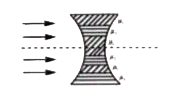
A symmetrical bioconcave lens having radius of curvature R is made up to two different materials as shown in figure. A parallel beam of light passing through the lens appear to diverge from two different points. Find the distance between them.

A

`2/R (mu_1 - mu_2)`

B

`R/2 ((mu_2 -mu_1))/((mu_1 - 1)(mu_2 - 1))`

C

`R/2 ((mu_2 - 1)/(mu_1 - 1))`

D

`R/2 ((mu_1 - 1)/(mu_2 -1))`

Text Solution

Verified by Experts

The correct Answer is:

B
Promotional Banner

Topper's Solved these Questions

  • GEOMETRICAL OPTICS

    AAKASH SERIES|Exercise ADDITIONAL PRACTICE EXERCISE (LEVEL-II PRACTICE SHEET (ADVANCED) MORE THAN ONE CORRECT ANSWER TYPE QUESTIONS)|4 Videos
  • GEOMETRICAL OPTICS

    AAKASH SERIES|Exercise ADDITIONAL PRACTICE EXERCISE (LEVEL-II PRACTICE SHEET (ADVANCED) LINKED COMPREHENSION TYPE QUESTIONS)|7 Videos
  • GEOMETRICAL OPTICS

    AAKASH SERIES|Exercise ADDITIONAL PRACTICE EXERCISE (LEVEL-II LECTURE SHEET(ADVANCED) INTEGER TYPE QUESTIONS)|4 Videos
  • ELEMENTS OF VECTORS

    AAKASH SERIES|Exercise QUESTIONS FOR DESCRIPTIVE ANSWERS|10 Videos
  • LAWS OF MOTION

    AAKASH SERIES|Exercise PRACTICE EXERCISE|106 Videos

Similar Questions

Explore conceptually related problems

A convex lens is made up of three different materials as shown in the figure. For a point object placed on its axis, the number of images formed are

One plano-convex and one plano-concave lens of same radius of curvature 'R' but of different materials are joined side by side as shown in the figure.If the refractive index of the material of 1 is mu_1 and that of 2 is mu_2 , then the focal length of the combination is :

A parallel beam of light falls on the surface of a convex lens whose radius of curvature of both sides of 20cm. The refractive index of the material of the lens varies as mu=1.5+0.5r , where r is the distance of the point on the aperture from the optical centre in cm. Find the length of the region on the axis of the lens where the light will appear. The radius of aperture of the lens is 1cm.

A light ray parallel to the principal axis is incident (as shown in the figure) on a thin planoconvex lens with radius of curvature of its curved part equal to 10 cm. Assuming that the refractive index of the material of the lens is 4//3 and medium on both sides of the lens is air, find the distance of the point from the lens where this ray meets the principal axis. Find your answer in the form (X)/(7)cm and fill value of X .

Centre of mass of two unifrom rods of same length but made up of different materials & kept as shown, if the meeting point is the origin of co-ordinates :-

A thin convex lens (L_(1)) of focal length 80 cm and a thin concave lens (L_(2)) of focal length f are kept co-axially, 20 cm apart as shown in figure below. When a narrow and parallel beam of light is incident on the conver lens, beam emerging from the concave lens is also a parallel beam. Find f.

A point object is placed at a distance of 0.3 m from a convex lens (focal length 0.2 m) cut into two halves each of which is displaced by 0.0005 m as shown in the figure. Find the position of the image . If more than one image is formed find their number and the distance between them.

A point object is placed at a distance of 0.3 m from a convex lens (focal length 0.2 m) cut into two halves each of which is displaced by 0.0005 m as shown in the figure. Find the position of the image . If more than one image is formed find their number and the distance between them.

A point object is placed at a distance of 0.3 m from a convex lens (focal length 0.2 m) cut into two halves each of which is displaced by 0.0005 m as shown in the figure. Find the position of the image . If more than one image is formed find their number and the distance between them.

Two lenses shown in figure. Are illuminated by a beam of parallel light from the left. Lens B is then moved slowly toward lens A. the beam emerging from lens B is

AAKASH SERIES-GEOMETRICAL OPTICS-ADDITIONAL PRACTICE EXERCISE (LEVEL-II PRACTICE SHEET (ADVANCED) STRAIGHT OBJECTIVE TYPE QUESTIONS)
  1. A plane mirror is fixed at the bottom of a tank containing water. A sm...

    Text Solution

    |

  2. A ray of light travelling in glass having refractive index (a)mu(g)=3/...

    Text Solution

    |

  3. A light ray is normally incident onone face of equilateral glass prism...

    Text Solution

    |

  4. A equilateral glass prism has a refractive index sqrt(2). A light ray ...

    Text Solution

    |

  5. The n transparent slabs of refractive index1.5 each having thickness 1...

    Text Solution

    |

  6. A glass sphere of diameter 50 cm and mu=1.5 has a small air bubble. Lo...

    Text Solution

    |

  7. A parallel beam falls on solid glass sphere of radius R and refractive...

    Text Solution

    |

  8. A transparent glass sphere of radius 10 cm and refractive index mu=1.5...

    Text Solution

    |

  9. A convex lens of focal length 20cm and another plano convex lens of fo...

    Text Solution

    |

  10. A symmetrical bioconcave lens having radius of curvature R is made up ...

    Text Solution

    |

  11. Light is incident on the thin lens as shown in figure. The refractive ...

    Text Solution

    |

  12. The given lens is broken into four parts rearranged as shown. If the i...

    Text Solution

    |

  13. A convex lens is placed between an object and a screen which are at a ...

    Text Solution

    |

  14. A thin biconvex lens of refractive index 3//2 is placed on a horizonta...

    Text Solution

    |

  15. A convex lens is placed between an object and a screen which are at a ...

    Text Solution

    |

  16. A point object is placed at a distance of 24 cm from a convex surface ...

    Text Solution

    |

  17. Two lenses shown in figure. Are illuminated by a beam of parallel ligh...

    Text Solution

    |

  18. A double convex lens forms a real image of an objectt on a screen whic...

    Text Solution

    |

  19. Choose the correct ray diagram of an equi convex lens which is cut as ...

    Text Solution

    |

  20. A biconvex thin lens of radius of curvature R is made up of variable r...

    Text Solution

    |
