Home
Class 12
CHEMISTRY
Write the state of hybridization, the s...

Write the state of hybridization, the shape and the magnetic behaviour of the following complex entities:
(i) `[Cr(NH_(3))_(4) Cl_(2)]Cl`
(ii) `[Co Fe_(6)]^(3-)`
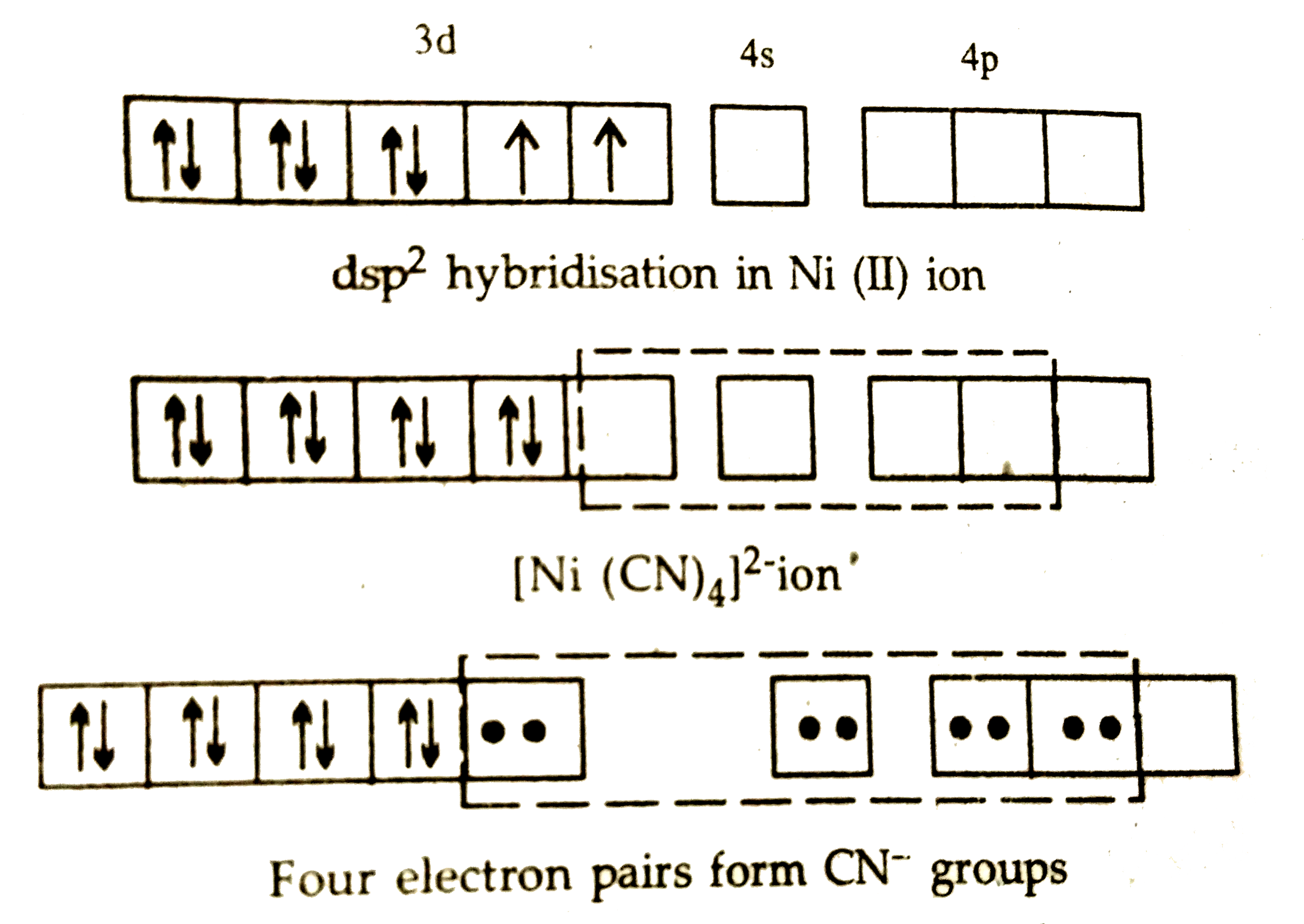
(iii) `K_(2)[Ni(CH)_(4)]`

Text Solution

Verified by Experts
(i) [`Co(NH_(3))_(5) Cl]Cl`
IUPSC name : Petaamincehclorids cobalt (III) Choride 0.5 _ 3 , Cl (III) : `d^(6)` Stereochemistry: Octahedral
Conf , ` t_(2g^(6))`
No. of unpaired electrons, n =0
Magnetic moment=0. digmagnetic
(ii) Complex ion `=[Co F_(6)]^(3-)`
Central metal ion `= Co^(3+)`
Configuration of metal ion = `d^(6)`
Hybridistaion of metal ion = `sp^(3) d^(2)`
(iii) Atomic oribatials of Ni (II) ion

As there are no unpaired electrons, the `[Ni(CN)^(4)]^(2-)` ions is diamagnetic .
Promotional Banner

Topper's Solved these Questions

  • XII BOARDS

    XII BOARDS PREVIOUS YEAR|Exercise CHEMISTRY (THEORY)|31 Videos
  • XII BOARDS

    XII BOARDS PREVIOUS YEAR|Exercise C.B.S.E CLASS XII|41 Videos
  • XII BOARDS

    XII BOARDS PREVIOUS YEAR|Exercise SET-II|32 Videos
  • SAMPLE PAPER 2019

    XII BOARDS PREVIOUS YEAR|Exercise SECTION: D|1 Videos

Similar Questions

Explore conceptually related problems

Write the state of hybridisation, the shape and the magnetic behaviour of the following complexes. i) [Cr(NH_(3))_(4)Cl_(2)]Cl ii) [Co(en)_(3)]Cl_(3) iii) K_(2)[Ni(CN)_(4)]

Write the state of hybridisation, the shape and the magnetic behaviour of the following complexes. i) [Cr(NH_(3))_(4)Cl_(2)]Cl ii) [Co(en)_(3)]Cl_(3) (iii) K_(2)[Ni(CN)_(4)]

Write the name , structure and magnetic behaviour of the following complexes (i) [Pt(NH_(3))_(2)Cl(NO_(2))] (ii) [Co(NH_(3))_(4)Cl_(2)]Cl

Give the shape and behaviour of the following complexes: i) [Co(NH_(3))_(6)]^(3+) ii) [Ni(CN)_(4)]^(2-)

Write the name, the state of hybridization, the shape and the magnetic behaviour of the following complexes : [CoCl_(4)]^(2-),[Ni(CN_(4)]^(2-), [Cr(H_(2)O)_(2)(C_(2)O_(4))_ (2)]^(-) ("At.No.": Co= 27, Ni = 28, Cr = 24)

Write the IUPAC name of the following : (i) [Co(NH_(3))_(6)]Cl_(3) (ii) [NiCl_(4)]^(2-) (iii) K_(2)[Fe(CN)_(6)]

XII BOARDS PREVIOUS YEAR-XII BOARDS-SET-III
  1. What type of colloid is formed when a gas is dispesed in a liquid? Giv...

    Text Solution

    |

  2. Write he IUPAC name of the following compound: CH(3)-O-underset(CH(3...

    Text Solution

    |

  3. Draw the structure of te following: (a) XeF(4) (b) BrF(4)

    Text Solution

    |

  4. Write the anme of the cell which is generally used in transistors. Wri...

    Text Solution

    |

  5. Using IUPAC norms write the formulae for the following: (a) Potassiu...

    Text Solution

    |

  6. (a) What type of isomerism is shown by the complex [Co(NH(3))(5)(SCN)]...

    Text Solution

    |

  7. (a) Based on the nature of intermolecular forces, classify the followi...

    Text Solution

    |

  8. (a) Write the principle of electrolytic refining. (b) Why does coppe...

    Text Solution

    |

  9. Define the following: (a) Cationic detergents (b) Broad spectrum a...

    Text Solution

    |

  10. Write the structures of the monomers used for getting the following po...

    Text Solution

    |

  11. Define " Order of a reaction" and " Activation energy of a reaction "...

    Text Solution

    |

  12. What is meant by reverse osmosis?.

    Text Solution

    |

  13. What type of ores can be concentrated by magnetic separation method ...

    Text Solution

    |

  14. Which compounds used to estimate the hardness of water volumetrically ...

    Text Solution

    |

  15. Describle the principal controlling each of the following processe...

    Text Solution

    |

  16. Explain giving reason: (i) Treansition metals and their compounds g...

    Text Solution

    |

  17. Enumerate the reactions of D-Glucose which cannot be explained by its ...

    Text Solution

    |

  18. Explain the following giving an exmaple in each case: (i) Linka...

    Text Solution

    |

  19. Write the state of hybridization, the shape and the magnetic behavi...

    Text Solution

    |

  20. Write the names and structure of the monomers of the following pol...

    Text Solution

    |

