Home
Class 12
CHEMISTRY
Decomposition of NH(4)NO(2)(aq into N(2)...

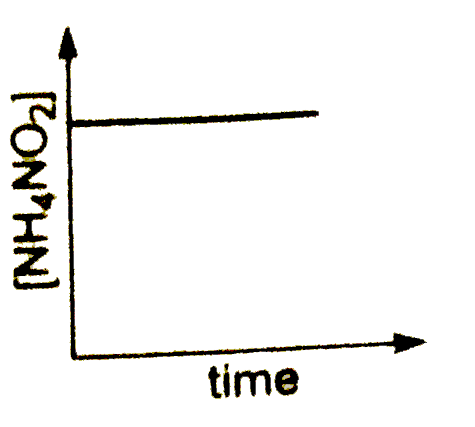
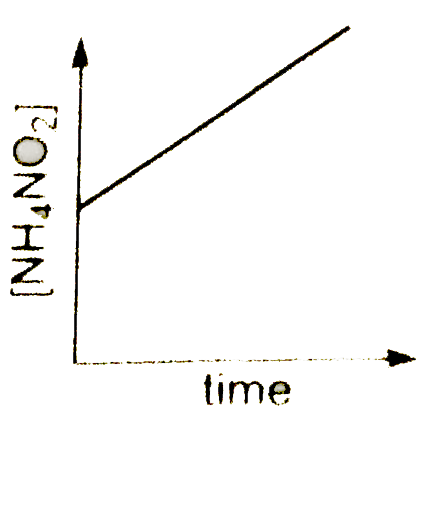
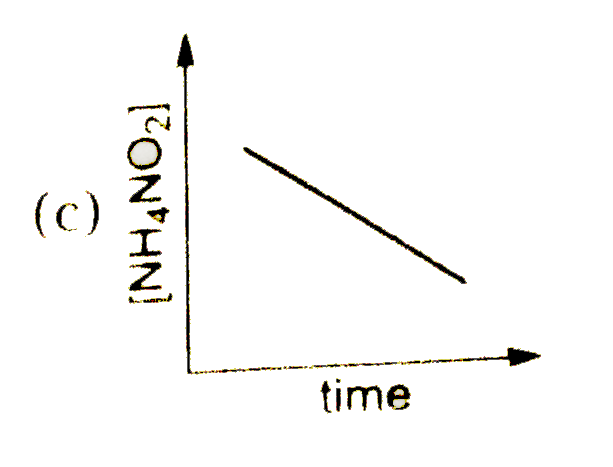
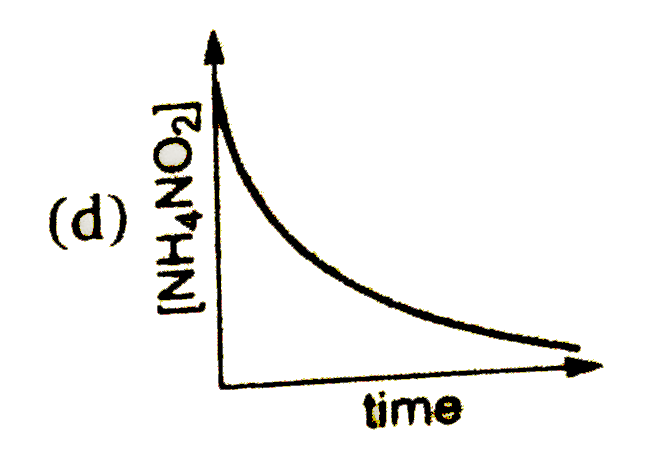
Decomposition of `NH_(4)NO_(2)(aq` into `N_(2)(g)` and `2H_(2)O(l)` is first order reaction.

A

B

C

D

Text Solution

Verified by Experts

The correct Answer is:

D
Promotional Banner

Topper's Solved these Questions

  • CHEMICAL KINETIC & NUCLEAR CHEMISTRY

    NARENDRA AWASTHI|Exercise Level 1 (Q.3 To Q.32)|2 Videos
  • CHEMICAL KINETIC & NUCLEAR CHEMISTRY

    NARENDRA AWASTHI|Exercise Level 1 (Q.33 To Q.62)|3 Videos
  • SURFACE CHEMISTRY

    NARENDRA AWASTHI|Exercise Level 3 - Assertion - Reason Type Questions|1 Videos

Similar Questions

Explore conceptually related problems

Thermal decomposition of (NH_(4))_(2)Cr_(2)O_(7) involves.

C + HNO_(3)(aq) rarr NO_(2) + CO_(2) + H_(2)O(l) . Balance this equation.

H_(2)SO_(4)(aq)+2NaOH_((aq))to Na_(2)SO_(4)(aq) +2H_(2)O_((l)) . Suggest the hest of this reaction.

Benzene diazonium chloride (A) decoposes into chlorobenzene (B) and N_(2) (g) in first order reaction. Volumes of N_(2) collected after 5 min and at the complete decomposition of A are 10 mL. and 50mL respectively. The are constant for the reaction is

The following data were obtained during the first order thermal decomposition of N_(2)O_(5) (g) at constant volume : 2N_(2) O_(5)(g)to 2N_(2)O_(4)(g) +O_(2)(g) Calculate the rate constnat.

For the decomposition of N_(2)O_(5)(g) it is given that 2NOI_(2)O_(5(g))to4NO_(2(g))+O_(2(g)) .Activation energy E_(a), N_(2)O_(5(g))to2NO_(2(g))+1/2O_(2(g)) Activating energy E_(a)

The decomposition of NH_(3) on platjinum surface is zero order reaction. Want are the rates of production of N_(2) and H_(2) if k=2.5 xx10^(-4) mol ^(-1) Ls^(-1).

H_(2)O_(2(aq)) decomposes to H_(2)O_((l))and O_(2(g)) in a first reaction w.r.t. H_(2)O_(2). The rate constant is k=1.06 xx10^(-3) "min" ^(-1). How long it will take 15% of the sample of defcompose ?

The standard enthalpies of formation of H_(2)O_(2(l)) and H_(2)O_((l)) are -187.8kJ "mole"^(-1) and -285.8 kJ "mole"^(-1) respectively. The DeltaH^(0) for the decomposition of one mole of H_(2)O_(2(l)) " to" H_(2)O_((l)) and O_(2(g)) is
