Home
Class 12
CHEMISTRY
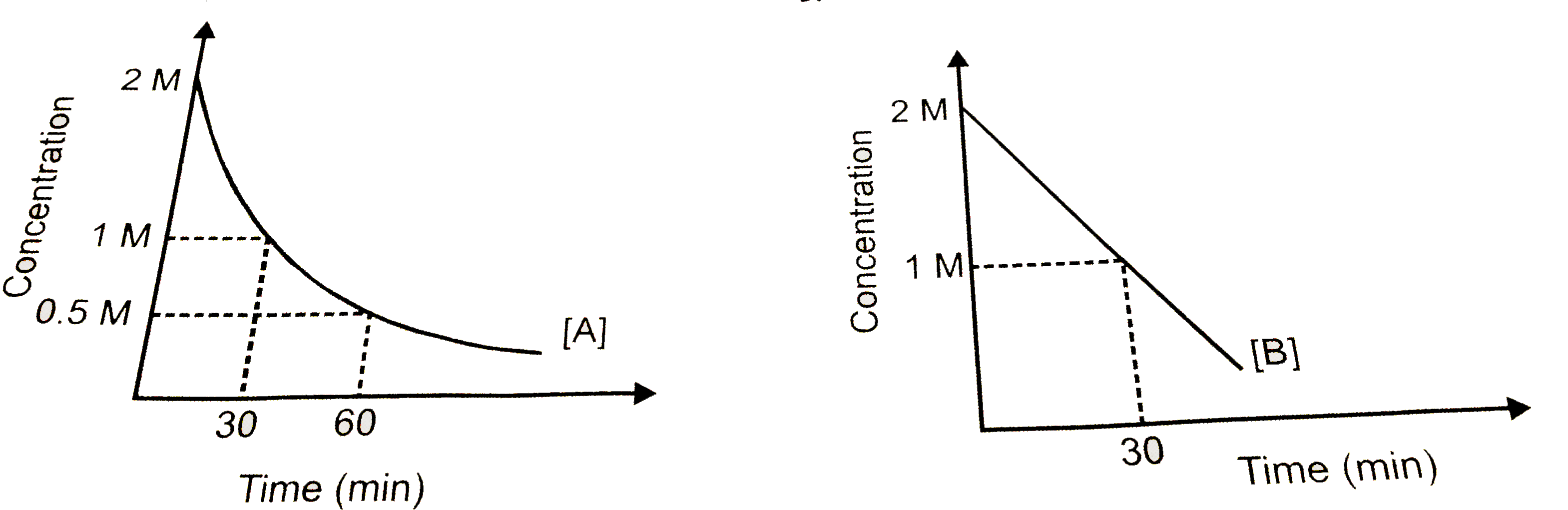
For the reaction (i) Aoverset(k(I))toP...

For the reaction
(i) `Aoverset(k_(I))toP`
(ii) `Boverset(K_(II))toQ`, following observation is made.

Calculate `(k_(1))/(k_(II))`, where `k_(I)` and `k_(II)` and rate constant for the respective reaction.

A

2.303

B

1

C

0.36

D

0.693

Text Solution

Verified by Experts

The correct Answer is:

D
Promotional Banner

Topper's Solved these Questions

  • CHEMICAL KINETIC & NUCLEAR CHEMISTRY

    NARENDRA AWASTHI|Exercise Level 1 (Q.3 To Q.32)|2 Videos
  • CHEMICAL KINETIC & NUCLEAR CHEMISTRY

    NARENDRA AWASTHI|Exercise Level 1 (Q.33 To Q.62)|3 Videos
  • SURFACE CHEMISTRY

    NARENDRA AWASTHI|Exercise Level 3 - Assertion - Reason Type Questions|1 Videos

Similar Questions

Explore conceptually related problems

Write the equation which ralates th rate constants k_(1)and k_(2) at temperatures T_(1) and T_(2) of a reaction.

The rate constant for a forward reaction in a reversible reaction (K_(eq) = 10^(6)) is 10^(2) . Calculate rate constant for its backward reaction

Write the Arrhenius equation for the rate constant (k) of a reaction.

The instantaneous rate of an elementary chamical reactkon aA+bBhArr cC+dD can be given by rate =K_(f)[A]^(a)[B]^(b)-K_(b)[C]^(c)[D]^(d) where K_(f) and K_(b) are rate constants for forward and backward reactions respectively for the reversible reaction. If the reaction is an irreversible one, the rate is expressed as, rate =K[A]^(a)[B]^(b) where K is rate contant for the given irreversible rate of disappearance of A is a/b times the rate of disappearance of B. The variation of rate constant K with temperature is expressed in terms of Arrhenius equation: K=Ae^(-E_(a)//RT) whereas the ratio (K_(f))/(K_(b)) is expressed in terms of van't Hoff isochore: (K_(f))/(K_(b))=Ae^(-DeltaH//RT) , where E_(a) and DeltaH are energy of activation and heat of reaction respectively. For a gaseous phase -I order reaction A(g)toB(g)+2C(g) (rate constant K=10^(-2)"time"^(-1) ) in a closed vesel of 2 litre containing 5 mole of A(g) at 27^(@)C which of the following is correct?

A certain endothermic reaction: Ato Product, DeltaH=+ve proceeds ina sequence of three elementary steps with the rate constant K_(1),K_(2) and K_(3) and each one having energy of activation E_(1),E_(2) and E_(3) respectively at 25^(@)C . The observed rate constannt for the reaction is equal to K_(3)sqrt((K_(1))/(K_(2))) . A_(1),A_(2) and A_(3) are Arrhenius parameters respectively. Presence of a catalyst decreasesthe energy of activation of each path by half the value of E_(1) . Assuming the other factors same, the observed energy of activation would be

The equilibrium constant (K_(C)) for the reaction HA +B hArr BH^(+) + A is 100. If the rate constant for the forward reaction is 10^(5) , rate constant for the reverse reaction is

The instantaneous rate of an elementary chamical reactkon aA+bBhArr cC+dD can be given by rate =K_(f)[A]^(a)[B]^(b)-K_(b)[C]^(c)[D]^(d) where K_(f) and K_(b) are rate constants for forward and backward reactions respectively for the reversible reaction. If the reaction is an irreversible one, the rate is expressed as, rate =K[A]^(a)[B]^(b) where K is rate contant for the given irreversible rate of disappearance of A is a/b times the rate of disappearance of B. The variation of rate constant K with temperature is expressed in terms of Arrhenius equation: K=Ae^(-E_(a)//RT) whereas the ratio (K_(f))/(K_(b)) is expressed in terms of van't Hoff isochore: (K_(f))/(K_(b))=Ae^(-DeltaH//RT) , where E_(a) and DeltaH are energy of activation and heat of reaction respectively. For an elementary reaction aAto product, the graph plotted log([-d[A]])/(dt) vs log[A]_(t) gives a straight line with intercept equal to 0.6 and showing an angle of 45^(@) then

A certain endothermic reaction: Ato Product, DeltaH=+ve proceeds ina sequence of three elementary steps with the rate constant K_(1),K_(2) and K_(3) and each one having energy of activation E_(1),E_(2) and E_(3) respectively at 25^(@)C . The observed rate constannt for the reaction is equal to K_(3)sqrt((K_(1))/(K_(2))) . A_(1),A_(2) and A_(3) are Arrhenius parameters respectively. The observed Arrhebius parameter for the reaction is

A certain endothermic reaction: Ato Product, DeltaH=+ve proceeds ina sequence of three elementary steps with the rate constant K_(1),K_(2) and K_(3) and each one having energy of activation E_(1),E_(2) and E_(3) respectively at 25^(@)C . The observed rate constannt for the reaction is equal to K_(3)sqrt((K_(1))/(K_(2))) . A_(1),A_(2) and A_(3) are Arrhenius parameters respectively. The observed energy of activation for the reaction is
