Give the correct order of initials T(true)F(false) for following satements. (I) If electron has zero quantum magnetic numbers, then it must be present in s-orbital
(II) In 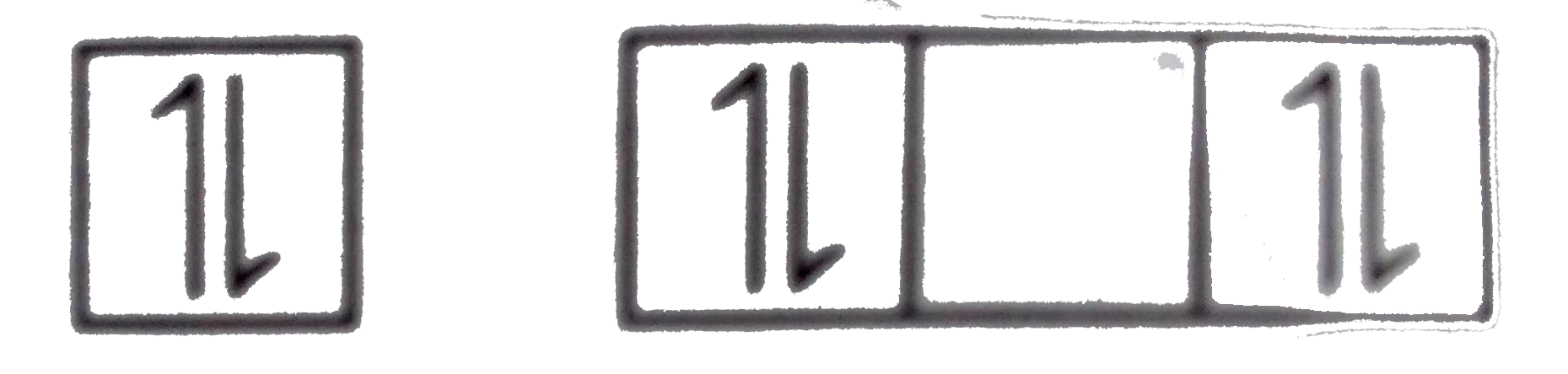 orbital diagram, Pauli's exclusion principal is violated
(III) Bohr's model can explain spectrum of the hydrogen atom.
(IV) A d-orbital can accommodate maximum 10 electrons only.
Give the correct order of initials T(true)F(false) for following satements. (I) If electron has zero quantum magnetic numbers, then it must be present in s-orbital
(II) In orbital diagram, Pauli's exclusion principal is violated
(III) Bohr's model can explain spectrum of the hydrogen atom.
(IV) A d-orbital can accommodate maximum 10 electrons only.
(II) In
orbital diagram, Pauli's exclusion principal is violated (III) Bohr's model can explain spectrum of the hydrogen atom.
(IV) A d-orbital can accommodate maximum 10 electrons only.
A
(a) TTFF
B
(B) FFTF
C
(C)TFTT
D
(D) FFTT
Text Solution
Verified by Experts



Topper's Solved these Questions
Similar Questions
Explore conceptually related problems
Give the correct order of initials T (True) or F (False) for following statements. (I) If electron has zero magnetic quantum number, then it must be present in s-orbital. (II) In orbital diagram, pauli’s exclusion principle is violated. (III) Bohr.s model can explain spectrum of the hydrogen atom. (IV) A d-orbital can accommodate maximum 10 electrons only.
The electrons in atoms occupy atomic orbitals (AO_(s)) that are represented as theregions around the nuclei where there is a high probability of finding the electrons. ln the so-called LCAO (linear combitaks) approach, as pioneered by Hund and Mulliken, when AOs come close together, they overlap forming MOs (molecular orbitals). Two AO s can overlap to form two MOs, one of which lies at a lower energy level (BMO) than the other at a higher energy level and is called an antibonding molecular orbital (ABMO). Each MO can hold one or two electrons in accordance with Pauli's exclusion principle. MOT can explain the paramagnetism of molecules such as O_(2) and NO and other spectral features. In a molecule number of electrons in bonding MO is more as compared to antibonding MO, hence
Check the correctness of the following state- ments about Bohr model of hydrogen atom (i) The acceleration of the electron n = 2 orbit is more than that in n = 1 orbit (ii) The angular momentum of the electron in ,n = 2 orbit is more than that in n = 1 orbit (iii) The K.E. of the electron in n = 2 orbit is less than that in n = 1 orbit.
Just as Bohr.s model of atom was developed on the basis of planck.s quantum theory, wave mechanical model of atom has been developed on the basis of quantum mechanics. The herat of quantum mechanism is Schrodinger wave equation which in turn is based on Heisenberg.s uncetainity principle and de broglie concept of dual nature of matter and radiation. Bohr model could explain the main lines of hydrogen or hydrogenic spectra but could not explain their fine structure. To explain this, it was suggested that each level consists of a number of sublevels, it was suggested that each level consists of a number of sublevels, the transitions between which gave rise to closely spaced lines. The numbers representing the main energy level are called Princiapl Quantum Number (n) while those representing sublevels are called Azimuthal Quantum numbers (l) and these determine the angular momentum of the electron. The orbital angular Number (m) which is just like a further split of a sublevel into finer sublevels. Lastly the electron may rotate or spin about its own axis given rise to Spin Quantum number (s) which determines the angular momentum of the electron. The orbital angular momentum of 2p electron is
The equation of Schroedinger for the hydrogen atom in the time-independet, non-relativistic form is a partial differential equation involving the position coordinates (x, y and z). The potential energy term for the proton-electron system is spherically symmetric of the form -1//4pi in_(0) xx (e^(2)//r) . THus it is advantages to change over from the cartesian coordinates (x,y and z) to the spherical polar coordinates, (r, theta and phi ). In this form the equation become separable in the radial part involving r and the angular part involving theta and phi . The probability of locating the electron within a volume element d tau = 4pi r^(2)dr is then given |Psi|^(2)(4pir^(2)dr) , where Psi is a function of r, theta and phi . With proper conditions imposed on Psi , the treatment yields certain functions, Psi , known as atomic orbitals which are solutions of the equations. Each function Psi correspods to quantum number n, l and m, the principal, the azimuthal and the magnetic quantum number respectively, n has values 1, 2, 3,...., l has values 0, 1, 2, ....(n-1) for each value of n and m (n-1) for each value of n and m (m_(l)) has values =1, +(l+1),...1,0,-1,-2...-l i.e., (2l+1) values for each value of l. In addition a further quantum number called pin had to be introduced with values +-1//2 . Any set of four values for n, l , m and s characterizes a spin orbital. Pauli.s exclusion principle states that a given spin orbital can accomodate not more than electron. Further the values l = 0, l=1, l=2, l=3 are designated s,p,d and f orbitals respectively. It is a basic fact that any two electrons are indistinguishable. 3 electrons are to be accomodated in the spin orbitals included under the designated 2p, conforming to the Pauli principle. Calculate the number of ways in which this may be done.
The equation of Schroedinger for the hydrogen atom in the time-independet, non-relativistic form is a partial differential equation involving the position coordinates (x, y and z). The potential energy term for the proton-electron system is spherically symmetric of the form -1//4pi in_(0) xx (e^(2)//r) . THus it is advantages to change over from the cartesian coordinates (x,y and z) to the spherical polar coordinates, (r, theta and phi ). In this form the equation become separable in the radial part involving r and the angular part involving theta and phi . The probability of locating the electron within a volume element d tau = 4pi r^(2)dr is then given |Psi|^(2)(4pir^(2)dr) , where Psi is a function of r, theta and phi . With proper conditions imposed on Psi , the treatment yields certain functions, Psi , known as atomic orbitals which are solutions of the equations. Each function Psi correspods to quantum number n, l and m, the principal, the azimuthal and the magnetic quantum number respectively, n has values 1, 2, 3,...., l has values 0, 1, 2, ....(n-1) for each value of n and m (n-1) for each value of n and m (m_(l)) has values =1, +(l+1),...1,0,-1,-2...-l i.e., (2l+1) values for each value of l. In addition a further quantum number called pin had to be introduced with values +-1//2 . Any set of four values for n, l , m and s characterizes a spin orbital. Pauli.s exclusion principle states that a given spin orbital can accomodate not more than electron. Further the values l = 0, l=1, l=2, l=3 are designated s,p,d and f orbitals respectively. Which of the following diagrams corresponds to the 2s orbital ?
The equation of Schroedinger for the hydrogen atom in the time-independet, non-relativistic form is a partial differential equation involving the position coordinates (x, y and z). The potential energy term for the proton-electron system is spherically symmetric of the form -1//4pi in_(0) xx (e^(2)//r) . THus it is advantages to change over from the cartesian coordinates (x,y and z) to the spherical polar coordinates, ( r, theta and phi ). In this form the equation become separable in the radial part involving r and the angular part involving theta and phi . The probability of locating the electron within a volume element d tau = 4pi r^(2)dr is then given |Psi|^(2)(4pir^(2)dr) , where Psi is a function of r, theta and phi . With proper conditions imposed on Psi , the treatment yields certain functions, Psi , known as atomic orbitals which are solutions of the equations. Each function Psi correspods to quantum number n, l and m, the principal, the azimuthal and the magnetic quantum number respectively, n has values 1, 2, 3,...., l has values 0, 1, 2, ....(n-1) for each value of n and m (n-1) for each value of n and m (m_(l)) has values =1, +(l+1),...1,0,-1,-2...-l i.e., (2l+1) values for each value of l. In addition a further quantum number called pin had to be introduced with values +-1//2 . Any set of four values for n, l , m and s characterizes a spin orbital. Pauli.s exclusion principle states that a given spin orbital can accomodate not more than electron. Further the values l = 0, l=1, l=2, l=3 are designated s,p,d and f orbitals respectively. How many spin orbitals are there corresponding to n = 3?
Electronic configuration of multielectron atoms can be written by the use of four quantum numbers and also by following certain principles. Pauli's exclusio principle suggests that maximum capacity of an atomic orbital is two. Auf bau principle suggests that the lower energy orbitals are filled first and hence stability can be attained. Hunds rule of maximum multiplicity suggests that pairing occurs with one electron. The arrangement of electrons in the space around the nucleus can be understood only after writing the electronic configuration. Thus writing electronic configuration is more important in the structure of an atom. Applying Hunds rule of maximum multiplicity, the maximum number of electrons that can posses spin quantum number +1/2 in 4p orbitals is