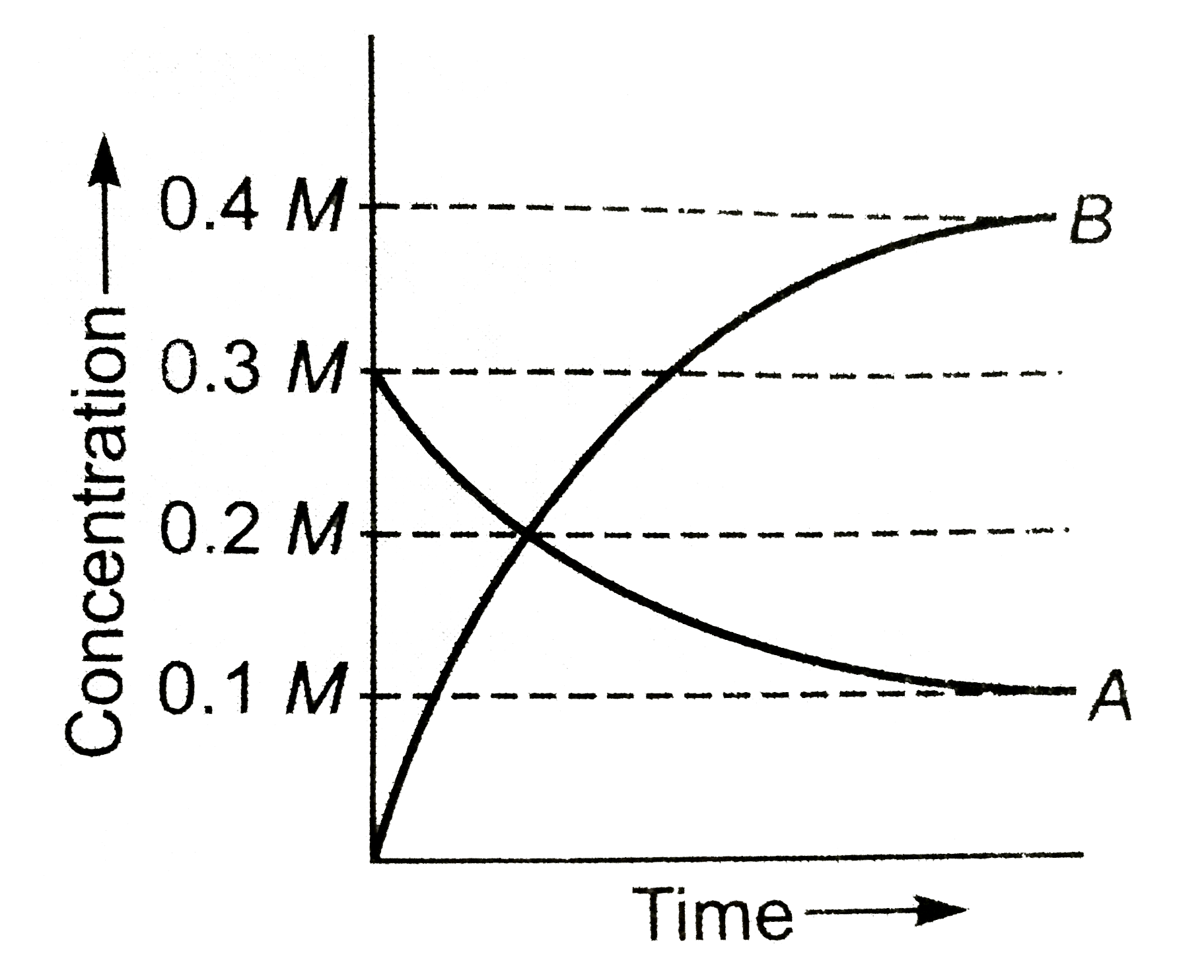
The figure shows the change in concentration of species A and B as a function of time. The equilibrium constant `K_(c)`for the reaction` A(g)hArr2B(g)` is :
A
`K_(c)gt1`
B
`Klt1`
C
`K=1`
D
data insufficient
Text Solution
Verified by Experts
The correct Answer is:
a
Topper's Solved these Questions
CHEMICAL EQUILIBRIUM
NARENDRA AWASTHI|Exercise Level 1 (Q.93 To Q.122)|1 Videos
CHEMICAL EQUILIBRIUM
NARENDRA AWASTHI|Exercise Level 2|1 Videos
ATOMIC STUCTURE
NARENDRA AWASTHI|Exercise level 2|1 Videos
DILUTE SOLUTION
NARENDRA AWASTHI|Exercise Level 3 - Match The Column|1 Videos
Similar Questions
Explore conceptually related problems
If DeltaG^@ for the reaction given below is 1. kJ, the equilibrium constant for a reaction. 2HI_((g)) harr H_(2(g))+I_(2(g)) at 25^@C is :
The compounds A and B are mixed in equimolar proportion to from the products, A+B harr C+D . At equilibrium, one third of A and B are consumed. The equilibrium constant for the reaction is
The initial concentrations of A and B are same for A +2B harr 3C and when equilibrium concentrations of B and C are same then K_(c) is
For the reaction A + B hArr C + D , the concentrations of A and B are equal . The equilibrium concentration of C is twice that of A . K_(C) of the reaction is
For the hypothetical reactions, the equilibrium constant (K) values are given A harr B, K_1=2.0 B harr C, K_2=4.0 C harr D, K_3=3.0 The equilibrium constant for the reaction A harr D is
A(g) + 3(g) hArr 4C(g) Initial concentration of A is equal to that of B. The equilibrium concentration of A and C are equal. K_(c) is equal to .
In the system A_((s)) hArr 2B_((g)) + 3C_((g)) . If the concentration of C at equilibrium is increased by a factor of 2. It will casuse the equilibrium concentration of B to change to:
At constant temperature 80% AB dissociates into A_(2) and B_(2) then the equilibrium constant for 2AB_((g)) harr A_(2(g)) +B_(2(g))
In the equilibrium reaction, A(g) + 2B(g) + (g), the equilibrium constant, K_(c) is given by the expression