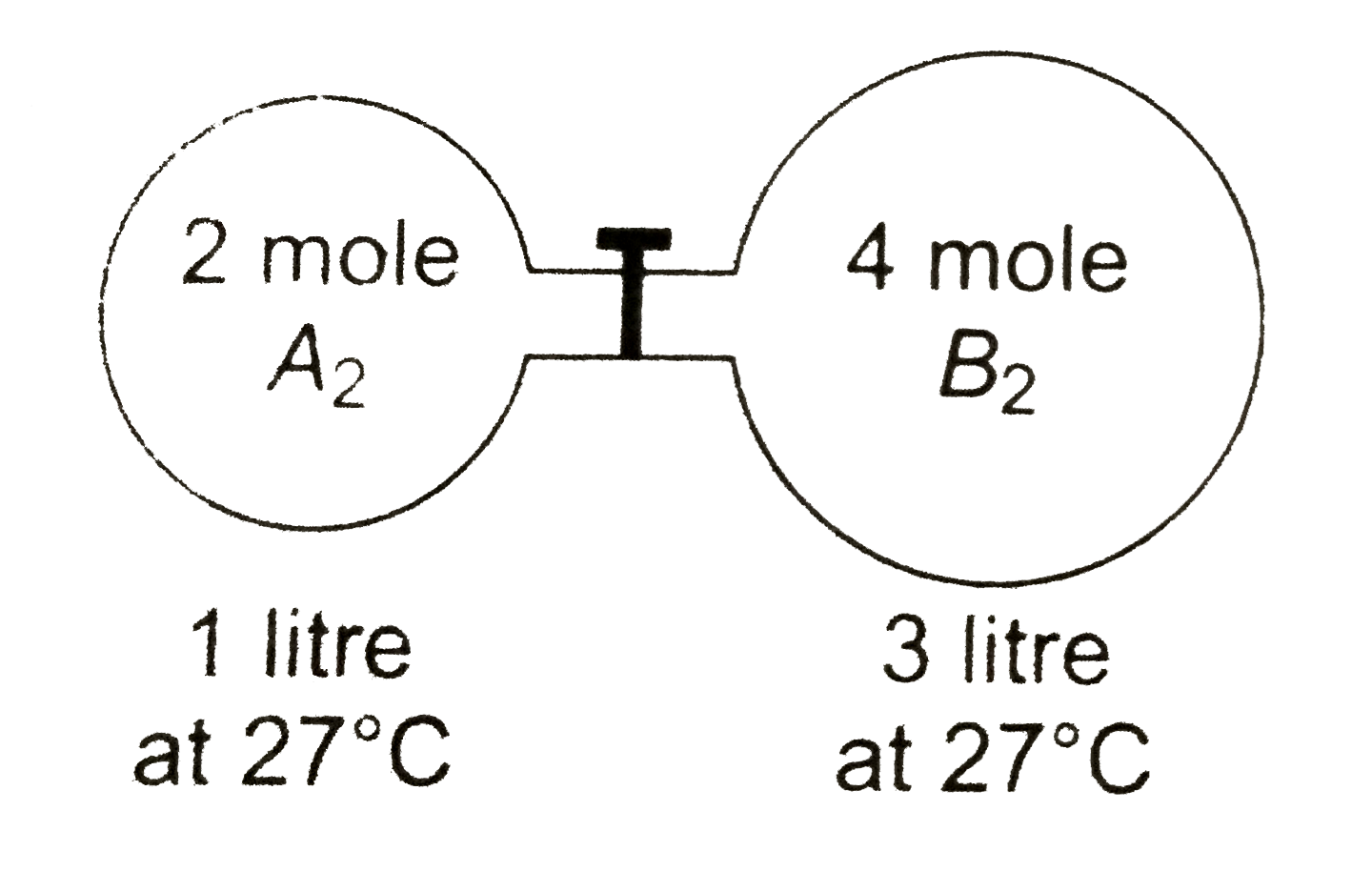
The gas `A_(2)` in the left flask allowed to react with gas `B_(2)` present in right flask as `A_(2)(g)+B_(2)(g)hArr2AB(g),K_(c)=4` at `27^(@)C.` What is the concentrartion of AB when equilibrium is established ?
A
`1.33` M
B
`2.66` M
C
`0.66` M
D
`0.33` M
Text Solution
Verified by Experts
The correct Answer is:
C
Topper's Solved these Questions
CHEMICAL EQUILIBRIUM
NARENDRA AWASTHI|Exercise Level 1 (Q.93 To Q.122)|1 Videos
CHEMICAL EQUILIBRIUM
NARENDRA AWASTHI|Exercise Level 2|1 Videos
ATOMIC STUCTURE
NARENDRA AWASTHI|Exercise level 2|1 Videos
DILUTE SOLUTION
NARENDRA AWASTHI|Exercise Level 3 - Match The Column|1 Videos
Similar Questions
Explore conceptually related problems
For the Chemical reaction A_(2(g)) + B_(2(g)) hArr 2 AB(g) the amount of AB at equilibrium is affected by
For the equilibrium in gaseous phase in 2 lit flask we start with 2 moles of SO_(2) and 1 mole of O_(2) at 3 atm, 2SO_(2(g)) + O_(2(g)) hArr 2SO_(3(g)) . When equilibrium is attained, pressure changes to 2.5 atm. Hence, equilibrium constant K_(c) is :
1 mol A_((g)) is heated in 1 lit closed vessel and equilibrium is reached at 300^(@) C in A_((g)) hArr B_((g)) . If K_(C) =4 , concentration of B_((g)) at equilibrium is (in mol/lit)
The gascous reaction A_((g)) + B_((g)) hArr 2C_((g)) + D_((g)) + q kJ is most favoured at :
For the reaction at 298K: A_((g)) +B_((g)) hArr C_((g)) + D_((g)) Delta H^(@) + 29.8kcal and Delta S^(@) = 100cal K^(-1) . Find the value of equilibrium constant.
0.5 mol of H_(2) and 0.5 mole of I_(2) react in 10 litre flask at 448^(@)C . The equilibrium brium constant K_(C) is 50 for H_(2)(g)I_(2)(g) hArr 2HI(g) Calcualte mole of I_(2) at equilibrium.
For the reaction A_((g))+B_((g)) harr C_((g))+D_((g)) K is 0.63 at 700^(@)C and 1.66 at 1000^(@)C . Then DeltaH^(@) is x KCal. What is x?