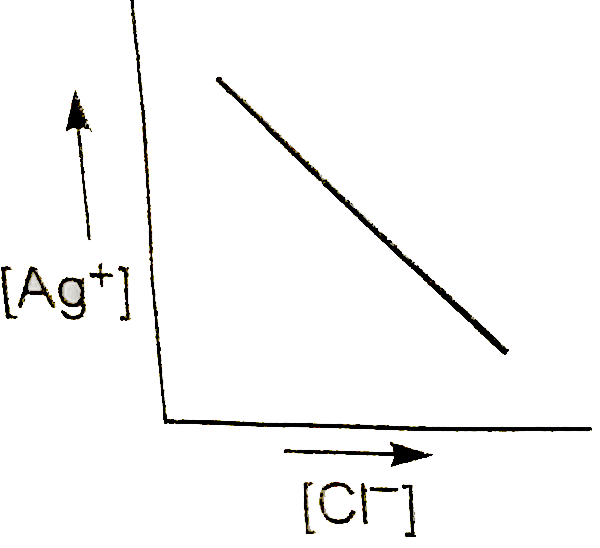
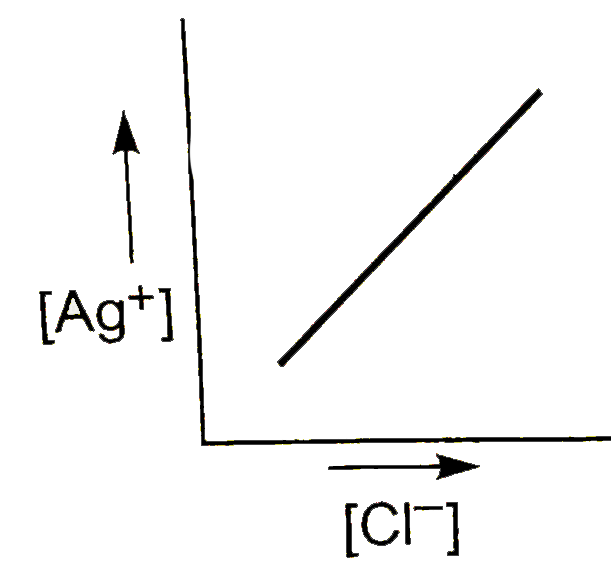
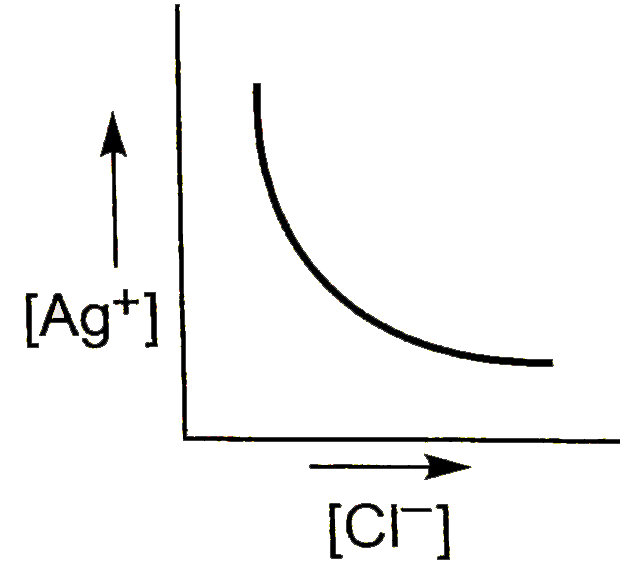
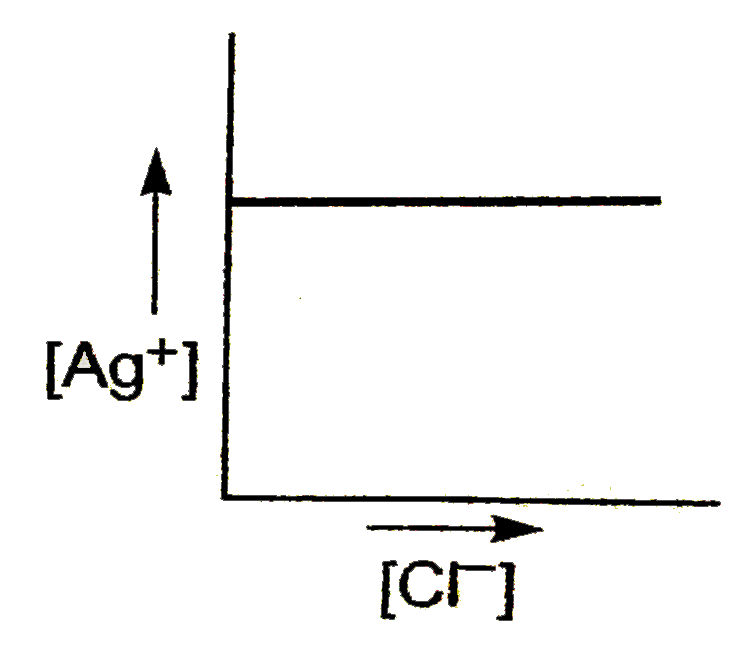
In a saturated solution of AgCl, NaCl is added gradually. The concentration of `Ag^(+)` is plotted against the concentration of `Cl^(-)`. The graph appears as :
The shape of the curve obtained when substrate concentration is plotted against velocity of reaction
In a saturated aqueous solution of AgBr , conc, of Ag^(+) ion is 10^(-6) mol/lit. if K_(sp) for Ag Br is 1 xx 10^(-12) , then concentration of Br^(-) in the solution is
A solution which remains in equilibrium with undissolved solute is said to be saturated. The concentration of a saturated solution at a given temperature is called solubility. The product of concentration of ions in a saturated solution of an electrolyte at a given temperature, is called solubility product (K_(sp)) . For the electrolyte, A_(x),B_(y),:A_(x),B_(y(s)) rarr xA^(y+)+ y^(Bx-) , with solubility S, the solubility product (K_(sp)) =x^(x)xxy^(y) xx s^(x+y) . While calculating the solubility of a sparingly soluble salt in the presence of some strong electrolyte containing a common ion, the common ion concentration is practically equal to that of strong electrolyte. If in a solution, the ionic product of an clectrolyte exceeds its K_(sp) , value at a particular temperature, then precipitation occurs. The solubility of BaSO_(4) , in 0.1 M BaCl_(2) , solution is (K_(sp) , of BaSO_(4), = 1.5 xx 10^(-9))
A solution which remains in equilibrium with undissolved solute is said to be saturated. The concentration of a saturated solution at a given temperature is called solubility. The product of concentration of ions in a saturated solution of an electrolyte at a given temperature, is called solubility product (K_(sp)) . For the electrolyte, A_(x),B_(y),:A_(x),B_(y(s)) rarr xA^(y+)+ y^(Bx-) , with solubility S, the solubility product (K_(sp)) =x^(x)xxy^(y) xx s^(x+y) . While calculating the solubility of a sparingly soluble salt in the presence of some strong electrolyte containing a common ion, the common ion concentration is practically equal to that of strong electrolyte. If in a solution, the ionic product of an clectrolyte exceeds its K_(sp) , value at a particular temperature, then precipitation occurs. The solubility of PbSO_(4) , in water is 0.303 g/l at 25^(@) C, its solubility product at that temperature is
What should happen if a thin slice of sugar beet is placed in a concentrated solution of NaCl?
The vapour pressure of a solution (b) as a function of temperature (a) is plotted as a graph for two solutions of same molar concentration along with water as shown below. A, B and C are respectively.
A 1.0 M solution of Cd^(+2) is added to excess iron and the system is allowed to reach equilibrium . What is the concentration of Cd^(+2) ? Cd^(2+)(aq) + Fe(s) to Cd(s) + Fe^(2+) (aq) , E^(0) = 0.037
The decomposition of N_(2)O_(5) in C Cl_(4) at 318K has been studies by monitoring the concentration of N_(2)O_(5) in the solution. Initially the concentration of N_(2)O_(5) is 2.33 mol L^(-1) and after 184 minutes, it is reduced to 2.08 mol L^(-1). The reaction takes placed according to the equation 2N_(2)O_(5)(g)to 4 NO _(2)(g) +O_(2)(g) Calculate the average rate of this reaction in terms of hours, minutres and seconds. What is the rate of proudction of NO_(2) during this period ?
500 ml of a 0.1 N solution of AgNO_(3) added to 500 mlof 0.1 N solution of KCI. The concentration of nitrate ion in the resulting mixture is
Silver metal is extracted from Ag_(2) S by cyanide process. The one is concentrated through froth floation process. The concentrated ore is the leached and solution is r ed with reducing agents to get spongy silver which then purified by fusion with an oxidant followed by electrolysis. Ag is precipitated from an aqueous solution of sodium argentocynide by adding
NARENDRA AWASTHI-IONIC EEQUILIBRIUM-Assertin-Reason Type Questions