Home
Class 11
CHEMISTRY
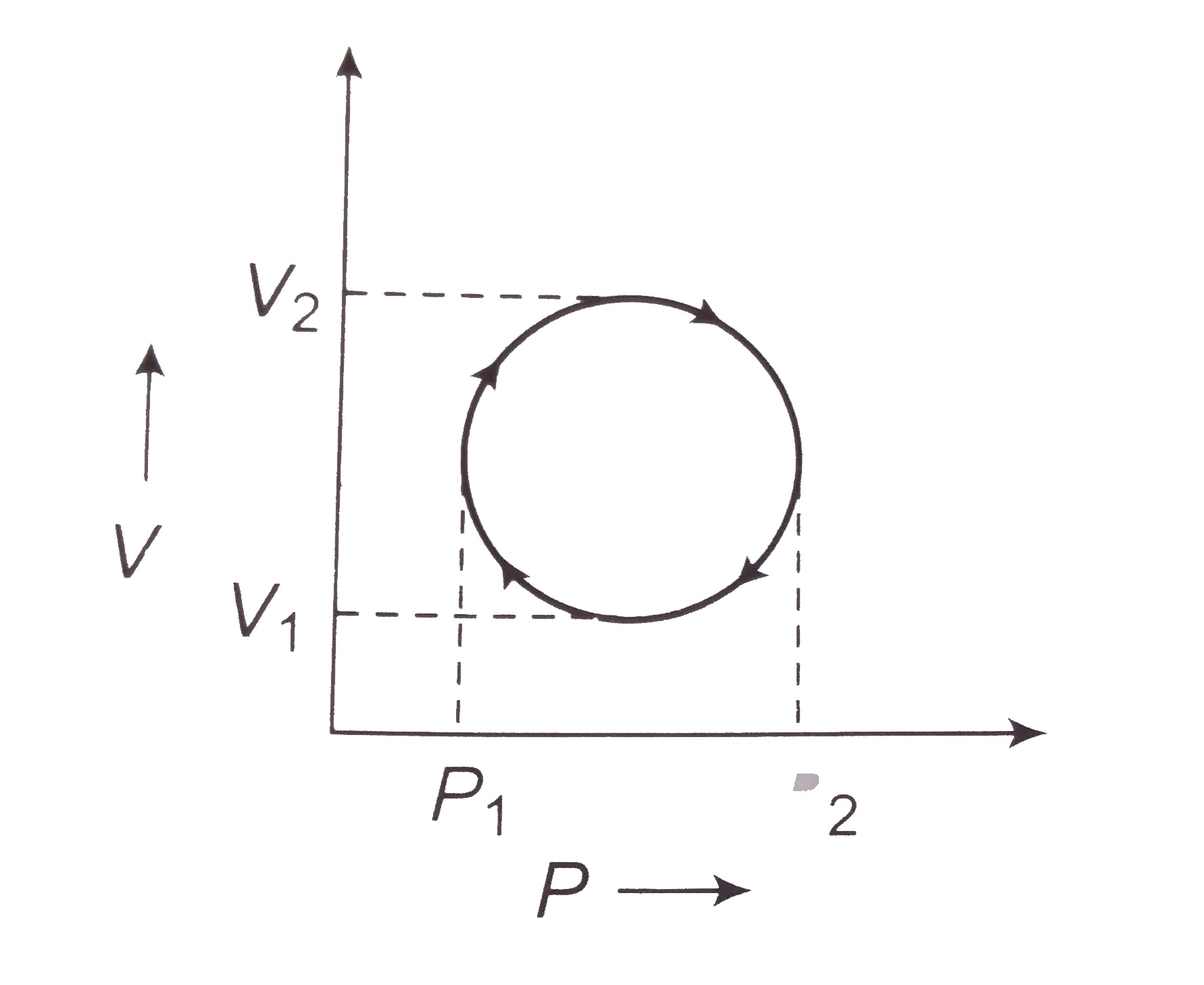
In the cyclic process shown in the V-P d...


In the cyclic process shown in the `V-P` diagram the magnitude of the work is done is

A

`pi((P_(2)-P_(1))/(2))^(2)`

B

`pi ((V_(2)-V_(1))/(2))^(2)`

C

`(pi)/(4) (P_(2)-P_(1))(V_(2)-V_(1))`

D

`pi(V_(2)-V_(1))^(2)`

Text Solution

Verified by Experts

The correct Answer is:
C

Process direction in V-P diagram is clockwise so process direction in P-V diagram is anti-clockwise.
Net work done by system = Area
`=pixx((P_(2)-P_(1)))/(2).((V_(2)-V_(1)))/(2)`
Promotional Banner

Topper's Solved these Questions

  • THERMODYNAMICS

    NARENDRA AWASTHI|Exercise Level 1 (Q.1 To Q.30)|6 Videos
  • THERMODYNAMICS

    NARENDRA AWASTHI|Exercise Level 1 (Q.31 To Q.60)|2 Videos
  • STOICHIOMETRY

    NARENDRA AWASTHI|Exercise Level 3 - Subjective Problems|20 Videos

Similar Questions

Explore conceptually related problems

In the cyclic process shown on the V-p diagram, the magnitude of the work done is

Identify the process shown in the diagram

An ideal gas undergoes cyclic process ABCDA as shown in given P-V diagram. The amount of work done by the gas is

A cyclic process is shown ion the p-T diagram. Which of the curves show the same process on a p-V diagram ?

A cyclic process is shown in the p-T diagram. Which of the curves show the same process on a V-T diagram?

An ideal monoatomic gas is taken round the cycle ABCDA as shown in the P-V diagram. Compute the work done in this process.

A cyclic process is shown on the p-T diagram. Which of the curves show the same process on a V-T diagram ?

A monoatomic ideal gas through a cyclic process as shown in the figure . The efficiency of this process is

