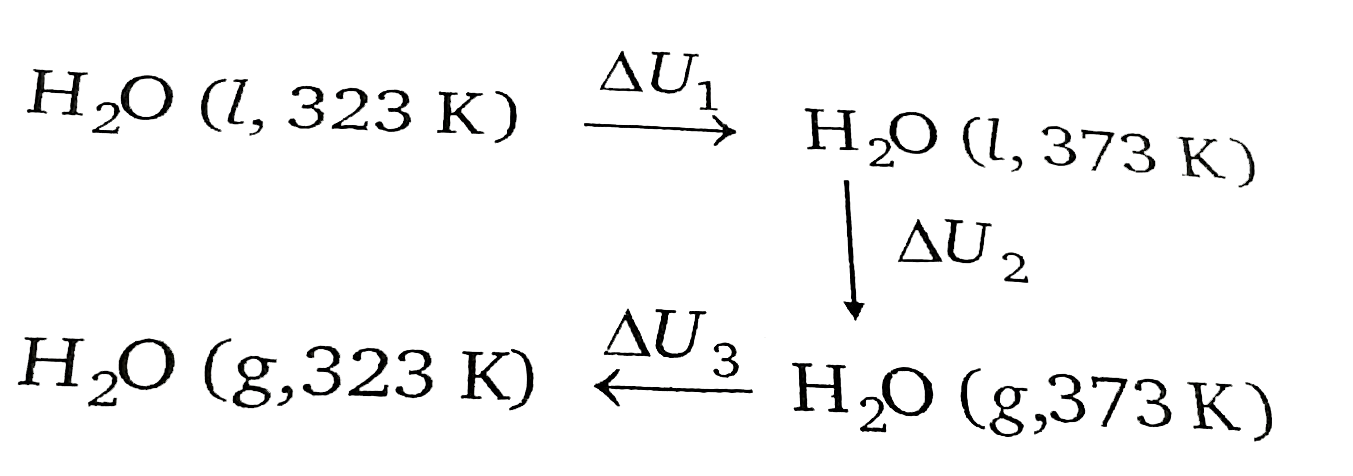
What is the value of change in internal energy at 1 atm in the process? `H_(2)O(l,323K)rarrH_(2)O(g,423K)` Given : `C_(v,m)(H_(2)O,l)=75.0JK^(-1) mol^(-1):" "C_(p,m)(H_(2)O,g)=33.314JK^(-1)mol^(-1)` `DeltaH_(vap)"ar 373 K"=40.7KJ//mol`
Liquid water freezes at 273K under external pressure of 1 atm. The process is at equilibrium H_(2)O (l) hArr H_(2)O (s) at 273 K & 1 atm. However it was required to calculate the thermodynamic parameters of the fusion process occuring at same pressure & different temperature.Using the following data, answer the question that follow. d_("ice") = 0.9 gm/cc, d_(H_(2)O(l)) = 1 gm//c, C_(P) [H_(2)O(s))] = 36.4 JK^(-1) mol^(-1) C_(P) [H_(2)O(l)] = 75.3 JK^(-1) mol^(-1), Delta H_("fusion") = 6008.2 J mol^(-1) The value of '' Delta H_("fusion") '' at 263K & 1 atm will be
Liquid water freezes at 273K under external pressure of 1 atm. The process is at equilibrium H_(2)O (l) hArr H_(2)O (s) at 273 K & 1 atm. However it was required to calculate the thermodynamic parameters of the fusion process occuring at same pressure & different temperature.Using the following data, answer the question that follow. d_("ice") = 0.9 gm/cc, d_(H_(2)O(l)) = 1 gm//c, C_(P) [H_(2)O(s))] = 36.4 JK^(-1) mol^(-1) C_(P) [H_(2)O(l)] = 75.3 JK^(-1) mol^(-1), Delta H_("fusion") = 6008.2 J mol^(-1) '' DeltaS_("fusion") '' at 263 K & 1 atm will be
The enthalpy change on freezing of 1 mol of water at 5^(@)C to ice at -5^(@) C is (Given Delta_("fus") H = 6 kJ mol^(-1) at 0^(@) C , C_(p) (H_(2) O , l) = 75.3 J mol^(-1) K^(-1) , C_(p) (H_(2) O , s) = 36.8 J mol^(-1) K^(-1))
Calculate the enthalpy change on freezing of 1.0 mol of water at 10.0^(@)C to ice at -10.0^(@)C . Delta_("fus")H=6.03 kJ mol^(-1) at 0^(@)C C_(p)[H_(2)O(l)]=75.3 J mol^(-1)K^(-1) C_(p)[H_(2)O(s)]=36.8 J mol^(-1)K^(-1)
What is r.m.s speed of O_(2) molecule if its kinetic energy is 2 k cal "mol"^(-1) ?
Standard entropies of H_(2)(g),O_(2)(g) " and "H_(2)O(l) are respectively 126.6, 201.2 and 68JK^(-1)mol^(-1) Determine DeltaS" for "2H_(2)(g)+O_(2)(g) to 2H_(2)O(l) at 25^(@)C .
Consider the following reaction : CO_((g)) + 2H_(2(g)) hArr CH_(3)OH_((g)) Given : Delta_(r) H^(@) (CH_(3)OOH, g) = -201 kJ/mol, Delta_(r) H^(@) (CO, g) = -114 kJ/mol S^(@) (CH_(3)OOH, g) = 240 J/K-mol , S^(@) (H_(2), g) = 29 JK^(-1)mol^(-1) S^(@) (CO, g) = 198 J/mol-K , C^(@)_(p,m) (H_(2)) = 28.8 J/mol-K C^(@)_(p,m) (CO) = 29.4 J/mol-K , C^(@)_(p,m) (CH_(3)OH) = 44 J/mol-K and ln ((320)/(300)) = 0.06 , all data at 300 K Delta_(r) H^(@) at 300 K for the reaction is :
NARENDRA AWASTHI-THERMODYNAMICS-Level 3 - Match The Column