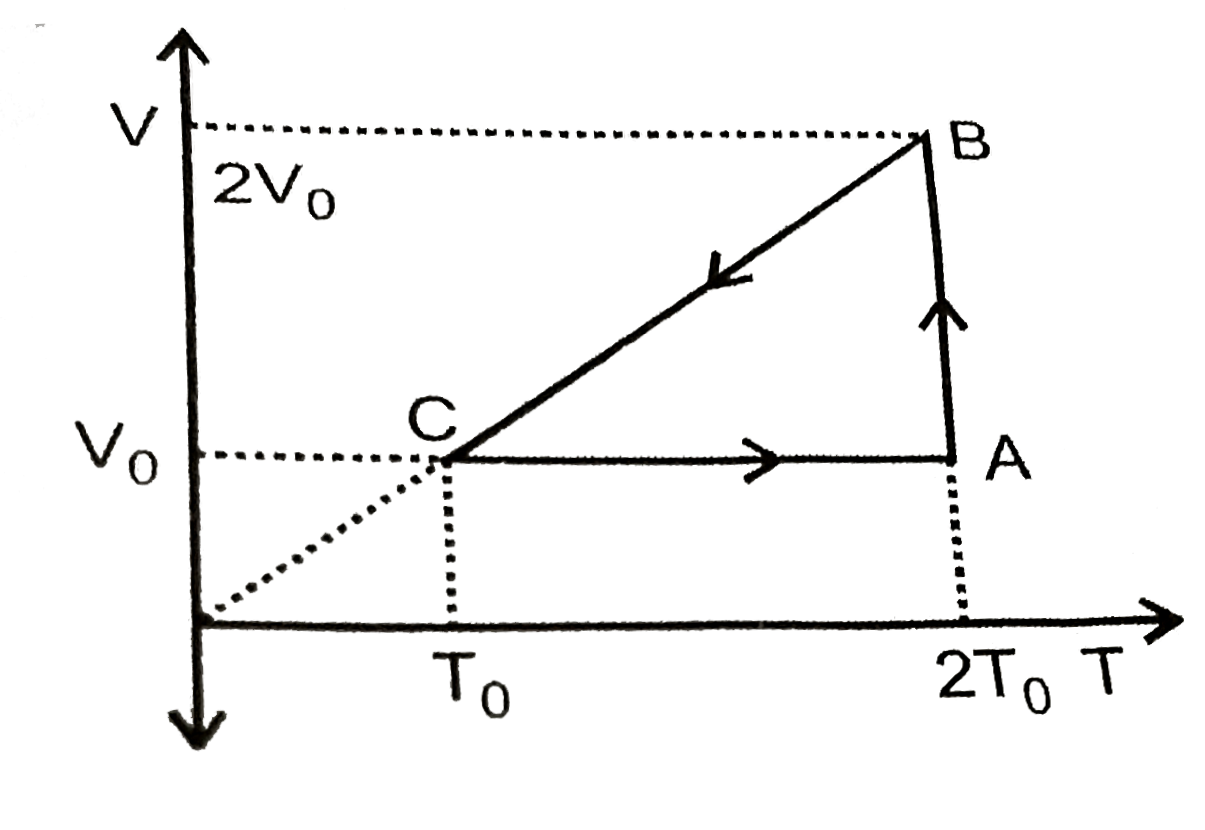
The efficiency of an ideal gas with adiabatic exponent `'gamma'` for the shown cyclic process would be
A
`((gamma-1)("2 ln 2"-1))/(1+(gamma-1)"2 ln 2")`
B
`((gamma-1)(1-"2 ln 2"))/((gamma-1)"2 ln 2"-1)`
C
`(("2 ln 2"+1)(gamma-1))/((gamma-1)"2 ln 2"+1)`
D
`(("2 ln 2"-1))/(gamma//(gamma-1))`
Text Solution
Verified by Experts
The correct Answer is:
A
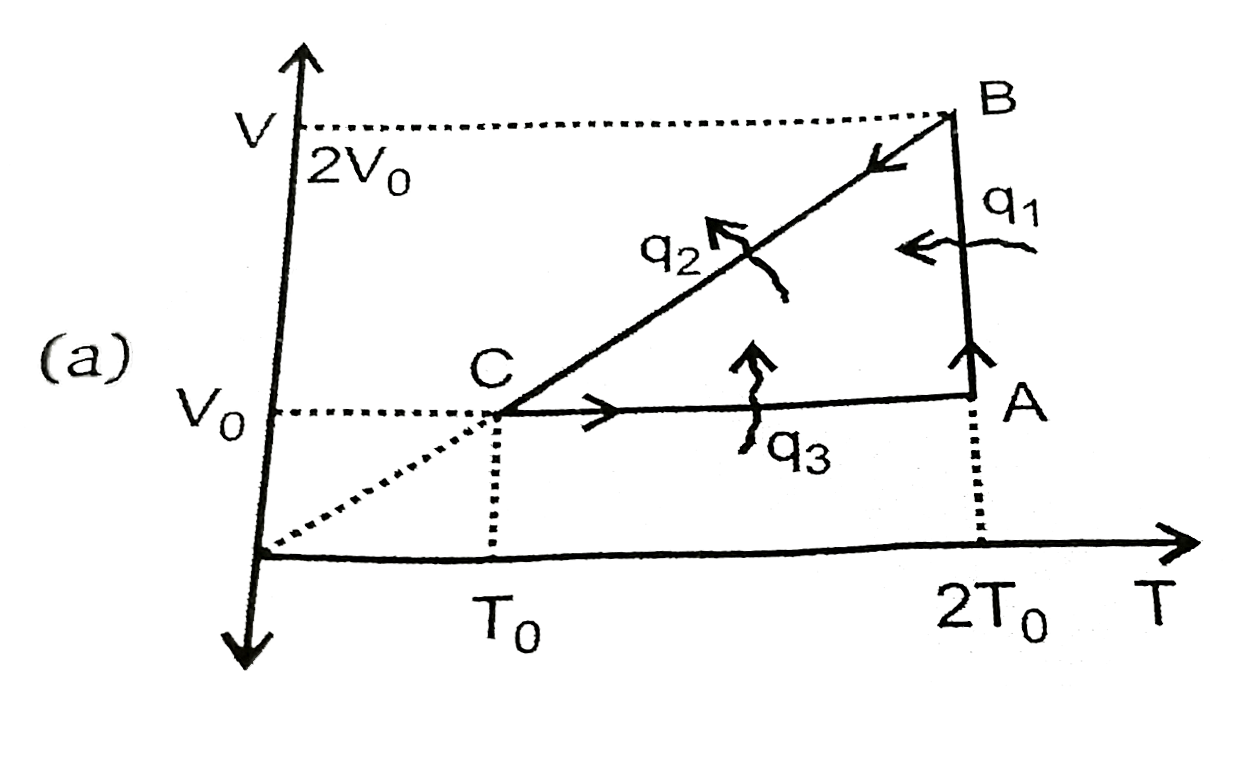
AB process `0=q_(1)+w_(1)` `=q_(1)-nR(2T_(0))ln2` BC process `DeltaU_(2)=q_(2)+w_(2)` `(nR)/((gamma-1))(T_(0)-2T_(0))=q_(2)-((nRT_(0))/(V_(0))).(V_(0)-2V_(0))` CA process `DeltaU_(3)=q_(3)+w_(3)` `(nR)/((gamma-1))(2T_(0)-T_(0))=q_(3)+0` `" Efficiency "= ("Total work done")/("Total heat absorbed")=(w_(1)+w_(2))/(q_(1)+q_(3))` `=((-2RT_(0)ln2)+(nRT_(0)))/((2RT_(0)ln2)+((nRT_(0))/(gamma-1)))`
Topper's Solved these Questions
THERMODYNAMICS
NARENDRA AWASTHI|Exercise Level 1 (Q.1 To Q.30)|6 Videos
THERMODYNAMICS
NARENDRA AWASTHI|Exercise Level 1 (Q.31 To Q.60)|2 Videos
For 1 mole of an ideal gas, during an adiabatic process, the square of the pressure of a gas is found to be proportional to the cube of its absolute temperature. The specific heat of the gas at constant volume is (R - universal gas constant)
In an adiabatic expansion of ideal gas:
(A): Workdone by an ideal gas in a cyclic process must be zero (R): During a cyclic process, a gas will come to same state of its parameters.
For the adiabatic expansion of an ideal gas
The reversible expansion of an ideal gas under adiabatic and isothermal conditions is shown in the figure. Which of the following statements(s) is (are) correct?
In a given process on an ideal gas, dW = 0 and dQ lt 0. Then for the gas
NARENDRA AWASTHI-THERMODYNAMICS-Level 3 - Match The Column