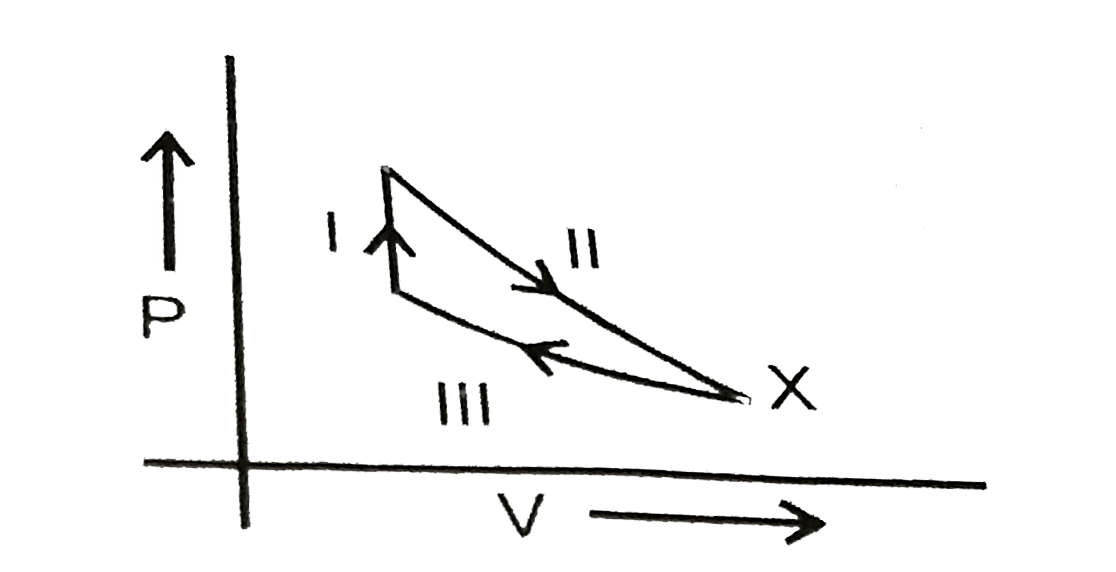
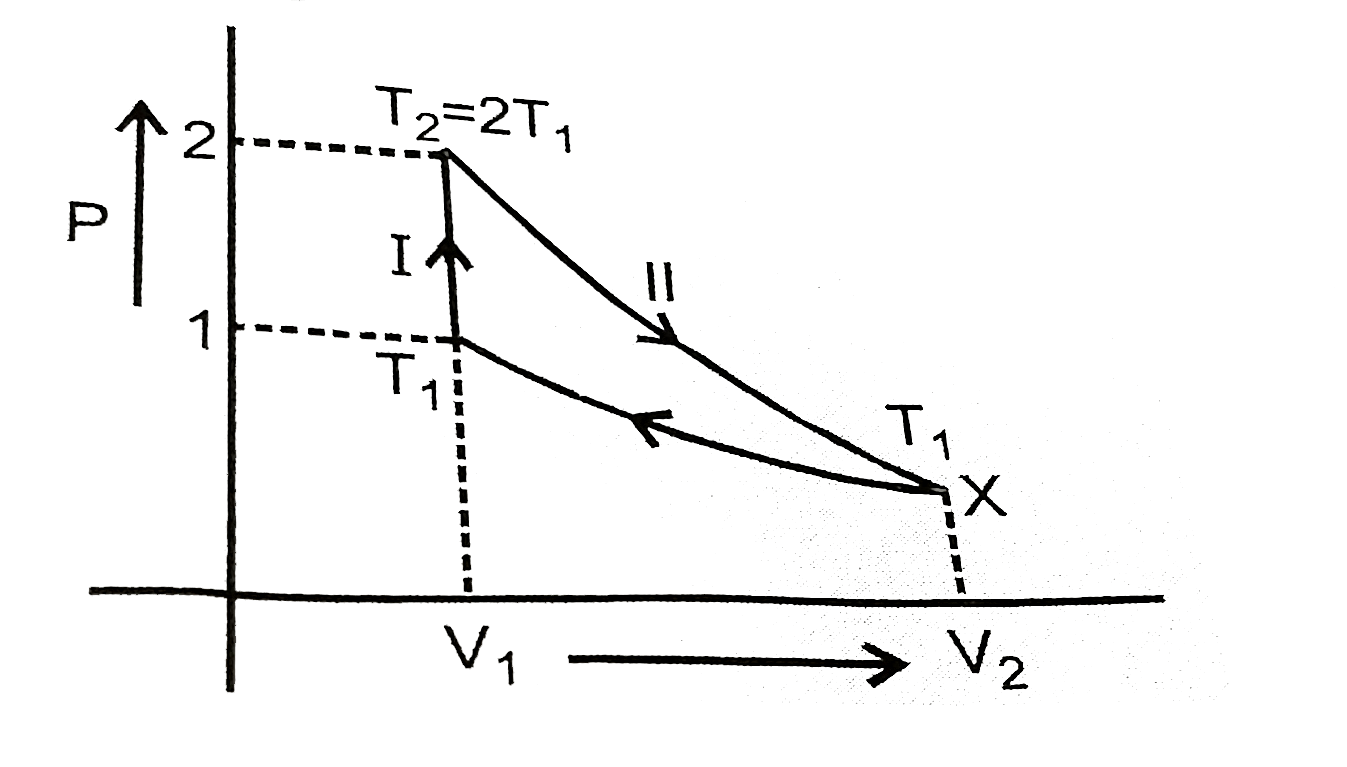
Initially one mole of ideal gas `(C_(v)=(5)/(2)R)` at `0.1` atm and 300 K is put through the following cycle: Step-I : Heating to twice its initial pressure at constant volume. Step-II : Adiabatic expansion to its initial temperature. Step-III : Isothermal compression back to `1.00` atm. what is the volume at state X?
A
`40.4` L
B
`65.0` L
C
139 L
D
4.35 L
Text Solution
Verified by Experts
The correct Answer is:
C
`V_(1)=24.63 "L " T_(1)=300 K , T_(2)=600 K` For path (II) `T_(1)V_(1)^(gamma-1)=T_(2)V_(2)^(gamma-1)` `(T_(1))/(T_(2))=((V_(2))/(V_(1)))^(gamma-1)` `(600)/(300)=((V_(2))/(V_(1)))^((7)/(5)-1)` `(2)^(5//2)=(V_(2))/(V_(1))` `V_(2)=4sqrt(2)xx24.63 = 139.3 L~~ 139 L`
Topper's Solved these Questions
THERMODYNAMICS
NARENDRA AWASTHI|Exercise Level 1 (Q.1 To Q.30)|6 Videos
THERMODYNAMICS
NARENDRA AWASTHI|Exercise Level 1 (Q.31 To Q.60)|2 Videos
One mole of an ideal gas at an initial temperature of TK does 6R joules of work adiabatically. If the ratio of specific hats of this gas a constant pressure and at constant volume is 5/3, the final temperature (T_f) of gas will be :
An ideal gas has volume V_0 at 27^@C . It is heated at constant pressure so that its volume becomes 2V_0 . The final temperature is
At a constant temperature a gas is initially at 2 atm pressure. To compress it to 1/8th of its initial volume, pressure to be applied is
When one mole of an ideal gas is compressed to half of its initial volume and simultaneously heated to twice its initial temperature, the change in entropy of gas (Delta S) is
An ideal gas is found to obey pV^(3/2) = constant during an adiabatic process. If such a gas initially at a temperature T is adiabatically compressed to half of its initial volume, then its final temperature is
NARENDRA AWASTHI-THERMODYNAMICS-Level 3 - Match The Column