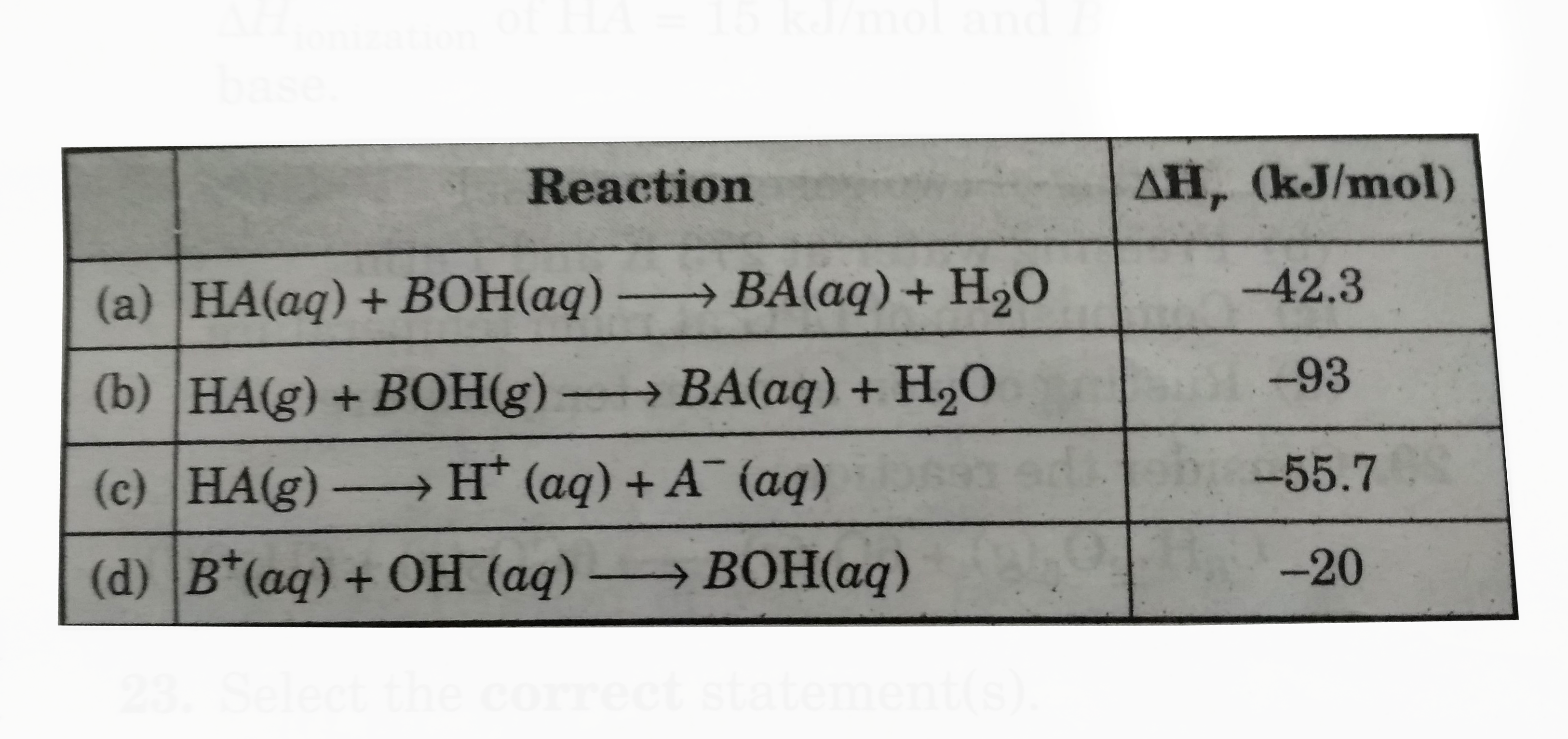
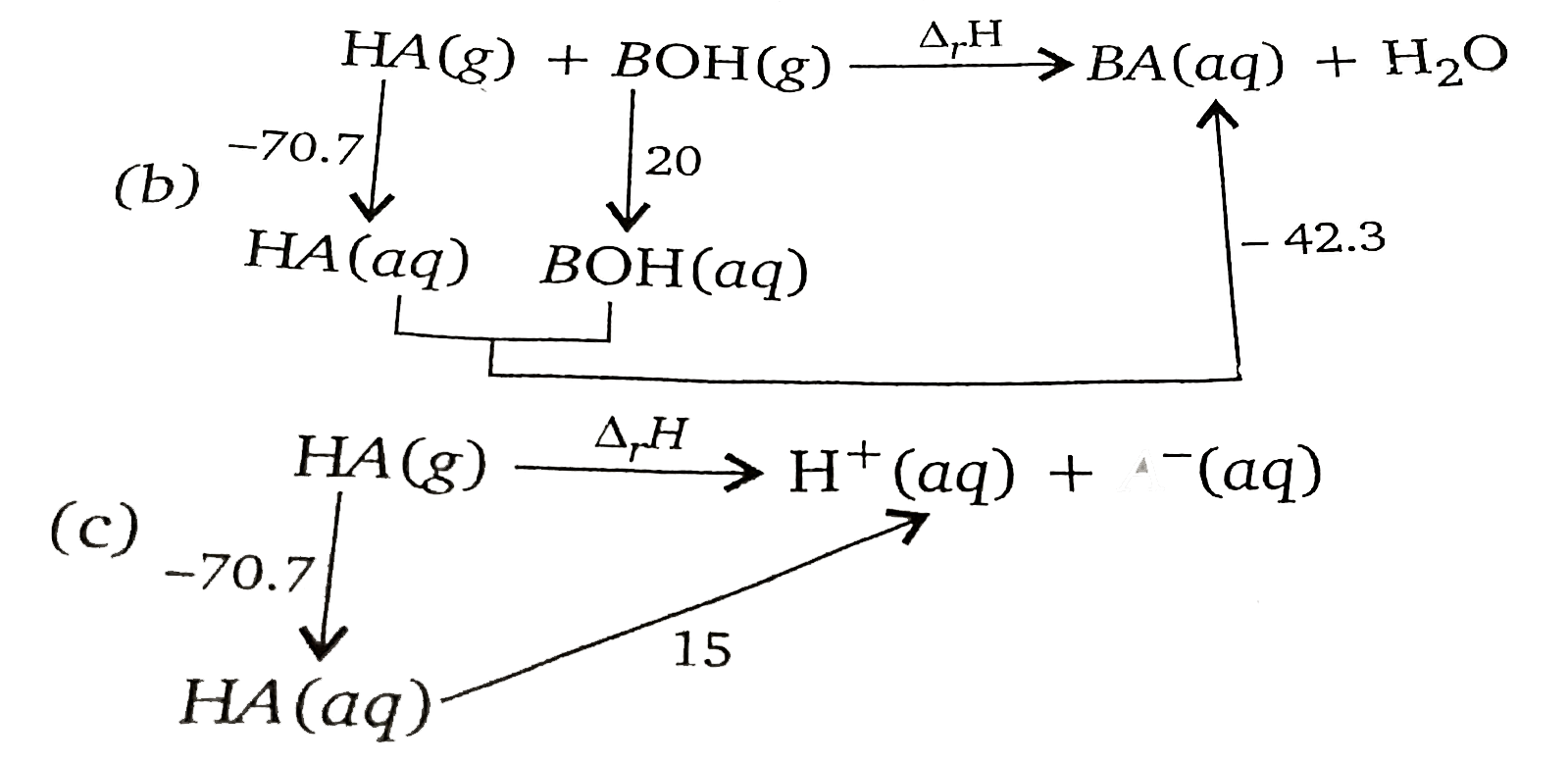
From the following date , mark the opation(s) where `Delta H` is correctly written for the given reaction . Given: `H+(aq) +OH-(aq) to H_(2)O(l),` `DeltaH=-57.3 kJ` `DeltaH_(solution) HA(g)=-70.7 kJ"mole"` `DeltaH_(solution) BOH(g)= 20 kJ"mole"` `DeltaH_("ionzatoin") ` of `HA=15 kJ//"mole"` and BOH is a strong base.
For the given reaction 2A(g)+ B(g) hArr C(g) , Delta H = x kJ which of the following favour the reactants ?
Calculate enthalpy of ionisation of OH^(-) ion. Given: H_(2)O_((l)) to H_((aq))^(+) + OH_((aq))^(-) , DeltaH^(@) = -285.83 KJ
H_(2(g)) rarr 2H_((g)) , DeltaH = 400 KJ , then DeltaS_("system") at 2000 K is
For the reaction at 300 K A_((g)) harr V_((g)) + S_((g) . Delta_(t) H^(@) = - 30 "KJ/mol" Delta_(t)S^(@) = - 0.1 K.J. K^(-1)."mole"^(-1) What Is the value of equilibrium constant ?
Calcutate Delta H in kJ for the following reaction C(g)+O_(2)(g) Given that , H_(2)O(g)+C_(g)toCO(g)+H_(2)(g),""""" DeltaH=+131kJ CO(g)+(1)/(2)O_(2)(g)toCO_(2)(g) """"'DeltaH=-282kJ H_(2)(g)+(1)/(2)O_(2)(g)toH_(2)O(g) """""DeltaH=-242kJ
DeltaH^(0) for a reaction F_(2) + 2HCl rarr 2HF + Cl_(2) is given as -352.8 kJ. Delta H_(f)^(0) for HF is -268.3 KJ mol^(-1) , then Delta H_(f)^(0) of HCl would be
The temperature of K at which Delta G =0 for a given reaction with Delta H= -20.5 kJ mol^(-1) and Delta S =- 50.0 JK^(-1)mol^(-1)
NARENDRA AWASTHI-THERMODYNAMICS-Level 3 - Match The Column