Home
Class 12
PHYSICS
Consider four equal charges q1 , q2 , q3...

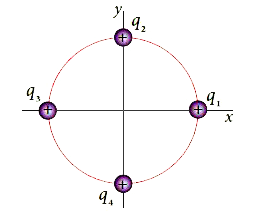
Consider four equal charges `q_1 , q_2 , q_3 and q_4 = q = + 1 muC` located at four different points on a circle of radius 1m, as shown in the figure. Calculate the total force acting on the charge q1 due to all the other charges.

Text Solution

Verified by Experts
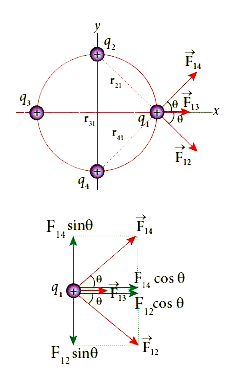
According to the superposition principle, the total electrostatic force on charge `q_1` is the vector sum of the forces due to the other charges,
`vec (F)_(1)^("tot") = vec( F)_(12) + vec( F )_(13) + vec( F)_(14)`
The following diagram shows the direction of each force on the charge `q_1`.

The charges `q_2 and q_4` are equip-distant from `q_1`. As a result the strengths (magnitude) of the forces `vec( F)_(12) and vec(F)_(14)` are the same even though their directions are different. Therefore the vectors representing these two forces are drawn with equal lengths. the charge `q_3` is located farther compared to `q_2 and q_4`. Since the strength of the electrostatic force decreases as distance increases, the strength of the force `vec( F)_(13)` is lesser than that of forces `vec( F)_(12) and vec(F)_(14)`. Hence the vector representing the force `vec(F)_(13)` is drawn with smaller length compared to that for forces `vec(F)_(12) and vec(F)_(14)`.
`F_(13) = 2.25 xx 10^(-3)N`
`F_(12) = (kq^2)/( r_(21)^2) = F_(14) = (9 xx 10^9 xx 10^(-22))/(2)`
`4.5 xx 10^(-3)`N
From the figure, the angle `theta = 45^(@)`. In terms of the components, we have
`vec(F)_(12) = F_(12) cos theta hat (i) - F_(12) sin theta hat (j)`
`= 4.5 xx 10^(-3) xx (1)/( sqrt2) hat(i) - 4.5 xx 10^(-3) xx (1)/( sqrt2) hat(j)`
`vec(F)_(13) = F_(13) hat(i) = 2.25 xx 10^(-3) N hat(i)`
`vec(F)_(14) = F_(14) cos theta hat(i) + F_(14) sin theta hat(j)`
`=4.5 xx 10^(-3) xx (1)/(sqrt2) hat(i) + 4.5 xx 10^(-3) xx (1)/( sqrt2) hat(j)`
Then the total force on `q_1` is,
`vec(F)_(1)^("tot") = ( F_(12) cos theta hat(i) - F_(12) sin theta hat(j) ) + F_(13) hat(i)`
`+ (F_(14) cos theta hat(i) + F_(14) sin theta hat(j) )`
`vec (F)_1^("tot") = (F_(12) cos theta + F_(13) + F_(14) cos theta ) hat(i)`
`+ ( - F_(12) sin theta + F_(14) sin theta ) hat(j)`
Since `F_(12) = F_(14)`, the `j^(th)` component is zero. Hence we have
`vec(F)_(1)^("tot") = (F_(12) cos theta + F_(13) + F_(14) cos theta) hat(i)`
substituting the values in the above equation,
`= ((4.5)/( sqrt2) + 2.25 + (4.5)/( sqrt2) ) hat(i) = (4.5 sqrt(2) + 2.25 ) hat(i)`
`vec(F)_(1)^("tot") = 8.61 xx 10^(-3) N hat(i)`
The resultant force is along the positive x axis.
Promotional Banner

Topper's Solved these Questions

  • ELECTROSTATICS

    NCERT TAMIL|Exercise EVALUATION (Multiple choice questions)|15 Videos
  • ELECTROSTATICS

    NCERT TAMIL|Exercise Exercises|23 Videos
  • ELECTROSTATIC POTENTIAL AND CAPACITANCE

    NCERT TAMIL|Exercise ADDITIONAL EXERCISES|1 Videos
  • MAGNETISM AND MAGNETIC EFFECTS OF ELECTRIC CURRENT

    NCERT TAMIL|Exercise EVALUATION (IV. Numerical problems)|10 Videos

Similar Questions

Explore conceptually related problems

The given figure is a plot of lines of force due to two charges q_(1) & q_(2) find out the sign of charges

Four point charges q_(A) = 2 muC, q_(B)=-5muC, q_(C)=2mu C and q_D=-5 muC are located at the corners of a square ABCD of side 10cm. What is the force on a charge of 1muC placed at the centre of the square?

A charged paticle (charge q ) is moving in a circle of radius R with uniform speed V . The associated magentic moment is given by

If a point charge is rotated in an arc of radius r around a charge q, what will be the work done. Explain.

A thin. Metallic spherical shell contains s charge Q on it. A point charge q is placed at the centre of the shell and another charge q_1 is placed outside it as shown in figure (30-Q1). All the three charges are positive. The force on the charge at the centre is

Five identical charges Q are placed equidistant on a semicircle as shown in the figure . Another point charge q is kept at the center of the circle of radius R. Calculate the electrostatic force experienced by the charge q.

NCERT TAMIL-ELECTROSTATICS-Exercises
  1. Consider four equal charges q1 , q2 , q3 and q4 = q = + 1 muC located...

    Text Solution

    |

  2. When two objects are rubbed with each other, approximately a charge of...

    Text Solution

    |

  3. The total number of electrons in the human body is typically in the or...

    Text Solution

    |

  4. Five identical charges Q are placed equidistant on a semicircle as sho...

    Text Solution

    |

  5. Suppose a charge +q on Earth’s surface and another +q charge is placed...

    Text Solution

    |

  6. Suppose a charge +q on Earth’s surface and another +q charge is placed...

    Text Solution

    |

  7. Draw the free body diagram for the following charges as shown in the f...

    Text Solution

    |

  8. Consider an electron travelling with a speed vo and entering into a un...

    Text Solution

    |

  9. A closed triangular box is kept in an electric field of magnitude E = ...

    Text Solution

    |

  10. A closed triangular box is kept in an electric field of magnitude E = ...

    Text Solution

    |

  11. The electrostatic potential is given as a function of x in figure (a) ...

    Text Solution

    |

  12. The electrostatic potential is given as a function of x in figure (a) ...

    Text Solution

    |

  13. A spark plug in a bike or a car is used to ignite the air-fuel mixture...

    Text Solution

    |

  14. A point charge of +10 muC is placed at a distance of 20 cm from anothe...

    Text Solution

    |

  15. Calculate the resultant capacitances for each of the following combina...

    Text Solution

    |

  16. Calculate the resultant capacitances for each of the following combina...

    Text Solution

    |

  17. Calculate the resultant capacitances for each of the following combina...

    Text Solution

    |

  18. An electron and a proton are allowed to fall through the separation be...

    Text Solution

    |

  19. An electron and a proton are allowed to fall through the separation be...

    Text Solution

    |

  20. An electron and a proton are allowed to fall through the separation be...

    Text Solution

    |

  21. During a thunder storm, the movement of water molecules within the clo...

    Text Solution

    |

