Home
Class 11
PHYSICS
Find the resultant of the three vectors ...

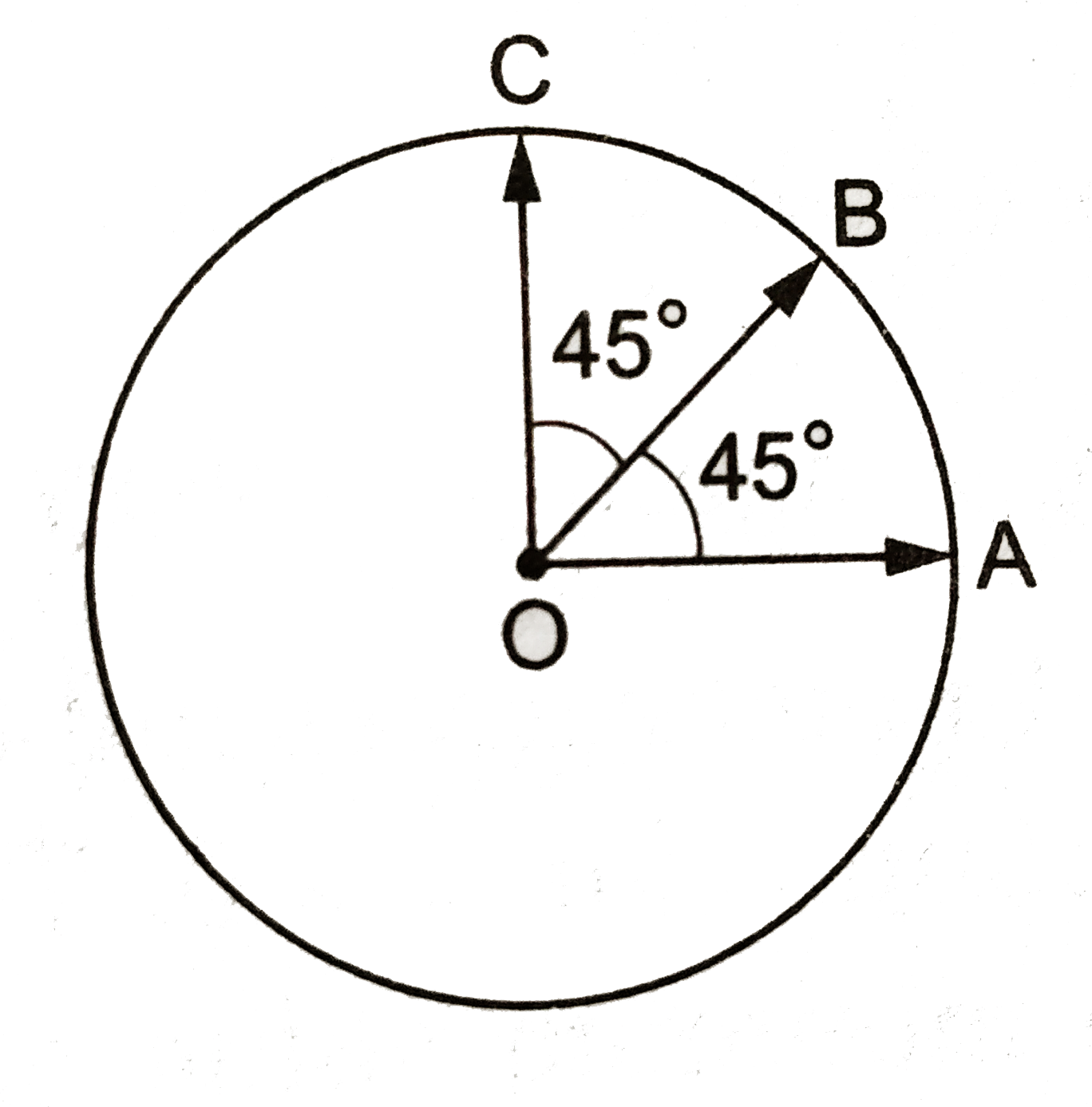
Find the resultant of the three vectors `vec(OA), vec(OB)` and `vec(OC)` shown in figure. Radius of the circle is R.

Text Solution

Verified by Experts

OA=OC
`vec(OA)+(OC)` is along `vec(OB)` (bisector ) and its magnitude is
`2Rcos45^0=Rsqrt2`
`vec((OA)+(vecOC))+vec(OB)` and its magnitude is
`Rsqrt2+R=R(1+sqrt2)`
Promotional Banner

Similar Questions

Explore conceptually related problems

Keeping one vector constant, if direction of other to be added in the first vector is changed continuously, tip of the resultant vector describes a circles, In the following figure vector vec(a) is kept constant. When vector vec(b) addede to vec(a) changes its direction, the tip of the resultant vector vec(r)=vec(a)+vec(b) describes circles of radius b with its centre at the tip of vector vec(a) . Maximum angle between vector vec(a) and the resultant vec(r)=vec(a)+vec(b) is

The resultant of two vectors vec(P) and vec(Q) is vec(R) . If vec(Q) is doubled then the new resultant vector is perpendicular to vec(P) . Then magnitude of vec(R) is :-

Figure shows three vectors vec(a), vec(b) and vec(c) , where R is the midpoint of PQ. Then which of the following relations is correct?

Assertion: Minimum number of non-equal Vectors in a plane required to give zero resultant is three. Reason: If vec(A)+vec(B)+vec(C )= vec(0) , then they must lie in one plane

If vec(a) and vec(b) , are two collinear vectors, then which of the following are incorrect : (A) vec(b)=lambda vec(a) , for some scalar lambda (B) vec(a)=+-vec(b) ( C ) the respective components of vec(a) and vec(b) are not proportional (D) both the vectors vec(a) and vec(b) have same direction, but different magnitudes.

The sum of three vectors shown in Fig. 2 ( c) . 77. is zero . . (a) What is the magnitude of the vector vec (OB) ? (b) What is the magnitude of the vector vec (OC) ?

Let O, O' and G be the circumcentre, orthocentre and centroid of a Delta ABC and S be any point in the plane of the triangle. Statement -1: vec(O'A) + vec(O'B) + vec(O'C)=2vec(O'O) Statement -2: vec(SA) + vec(SB) + vec(SC) = 3 vec(SG)

vec a , vec b , vec c are three coplanar unit vectors such that vec a+ vec b+ vec c=0. If three vectors vec p , vec q , and vec r are parallel to vec a , vec b , and vec c , respectively, and have integral but different magnitudes, then among the following options, | vec p+ vec q+ vec r| can take a value equal to
