Home
Class 11
PHYSICS
Figure shows the speed versus time graph...

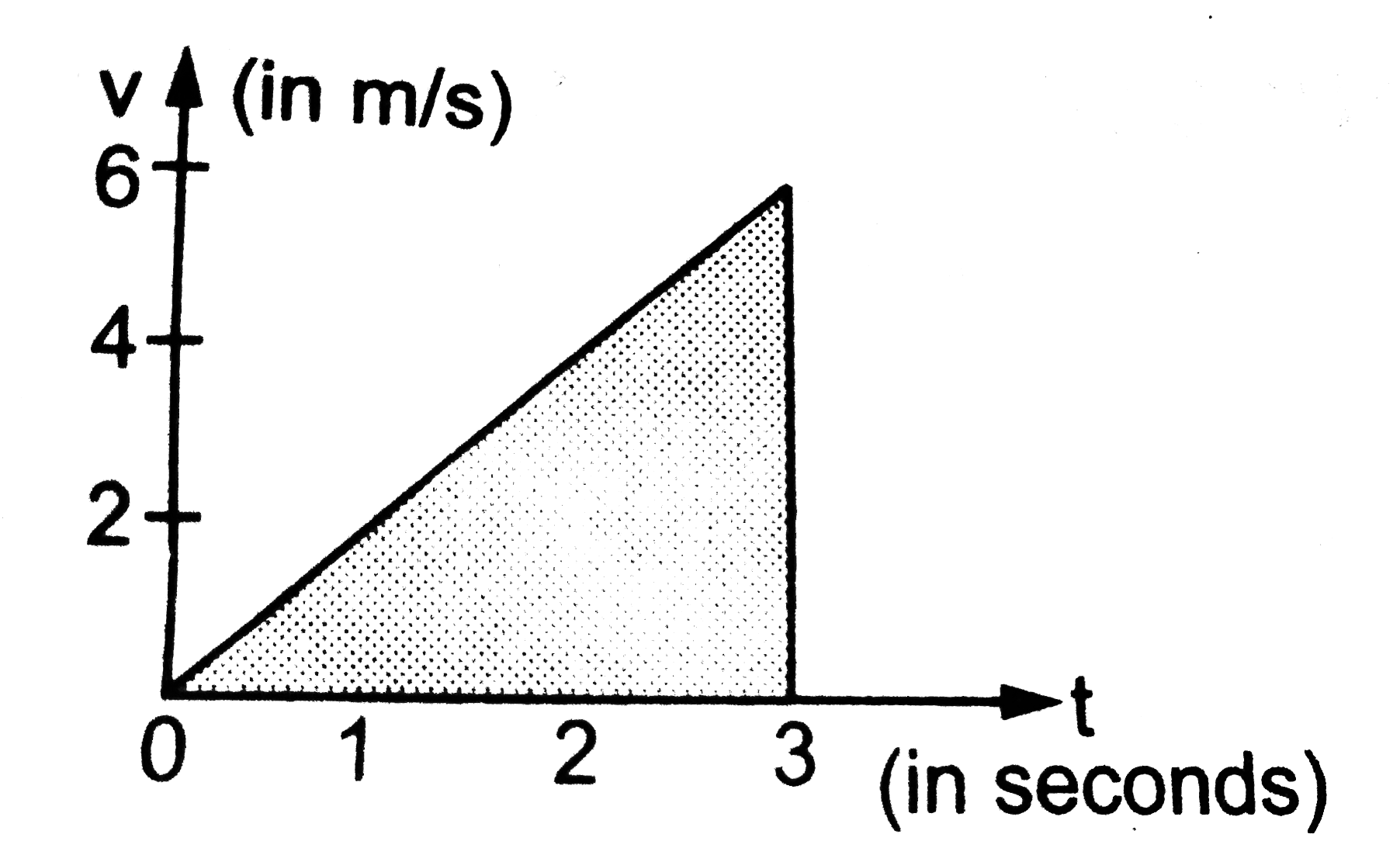
Figure shows the speed versus time graph for a particle. Find the distance travelled by the particle during the time t=0 to t=3s.

A

`9 m`

B

`5 m`

C

`2 m`

D

`1 m`

Text Solution

Verified by Experts

The correct Answer is:

A

The distance travelled by the particle in the time 0 to 3 s is equal to the area shaded in the ure.
This is a right angled triangle with height `=6m/s and the base =3s`. The area is `1/2` (base)(height)`= 1/2xx(3s)(6m/s)=9m`. Thus, particle covered a distance of 9 m during the time 0 to 3. .
Promotional Banner

Similar Questions

Explore conceptually related problems

If velocity (in ms^(-1) ) varies with time as V = 5t, find the distance travelled by the particle in time interval of t = 2s to t = 4 s.

A particle is moving on X- axis. Its velocity time graph is given in the figure. Find distance travelled by the particle in 5 sec .

A particle moves in a straight line from origin. Its velocity time curve is shown. Find the distance of particle at the =8sec. From the origin and the distance travelled by the particle during first 8 seconds.

Figure shows the graph of velocity versus time for a particle going along x axis. Initially at t=0, particle is at x=3m. Find postion of particle at t=2s. (in m) ltimg src="https://d10lpgp6xz60nq.cloudfront.net/physics_images/ALN_PHY_R05_E03_017_Q01.png" width="80%"gt

The fig. shows the v-t graph of a particle moving in straight line. Find the time when particle returns to the starting point.

Position time graph of a particle of mass 2 kg is shown in figrure. Total work done on the particle from t=0 to t=4s is

The speed-time graph of a particle moving along a fixed direction is shown in figure. Obtain the distance traversed by the particle between (a) t =0 s to 10s. (b) t = 2 s to 6s. What is the average speed of the particle over the intervals in (a) and (b) ?

Shows the position-time graph of a particle of mass 4 kg. What is the (a) force on the particle for t lt 0, t gt 4 s, 0 lt t lt 4 s ? (b) impulse at t = 0 and t = 4 s ? (Consider one­dimensional motion only).
